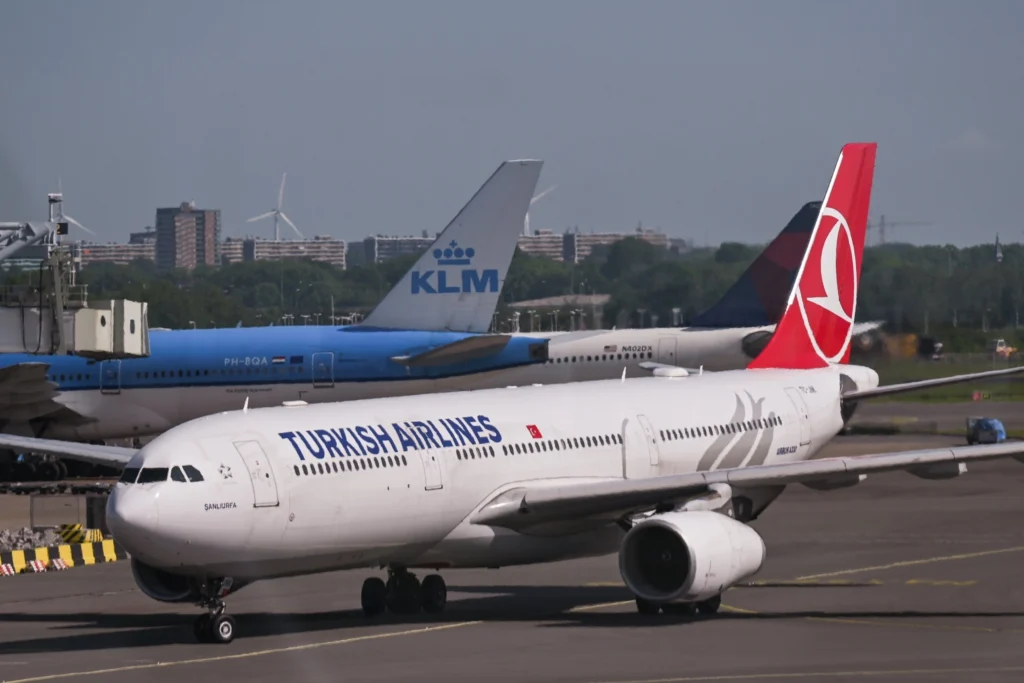
Turkish Airlines Flight TK710, travelling from Istanbul to Islamabad, diverted safely to Baku after an in-flight urgency prompted the crew to change course during the international journey.
The service, operated by an Airbus A330-300, had departed Istanbul for Pakistan’s capital before diverting toward Heydar Aliyev International Airport in Azerbaijan.
The aircraft landed safely in Baku, bringing the immediate airborne phase of the incident to a controlled conclusion.
The exact reason that prompted the diversion has not been officially established in the verified information available for this report. Therefore, no specific technical, medical or operational cause should be attributed to the incident without confirmation from Turkish Airlines or the relevant aviation authorities.
For passengers, the event highlights how airlines use alternate airports and established emergency procedures when circumstances require an unscheduled landing.
Crew changes course during international journey
Flight TK710 normally connects Istanbul Airport with Islamabad International Airport, providing an important air link between Türkiye and Pakistan.
During the journey, however, the aircraft changed its planned route and headed toward Baku.
When pilots determine that continuing toward the scheduled destination is no longer the preferred course of action, they can select a suitable alternate airport based on operational circumstances.
Several factors can influence that decision, including airport facilities, runway capability, geographic position, weather and the availability of ground support.
Baku’s Heydar Aliyev International Airport provides significant international aviation infrastructure, making the Azerbaijani capital an important regional gateway for flights travelling between Europe and Asia.
Emergency declaration gives aircraft priority
An emergency or urgency declaration is an established aviation procedure designed to help flight crews receive appropriate priority and assistance from air traffic control.
Such a declaration does not, by itself, establish that an aircraft is facing a catastrophic situation.
Depending on the circumstances, controllers can provide priority routing, coordinate a direct approach and ensure that airport services are prepared for the aircraft’s arrival.
Emergency response vehicles may also be positioned as a precaution.
This preparation allows firefighters, medical teams and other airport personnel to respond immediately should their assistance become necessary.
For TK710, the important confirmed outcome is that the aircraft reached Baku safely.
Exact reason remains unconfirmed
Any unexpected diversion involving a long-haul passenger aircraft naturally generates questions about what happened onboard.
Commercial flights can divert for numerous reasons.
Possible circumstances across the wider aviation industry include technical indications, medical situations involving passengers or crew, weather changes and other operational considerations.
However, these general possibilities should not be presented as the cause of the Turkish Airlines diversion.
Until an official explanation is provided, the circumstances that prompted TK710 to divert should remain classified as unconfirmed.
This distinction is particularly important because flight diversions can sometimes generate inaccurate speculation before airlines and technical teams complete their assessments.
Passengers may face onward travel changes
For passengers travelling to Islamabad, the diversion can create consequences beyond the unexpected landing itself.
Once an aircraft reaches an alternate airport, airline operational teams must determine the most appropriate next step.
Depending on the circumstances, an aircraft could continue after checks and refuelling, remain temporarily on the ground for inspection or require alternative arrangements for passengers.
Crew duty limits and airport operating conditions can also influence how quickly a journey resumes.
Travellers with onward connections from Islamabad could therefore face additional itinerary changes if the diversion results in a significant delay.
Passengers should rely on direct airline communications for updated departure times, rebooking information and onward travel arrangements.
Airbus A330 supports long-haul network
The Airbus A330-300 is a twin-engine widebody aircraft widely used for medium- and long-haul international operations.
Turkish Airlines has deployed widebody aircraft across an extensive network connecting Istanbul with destinations in Asia, Africa, Europe and other international markets.
Following an unscheduled diversion, technical teams may inspect an aircraft when required before it resumes commercial operations.
Such assessments form part of normal airline safety and maintenance procedures.
The decision about whether an aircraft continues its journey depends on the specific circumstances surrounding each diversion.
Diversions demonstrate aviation safety systems
Although passengers can find emergency diversions concerning, they also demonstrate the flexibility built into modern aviation.
Pilots, dispatch teams, air traffic controllers and airport personnel operate within established procedures designed to manage changing circumstances safely.
Selecting an alternate airport allows crews to address a developing situation without unnecessarily continuing toward the original destination.
For Turkish Airlines Flight TK710, the safe arrival in Baku remains the central development.
Until Turkish Airlines or relevant authorities provide further verified information, the exact trigger behind the mid-air urgency should not be assumed.
The incident nevertheless demonstrates why alternate airports, trained crews and coordinated air traffic systems remain essential to international aviation.
For travellers, it is also a reminder to monitor official airline updates whenever an unexpected diversion affects a journey, particularly on international routes where delays can influence visas, connections, accommodation and onward transportation plans.
For more travel news like this, keep reading Global Travel Wire