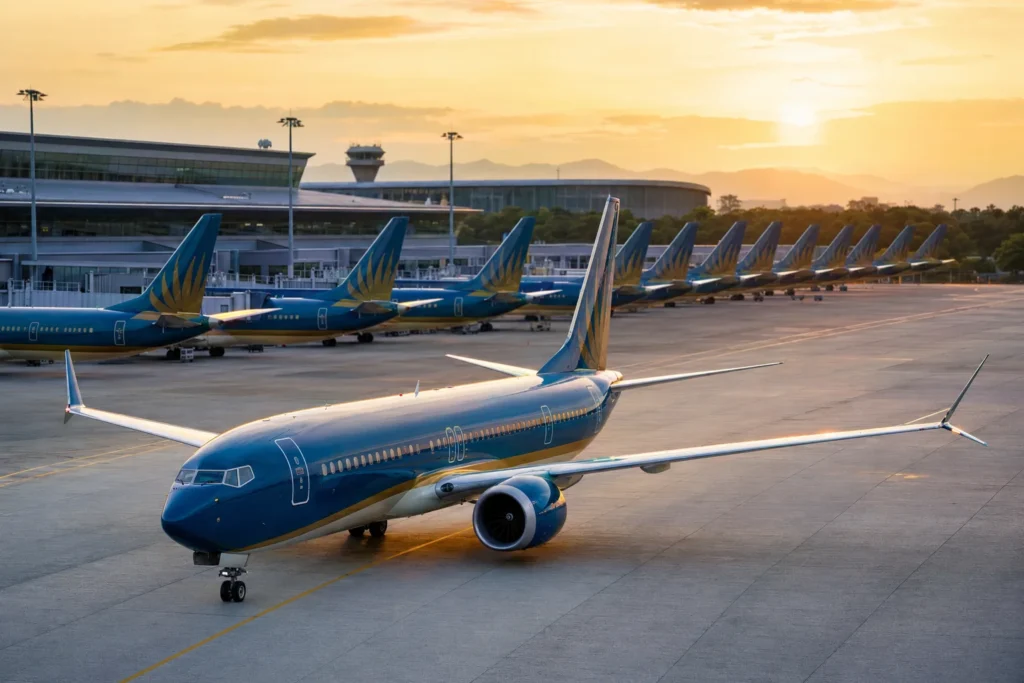
In a major strategic push to modernize its operating fleet and scale regional flight operations, Vietnam Airlines has unveiled plans to lease 19 Boeing 737 MAX 8 aircraft. Announced during the official proceedings at the Farnborough International Airshow, the agreement with three major global aircraft lessors marks a pivotal phase in the flag carrier’s multi-year fleet investment strategy.
The newly leased narrow-body jets are scheduled to join the fleet beginning in 2028. These additions will supplement an existing direct purchase commitment for 50 Boeing 737 MAX 8 aircraft, bringing the carrier’s total planned single-aisle fleet of the model to 69 aircraft. The substantial expansion positions the 737 MAX 8 as the core operational foundation for the airline’s domestic and intra-regional route networks.
Strategic Lessors Support Fleet Flexibility and Capacity Growth
To manage capital allocation and secure timely delivery slots amidst global aviation supply chain constraints, Vietnam Airlines is combining direct manufacturer purchases with structured operating leases. The 19 leased aircraft will be sourced through individual agreements with three leading international leasing entities:
SMBC Aviation Capital will supply 10 aircraft.
Phoenix Aviation Capital (managed by AIP Capital) will supply five aircraft.
Avolon Aerospace Leasing Limited will supply four aircraft.
By diversifying its procurement sources across multiple lessors, the airline ensures greater schedule reliability while expanding total seat capacity to meet projected growth across Asian travel markets.
Dang Ngoc Hoa, Chairman of the Board of Directors of Vietnam Airlines, noted during official announcements that the agreements mark a critical step forward in the company’s long-term fleet development strategy. The carrier emphasized that expanding its narrow-body fleet is vital to maintaining market competitiveness and establishing modern, efficient transport links to support national economic and tourism goals.
Driving Southeast Asia Tourism via Modern Intra-Regional Connectivity
As demand for travel across Southeast Asia tourism hubs continues to rise, modern narrow-body jets play an essential role in linking secondary urban centers with major international gateways. Vietnam’s domestic and regional aviation market has experienced rapid expansion over the past decade, driven by strong economic fundamentals, growing inbound leisure travel, and expanding trade networks.
Integrating the Boeing 737 MAX 8 into core flight schedules allows the flag carrier to increase flight frequencies on popular routes connecting Hanoi and Ho Chi Minh City with key regional destinations across the Association of Southeast Asian Nations (ASEAN) network, East Asia, and South Asia. The aircraft’s operational range and seating capacity make it ideally suited for short- to medium-haul regional travel.
Furthermore, the introduction of modern single-aisle aircraft enhances connectivity with the airline’s existing long-haul wide-body fleet, which includes 17 Boeing 787 Dreamliners. This dual-fleet strategy creates seamless transfer opportunities at national airport hubs for long-haul international visitors traveling onward to regional destinations.
Efficiency Improvements and Environmental Sustainability
The operational transition to new-generation aircraft directly addresses environmental and cost-efficiency targets set by civil aviation authorities and international transport organizations.
The Boeing 737 MAX 8 is engineered to deliver a 20 percent reduction in fuel consumption and carbon emissions compared to the older aircraft models it will replace. In addition, the aircraft generates a significantly smaller noise footprint, aligning with global industry standards for environmental sustainability in aviation. Combined with the fuel-efficiency advantages of the carrier’s wide-body 787 fleet, the overall modernization initiative is expected to reduce total operating expenses while lowering carbon intensity per passenger kilometer.
Broader Asia-Pacific Fleet Modernization Trends
The announcement by Vietnam Airlines reflects broader regional aviation trends highlighted during official airshow updates, as carriers across the Asia-Pacific region accelerate fleet modernization to capture rising passenger volumes.
During the same event, other regional operators announced major fleet commitments, including Philippine Airlines’ agreement for up to 20 Boeing 787-10 Dreamliners to support long-haul expansion. Additionally, global leasing firm SMBC Aviation Capital announced an order for 100 Boeing 737 MAX aircraft, emphasizing continued industry confidence in single-aisle jet demand across emerging travel markets.
Meanwhile, competitive dynamics within the Vietnamese aviation sector continue to evolve. Regional low-cost operator VietJet Air is pursuing regulatory approvals to establish a domestic airline subsidiary in Australia, seeking airport slots in Sydney, Melbourne, and Brisbane to deploy Boeing 737 MAX aircraft on trans-Tasman and Australian domestic routes.
Through its multi-lessor agreement for 19 additional aircraft, Vietnam Airlines strengthens its operational capacity, ensuring the flag carrier remains well-positioned to drive tourism growth and handle increasing passenger traffic across Southeast Asia’s expanding aviation landscape.
For more travel news like this, keep reading Global Travel Wire