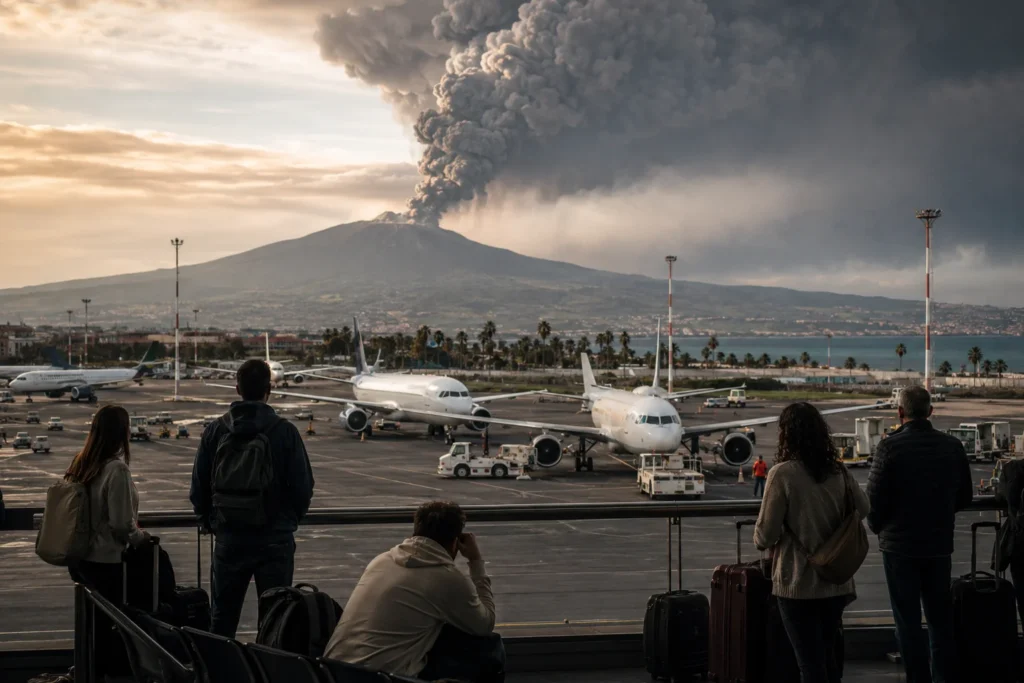
Fresh volcanic activity from Mount Etna has prompted aviation authorities and regional transport officials to enforce extended airspace restrictions across eastern Sicily, leading to the temporary closure of Catania-Fontanarossa Airport during the height of the summer holiday season. Volcanic ash emissions drifting from Europe’s tallest and most active volcano forced the airport operator, Società Aeroporto Catania (SAC), to halt all arriving and departing flights as safety protocols were activated across the region. The operational halt at Sicily’s primary international gateway has created widespread travel adjustments for thousands of holidaymakers visiting popular Mediterranean destinations.
The latest eruptive phase has generated dense atmospheric ash plumes, requiring immediate airspace sector closures to safeguard commercial air navigation. Municipal leaders, civil protection agencies, and airport management teams across Sicily have activated emergency coordination networks to manage rerouted passenger traffic, expand ground support at alternative regional airports, and maintain passenger safety across transport corridors.
Volcanic Ash Emissions Force Airspace Closures Across Eastern Sicily
Mount Etna, which rises to over 3,300 meters on Sicily’s eastern coastline, is monitored continuously by the National Institute of Geophysics and Volcanology (INGV). When eruptive vents eject fine rock and glass particles into upper air corridors, national civil aviation safety guidelines mandate immediate flight restrictions. Even low concentrations of airborne volcanic ash pose severe risks to jet engines, making strict airspace management a non-negotiable safety standard across international civil aviation.
The closure of Catania Airport—Italy’s fifth-busiest air hub processing over 12 million passengers annually—has sent ripple effects throughout regional transit networks. Operational restrictions were extended as shifting atmospheric winds carried ash clouds across eastern Sicily and south toward neighboring Mediterranean flight paths. In neighboring Malta, civil aviation authorities monitored drifting ash plumes that caused temporary flight delays and cancellations at Malta International Airport before atmospheric conditions began to stabilize.
Meanwhile, nearby Comiso Airport in southern Sicily experienced temporary operational pauses due to localized ash accumulation before resuming full flight management services. Transport authorities confirmed that Comiso successfully handled dozens of diverted passenger flights, serving as an important relief valve for eastern Sicily’s air transit system.
Rerouting Air Traffic to Palermo and Regional Transit Logistics
To maintain essential island connectivity during the Catania airport closure, civil aviation coordinators diverted scores of scheduled flights to alternative gateways across the island, primarily Falcone Borsellino Airport in Palermo on the northern coast and Trapani Airport in western Sicily.
Official statements from the Mayor of Palermo confirmed that the city’s airport absorbed nearly 200 diverted flights originally scheduled to land in or depart from Catania over the course of the disruption. The sudden surge in passenger traffic at Palermo established a high-density logistical operation, requiring local municipal transport departments, regional bus operators, and taxi fleets to rapidly deploy additional vehicles to assist travelers making the cross-island journey between Palermo and eastern resort towns.
To manage crowding within terminal facilities, SAC collaborated with the Civil Protection Department and regional emergency services to set up dedicated passenger support zones. Airport facilitators distributed thousands of bottles of drinking water, arranged temporary rest areas with cots and seating, and provided continuous terminal assistance for waiting families and international visitors.
Official Guidance and Passenger Rights for Affected Travelers
In official public announcements, SAC emphasized that operational decisions remain strictly bound to international aviation safety criteria established in coordination with Italy’s Civil Aviation Authority (ENAC) and the Civil Protection Department. Airport management noted that while infrastructural maintenance is kept at peak readiness to allow an immediate resumption of flights once airspace clears, individual air carriers maintain sole responsibility for managing flight schedules, rebookings, diversions, and direct passenger communications.
Civil aviation regulations governing air passenger rights protect travelers affected by volcanic closures. Because volcanic eruptions are categorized under extraordinary meteorological circumstances, direct monetary compensation is generally exempt; however, airlines remain legally obligated to provide unconditional duty-of-care services. These statutory protections require airlines to supply affected passengers with:
Mandatory meals and refreshments proportional to total waiting time at terminal facilities.
Compliant hotel accommodation and local ground transportation whenever overnight delays occur.
Free flight rebooking on the next available service or a full cash refund of the unused ticket fare at the traveler’s discretion.
Travelers currently scheduled to fly into or out of eastern Sicily are strongly urged by civil aviation authorities to verify flight status directly through their respective airline digital portals prior to traveling to airport terminals.
Maintaining Tourism Resilience Across Sicilian Destinations
Despite temporary flight schedule adjustments, regional tourism authorities emphasize that ground-level tourism infrastructure across Sicily remains safe, fully operational, and welcoming to international visitors. Cultural landmarks, historical monuments, world heritage sites, coastal resorts, and national parks outside the immediate volcanic zone continue regular operations.
The INGV Etna Observatory continues 24-hour satellite and ground monitoring of eruptive vents, gas emissions, and wind drift patterns to supply real-time technical assessments to aviation control centers. As atmospheric ash concentrations diminish and wind directions shift away from flight corridors, civil aviation authorities and SAC remain prepared to gradually restore standard flight frequencies, ensuring that Sicily continues to connect safely and efficiently with global travel markets.
For more travel news like this, keep reading Global Travel Wire