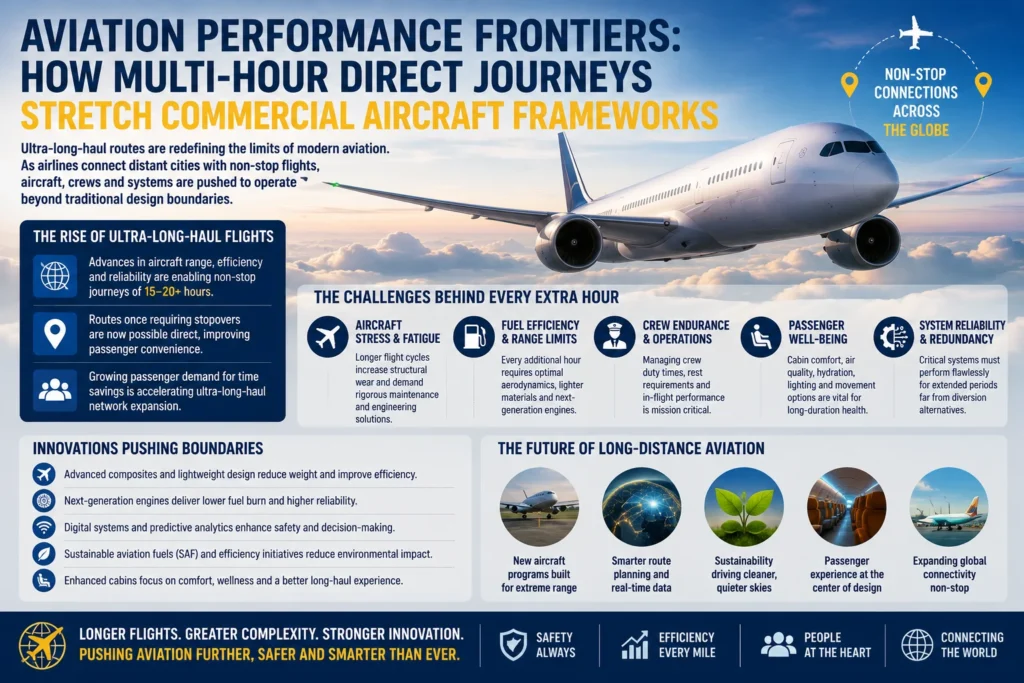
The global aviation sector is experiencing a significant shift as modern point-to-point routes alter long-distance tourism patterns. Connecting capital cities across vast ocean corridors, the expansion of direct paths has systematically reduced travel times, bypassing historic stopover hubs across Southeast Asia and the Middle East. At the forefront of this operational change is the flagship non-stop transit between Western Australia and London Heathrow, representing one of the longest scheduled commercial air links globally. Covering approximately 14,500 kilometers in a single block time of 17 hours and 30 minutes, this high-profile service relies extensively on precise operational planning and strict payload controls to maintain statutory flight safety buffers.
According to data parameters published in state infrastructure archives and official carrier fleet specifications, executing these lengthy direct segments requires extreme mathematical accuracy. The twin-engine widebody aircraft selected for the route must carry massive fuel volumes to cover the immense geographic distance while retaining legal reserves for emergency diversions or unexpected weather delays. This fundamental operational reality means that flight dispatchers must continuously balance total passenger counts, heavy commercial cargo manifests, and unpredictable seasonal weather variations to prevent exceeding absolute structural weight limitations.
Engineering Realities and Airframe Thresholds under Real Conditions
The aircraft engineered to facilitate this intercontinental corridor is constructed with lightweight carbon fiber composites and high-efficiency powerplants optimized to maximize long-range efficiency. Official technical publications show that the aircraft possesses an idealized maximum range threshold of approximately 7,830 nautical miles when evaluated under controlled, standard test parameters. Because the distance between Western Australia and the United Kingdom matches this maximum structural limit closely, real-world operators must adapt to a thin margin for operational error.
Under active line conditions, shifting high-altitude wind patterns, tactical flight path detours, and minor meteorological variations require increased fuel consumption. To guarantee that the aircraft holds sufficient fuel margins to handle a late-stage diversion, departures must frequently occur very close to the maximum structural takeoff weight. Because the dry structural mass of the airframe remains completely static, every single kilogram of additional weight introduced via passenger baggage or commercial freight directly reduces the allowable fuel capacity on board. Consequently, strict cargo caps are systematically enforced, and consumer booking allocations are actively managed to preserve the necessary operational range across hemispheres.
Thermal Physics and Ground Level Mass Dynamics
Ambient surface temperatures at the primary departure airfield play a powerful and direct role in shaping the operational profile of these ultra-long-range segments. During peak summer seasons, ground temperatures across Western Australian airfields regularly escalate into extreme brackets. This local environmental heat directly modifies the physical properties and overall density of modern jet fuels, complicating standard refueling procedures.
As temperature levels climb, aviation fuel naturally undergoes volumetric expansion. This physical change means that while the liquid completely fills the physical volume of the internal wing tanks, the overall molecular density of the fuel mass drops. Since aircraft fuel capacity is constrained by a fixed cubic tank volume, warm fuel effectively decreases the total usable mass of energy loaded onto the plane. To compensate for this thermal energy deficit during scorching ground conditions, flight operations bureaus must systematically reduce the overall payload of the aircraft. This structural necessity explains why flights may depart with empty seats despite high consumer demand, as leaving seats unsold provides the required weight capacity to accommodate safe fuel loads.
Advanced Cabin Enhancements and Passenger Well-Being
Sustaining continuous flight environments for over 17 hours demands sophisticated engineering modifications inside the passenger cabin to minimize physiological fatigue and lessen the impacts of rapid time zone transitions. Modern composite fuselages enable advanced atmospheric management systems that are unachievable inside traditional aluminum airframes, dramatically changing the modern long-haul passenger experience.
The integration of composite structural ribs allows the internal cabin altitude pressure to be maintained at an equivalent level of 6,000 feet, which is significantly lower than the standard pressure profiles found on older-generation long-haul jets. This increased pressure level optimizes oxygen absorption in the bloodstream, lowering instances of altitude headaches and exhaustion. Concurrently, specialized moisture management systems maintain significantly higher relative humidity levels, preventing the dry skin and respiratory tract irritation typically associated with prolonged high-altitude transit. Combined with acoustic damping insulation that dampens engine noise and dynamic internal lighting grids that simulate natural diurnal patterns, these environmental settings help international tourists better manage circadian disruption during multi-hemisphere travel.
Operational Volatility and Long-Term Route Adaptation
Maintaining a flight route at the outer boundary of physical aircraft performance introduces clear financial and operational trade-offs for commercial network planners. While business travelers and high-value tourists routinely pay premium pricing structures to secure the time-saving benefits of non-stop travel, the immense weight of the fuel required to support the final hours of the journey effectively reduces the volume of revenue-generating cargo that can be transported.
Furthermore, historical flight logs show that localized geopolitical adjustments or airspace restrictions can disrupt these tightly calibrated routes. A minor detour requiring an additional 30 to 45 minutes of flight time can force long-range non-stop services to introduce temporary technical refueling stops at mid-point airports, demonstrating that high-range operations remain sensitive to external variables. As regional climates continue to register higher average temperatures, payload restrictions linked to fuel density expansion are expected to become more frequent, forcing long-term adjustments in how international itineraries are scheduled and priced.
Future Projections for Global Direct Travel Networks
The persistent consumer demand for point-to-point services continues to accelerate new investment in dedicated, long-range aerospace technology. Industry developments indicate that international carriers are shifting toward purpose-built long-range platforms equipped with expanded internal fuel cell configurations and optimized structural maximum takeoff weights.
Future long-range aviation frameworks will rely on custom airframes designed with specialized auxiliary center tanks to support non-stop transits exceeding 20 hours, connecting eastern capital cities directly with major global capitals. Until these next-generation long-range configurations are fully integrated into active service fleets, aviation networks will continue to rely on meticulous payload planning, seasonal ticket capacity caps, and strict environmental tracking to maintain the safety and reliability of existing direct international connections.
For more travel news like this, keep reading Global Travel Wire