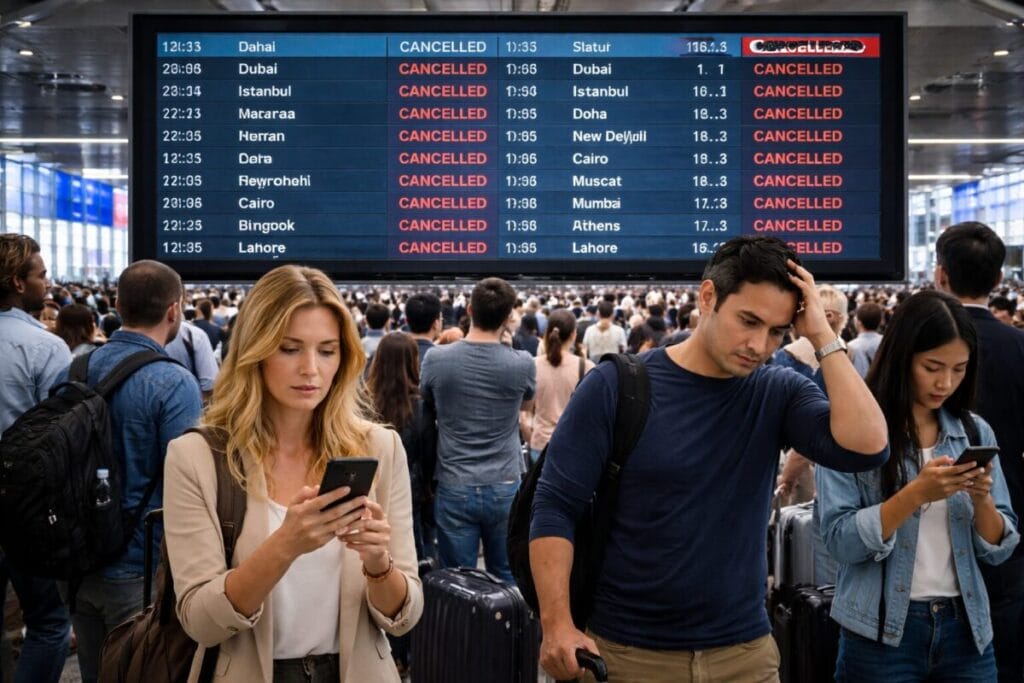
Global aviation faces severe disruption as geopolitical tensions in the Middle East close key international air routes. Airlines now cancel thousands of flights while travelers struggle to reach destinations during peak spring break travel. Aviation experts warn that the crisis has triggered widespread cancellations, longer routes, and rapidly rising ticket prices.
Major air corridors that connect Europe, Asia, and North America now face restrictions or closures. Airlines must reroute flights around restricted airspace to maintain passenger safety. These changes have created significant delays and logistical challenges for both airlines and travelers.
Airports across the Gulf region serve as major transit hubs for global aviation networks. When conflict disrupts this region, travel disruptions quickly spread worldwide. Passengers now experience unexpected cancellations, longer travel times, and rapidly increasing airfare costs.
Tourism officials and airline operators continue monitoring the situation closely. Travelers now receive strong advice to confirm flights and remain flexible with travel plans.
Thousands of flights disappear as airspace closures expand
The aviation industry has experienced an unprecedented wave of flight cancellations during the recent crisis. Aviation analysts estimate that around forty thousand flights disappeared from airline schedules across the Gulf region within weeks. Airlines removed these flights after governments restricted or closed several airspace zones.
Countries including Iran and Iraq now restrict or suspend commercial aviation in large areas of their airspace. These closures force airlines to avoid entire flight corridors that once carried thousands of daily flights. Airlines must now choose longer and more complex routes.
Major transit airports have experienced operational disruption as a result. Airports in Dubai, Doha, and Abu Dhabi serve millions of connecting passengers each year. Reduced capacity at these hubs immediately affects international flight schedules.
Passengers traveling between Europe and Asia now face the greatest disruption. Many airlines previously relied on Gulf airspace for efficient long-haul routes. With those routes closed, carriers must design new flight paths.
Travel authorities also warn that conditions may change quickly. Airlines often cancel flights with little notice when security concerns increase.
Global travel networks struggle with rerouted flights
Airspace closures in the Middle East have created a ripple effect across global aviation networks. Airlines must now redirect aircraft through alternative flight corridors. These detours significantly increase travel time and fuel consumption.
Flights that previously crossed the Middle East now fly around the region instead. Some aircraft travel north through Central Asia or south through the Indian Ocean. These diversions add several hours to long-haul journeys.
Passengers traveling between Europe and South Asia experience especially long delays. Certain routes now require additional stops for refueling or crew changes. Airlines must also adjust flight schedules to accommodate new routes.
Travelers often face missed connections when flights arrive late. Airports struggle to manage large numbers of passengers whose itineraries change suddenly. These disruptions create congestion at major international hubs.
Travel companies urge passengers to monitor airline notifications regularly. Airlines frequently update routes and schedules as the situation evolves.
Travelers seek alternative routes to reach destinations
Many travelers now search for creative travel routes to bypass restricted airspace. Some passengers stranded in Gulf countries choose overland journeys to reach alternative airports. Cities outside restricted zones now serve as temporary departure points.
Travelers in the United Arab Emirates have begun traveling to Oman to catch international flights. Muscat now handles additional flights from airlines seeking safer departure routes. European carriers operate several repatriation flights from the city.
Other travelers attempt long detours through East Asia. Flights via Hong Kong, Tokyo, or Seoul now provide alternative paths to Europe and North America. These journeys can extend travel time by six to ten hours.
Passengers must also consider visa rules for new transit destinations. Unexpected layovers may require transit permits or entry visas. Travelers who fail to check visa requirements risk being denied boarding.
Travel experts encourage travelers to review documentation carefully before departure.
Airline fuel costs drive surge in ticket prices
The aviation crisis has also pushed airfare prices sharply higher. Fuel prices often rise during geopolitical conflicts due to uncertainty in energy markets. Airlines now face increased costs for aviation fuel and operational logistics.
Longer flight routes also require additional fuel consumption. Aircraft must travel greater distances to avoid restricted airspace. Airlines must therefore adjust ticket prices to cover these expenses.
Several carriers have already introduced new fuel surcharges. These fees can add significant costs to long-distance flights. Some routes now include surcharges reaching hundreds of dollars.
Economy-class tickets on several major routes have doubled in price. Travelers who search for last-minute flights often face extremely high fares. Budget-friendly spring break travel has become difficult for many passengers.
Industry analysts expect elevated fares to continue while airspace restrictions remain in place.
Businesses and travelers adopt flexible travel strategies
Corporate travelers also face serious disruption due to the aviation crisis. Companies with employees traveling through the Middle East must adjust business travel policies. Many organizations now prioritize flexible travel arrangements.
Travel managers recommend booking refundable tickets and flexible hotel reservations. This strategy allows travelers to change routes quickly when conditions shift. Companies also monitor airline schedules closely.
Businesses now select alternative travel hubs in cities such as Istanbul or Amman. These locations currently offer safer connections for travelers avoiding restricted zones. Employees may stay in these hubs until new travel routes become available.
Companies also encourage staff to prepare contingency plans. Travelers should carry additional funds and emergency contact information. These precautions help travelers manage unexpected changes.
Travel management experts also recommend comprehensive travel insurance. Policies that cover disruption provide important protection during unstable travel conditions.
Tourism industry faces uncertainty during global travel disruption
The current aviation crisis has created uncertainty for the global tourism sector. Airlines, hotels, and tour operators now face unpredictable travel demand. Many travelers delay bookings while monitoring geopolitical developments.
Tourism destinations that depend on international flights may experience fewer visitors. Regions connected to affected air routes may face the greatest impact. Airlines must restore reliable flight schedules before tourism can fully recover.
However, travel demand remains strong in many parts of the world. Travelers continue searching for destinations accessible through stable flight corridors. Airlines may adjust routes to support tourism markets less affected by conflict.
Travel industry leaders believe global aviation will eventually stabilize. The reopening of restricted airspace will allow airlines to restore normal routes. Until then, travelers must prepare for longer travel times and higher costs.
Airlines and governments continue cooperating to maintain passenger safety. Travelers who remain informed and flexible can still navigate the current travel disruption successfully.
For more travel news like this, keep reading Global Travel Wire