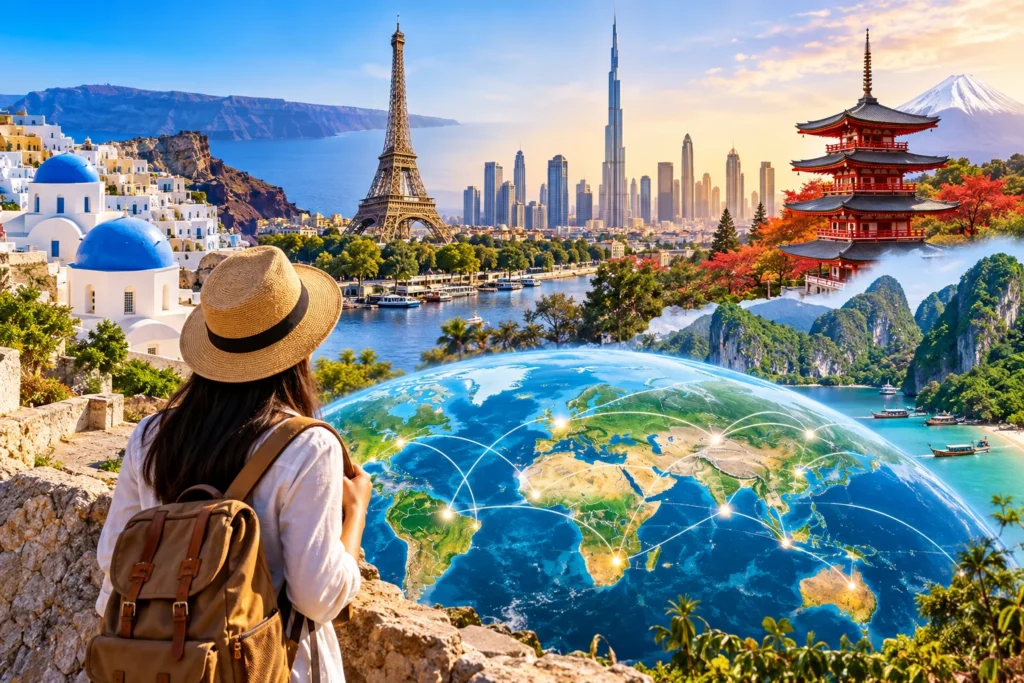
On World Tourism Day, celebrated annually across the globe, international focus returns to the primary destinations and policy frameworks defining the future of international mobility. The release of the World Economic Forum 2026 Travel and Tourism Development Index evaluates 110 global economies on factors ranging from infrastructure and environmental resilience to cultural assets and business environment readiness.
Official figures indicate that international tourist arrivals reached 1.5 billion, marking a full recovery and a 4.4 percent increase compared to pre-pandemic baseline data. The global travel index 2026 underscores how strategic investments in destination sustainability, digital infrastructure, and cultural preservation are propelling leading destinations ahead in a competitive global landscape.
Top Destinations Leading Global Travel
1. Japan
Ascending two spots to claim the top position in the overall index, Japan continues to showcase world-class transport infrastructure and cultural heritage preservation. Official tourism monitoring reports indicate that the nation welcomed a record 42.7 million international visitors over the recent evaluation period, generating approximately 59.7 billion US dollars in tourist expenditure. Key urban hubs such as Tokyo and Osaka, alongside historical centers including Hiroshima and natural landmarks like Mount Fuji, remain central to the country’s international appeal.
2. United States
Holding the second position after leading in previous editions, the United States remains a global powerhouse for travel and tourism. Fueled by high-capacity air transport networks and diverse natural assets, the country attracts millions of travelers annually. Major metropolitan centers including New York City and Los Angeles, coupled with expansive national park systems such as the Grand Canyon and Yellowstone, drive both domestic and international visitor demand.
3. Spain
Maintaining its strong standing in third place, Spain represents one of Europe’s most resilient tourism economies. Renowned for robust tourist service infrastructure, historical sites, and rich cultural heritage, key urban destinations such as Barcelona and Madrid consistently attract high volumes of international visitors. Spain continues to prioritize sustainable tourism framework developments to balance visitor capacity with heritage conservation.
4. Australia
Rising to fourth place globally, Australia has demonstrated significant growth in its enabling environment for travel. Exceptional natural resources, including iconic marine reserves like the Great Barrier Reef and diverse outdoor landscapes, support a robust eco-tourism sector alongside major urban centers like Sydney and Melbourne.
5. France
Rounding out the top five, France remains a cornerstone of international travel. Celebrated for world-renowned cultural institutions, UNESCO World Heritage sites, and culinary traditions, France consistently records high visitor volumes across major regional hubs and capital attractions.
6. Germany
Occupying the sixth spot, Germany excels in business travel infrastructure, ground transport efficiency, and sustainable urban management. A strong balance of historic landmarks, cultural festivals, and modern commercial centers supports stable inbound tourism flows.
7. United Kingdom
Ranked seventh, the United Kingdom maintains a dominant position through strong international connectivity and world-class heritage assets. Historic destinations across England, Scotland, Wales, and Northern Ireland continue to draw global travelers seeking cultural and historical experiences.
8. China
Holding eighth place, China remains the only non-advanced economy featured in the global top ten. Backed by significant national investments in high-speed rail, cultural heritage site management, and expansive natural reserves, the country represents a major force in regional and global travel dynamics.
9. Switzerland
Ranking ninth globally, Switzerland is recognized for outstanding environmental sustainability, pristine natural landscapes, and high-quality tourism service infrastructure. Its focus on eco-friendly transport networks makes it a benchmark for sustainable tourism development.
10. Italy
Completing the top ten list, Italy attracts global travelers through an unmatched concentration of historical monuments, art, and UNESCO World Heritage sites. Italian tourism policy continues to focus on dispersing visitor traffic across regional destinations to preserve local ecosystems and heritage integrity.
Key Trends in Global Travel Development
The global travel index 2026 highlights widespread progress across regions, with 92 percent of assessed economies improving their overall index scores over the two-year period. Average global scores grew by 2.1 percent, representing the fastest pace of development recorded since 2019.
The Asia-Pacific region recorded the strongest regional gain, increasing its average performance score by 3.6 percent, driven by enhanced air connectivity and modern infrastructure development. The Middle East and North Africa followed with a 2.5 percent gain, while Europe and Eurasia experienced a 1.8 percent rise.
Despite positive expansion, official reports emphasize emerging operational challenges across the sector. Price competitiveness decreased in nearly three out of four economies due to rising travel costs. Additionally, capacity constraints, labor shortages in hospitality, and the need to scale tourism investment alongside growing visitor demand remain central priorities for national tourism ministries worldwide. Integrating long-term destination sustainability with economic growth strategies remains critical to ensuring the sector’s future resilience.
For more travel news like this, keep reading Global Travel Wire