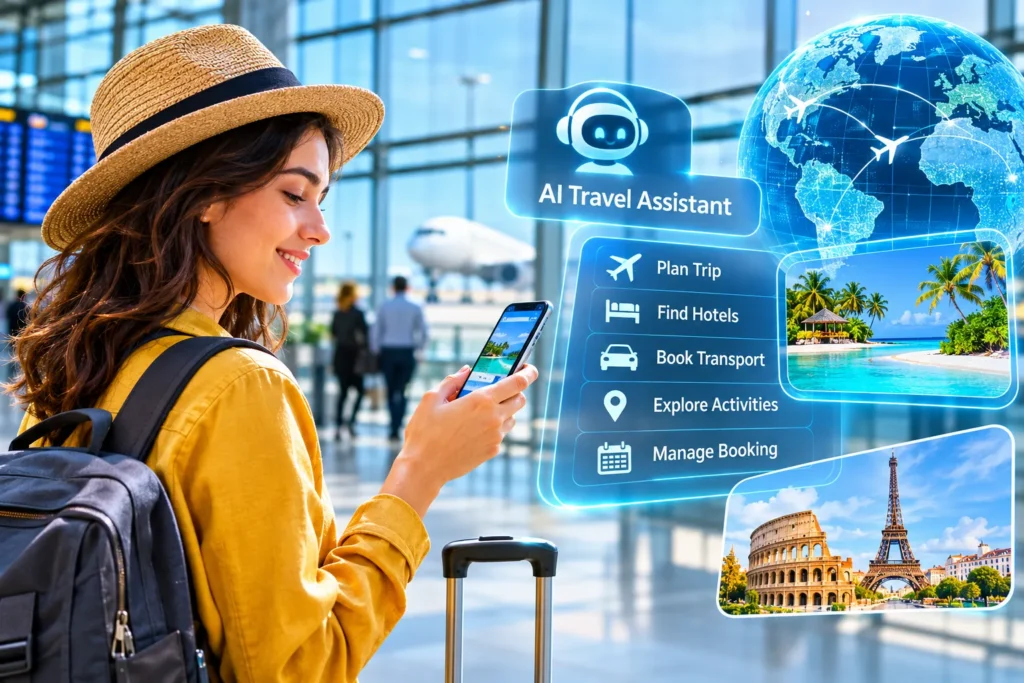
The traditional rituals of travel—flipping through printed guidebooks, unfolding paper city maps, queuing at ticket counters, and struggling across unfamiliar language barriers—are rapidly giving way to intelligent mobile assistance. Today, artificial intelligence serves as a personal travel planner, real-time interpreter, financial advisor, and round-the-clock safety guide directly inside a traveler’s smartphone. Reflecting this structural transformation across the global visitor economy, the United Nations Tourism organization dedicated World Tourism Day 2026 to the theme of advancing a digital agenda and artificial intelligence to redesign tourism. According to UN Tourism, artificial intelligence is now a central catalyst for building smarter, more inclusive, and environmentally sustainable travel ecosystems worldwide.
Automated Itinerary Design and Agentic Travel Planning
Planning a multi-stop journey once required days of cross-referencing schedules, accommodation reviews, and transit connections. Modern generative and agentic AI systems compress that process into seconds. Once a traveler specifies their budget, trip duration, dietary preferences, and pace of exploration, intelligent assistants construct customized day-by-day itineraries tailored to individual interests.
Crucially, newer agentic AI tools move beyond passive recommendations. With explicit user authorization, these systems compare real-time availability, reserve flights, confirm hotel rooms, and secure timed entry passes for national parks and cultural landmarks. In emerging tourism markets such as Bangladesh, domestic and international visitors increasingly rely on intelligent routing tools to plan efficient journeys across Cox’s Bazar, the Sundarbans mangrove forest, the tea estates of Sylhet, and the Chattogram Hill Tracts—identifying optimal travel windows, verified accommodations, and less congested visiting hours.
Dynamic Fare Forecasting and Seamless Cross-Border Communication
Airfare and hospitality pricing fluctuate continuously based on seasonal demand, booking lead times, and regional events. Predictive AI models analyze vast historical pricing datasets to forecast fare drops and send automated booking alerts, helping travelers secure competitive rates on flights and lodging. Simultaneously, natural language processing summarizes thousands of verified guest reviews into concise insights on property cleanliness, location convenience, and service reliability.
Once on the road, real-time speech translation tools and computer vision cameras remove longstanding communication hurdles. Travelers can hold natural conversations in unfamiliar destinations through instantaneous voice translation, while pointing a smartphone camera at street signs, railway timetables, museum plaques, or restaurant menus overlays accurate translations in their preferred language. Dietary verification tools further allow visitors to locate halal, vegetarian, vegan, or allergen-safe dining options while learning local cultural etiquette ahead of arrival.
Supporting Sustainable Tourism, Smart Airports, and Accessibility
Beyond individual convenience, artificial intelligence directly supports public policy goals around destination stewardship and inclusive mobility. In alignment with UN Tourism’s sustainability priorities, recommendation engines help ease overtourism pressures by highlighting lesser-known heritage sites, rural circuits, and lower-emission transport routes. At major international aviation hubs, biometric facial recognition and computer vision streamline immigration clearance and baggage tracking, cutting terminal wait times while strengthening security.
Inclusive travel represents another major breakthrough. Audio-descriptive AI applications read surroundings aloud through a smartphone camera, empowering blind and visually impaired travelers to navigate unfamiliar streets, transit stations, and exhibitions independently. Real-time meteorological and hazard-monitoring algorithms also deliver early weather warnings, suggest safe detour routes, and connect travelers immediately with nearby hospitals, pharmacies, or diplomatic missions during emergencies.
Advancing Smart Tourism Policy and Human-Centered Hospitality
National tourism authorities are actively integrating digital intelligence into public destination management. In Bangladesh, the Ministry of Civil Aviation and Tourism, the Bangladesh Tourism Board, and the Bangladesh Parjatan Corporation have expanded initiatives to digitize visitor information services, introduce virtual destination previews, and build smart tourism management frameworks alongside private tour operators.
Even as adoption accelerates across public and private sectors, technology specialists and UN Tourism leadership emphasize that digital innovation must remain open, ethical, and human-centered. Travelers are encouraged to verify critical operational details—particularly in remote forest or highland regions with limited mobile connectivity—and safeguard sensitive passport and payment credentials when using digital platforms. Ultimately, while artificial intelligence removes friction, uncertainty, and unnecessary travel expenses, the enduring heart of tourism remains genuine cultural exchange and the irreplaceable warmth of local hospitality.
For more travel news like this, keep reading Global Travel Wire