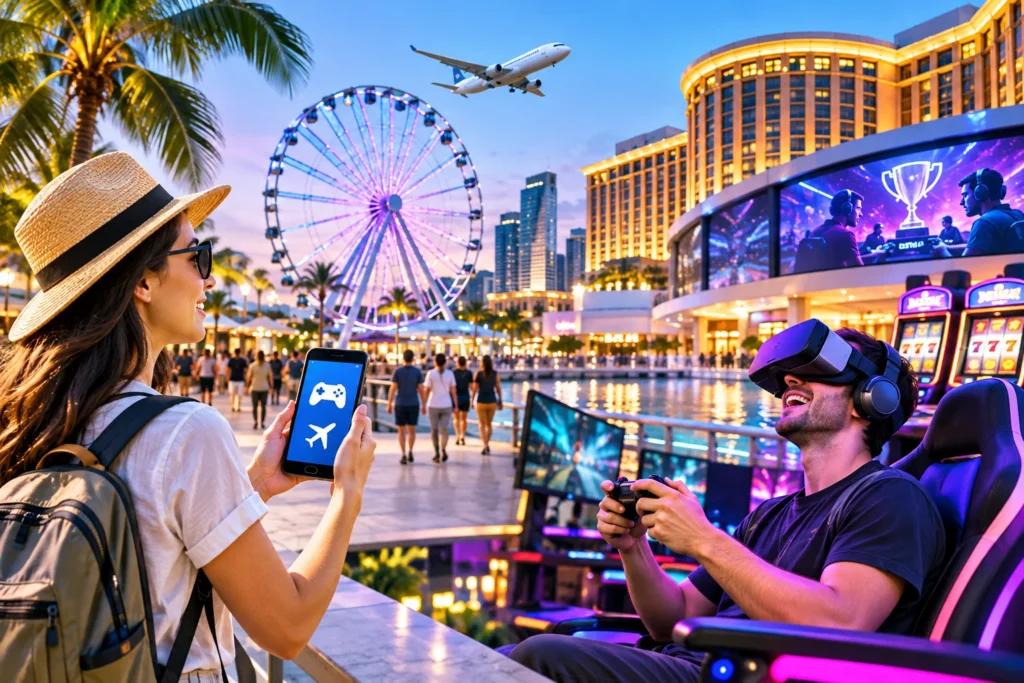
As global travel evolves beyond traditional sightseeing toward immersive leisure experiences, the broader entertainment tourism economy is undergoing a structural transformation. According to official assessments from UN Tourism, approximately 690 million international tourists traveled across borders during the first half of 2026 alone, underscoring resilient global appetite for leisure, hospitality, and recreational experiences. Alongside physical travel, digital entertainment platforms—including regulated online gaming and interactive leisure ecosystems—have emerged as major drivers of consumer time and discretionary spending worldwide.
For destination marketers, hospitality operators, and economic policymakers, the intersection between digital entertainment and physical tourism reveals critical insights into how modern travelers allocate both attention and leisure budgets. Whether engaging with interactive platforms from mobile devices at home or visiting large-scale integrated resorts abroad, consumers increasingly treat entertainment as a continuous, multi-channel experience rather than an occasional indulgence.
The Attention Economy Connects Digital Platforms and Destination Hospitality
At the core of the modern entertainment tourism economy lies a fierce competition for consumer attention and engagement. Both digital media ecosystems and physical hospitality destinations rely on the same fundamental metrics to sustain growth: session duration, repeat visitation, and personalized customer retention.
In the digital sphere, mobile connectivity has transformed interactive gaming and online casino platforms into mainstream leisure channels. Industry data indicates that mobile devices account for over 70 percent of global online gaming traffic, with average user sessions lasting between 30 and 90 minutes. That window of sustained engagement rivals the time consumers spend browsing digital publications, streaming video, or researching upcoming holiday itineraries.
Meanwhile, emerging digital economies are accelerating this shift. Official economic indicators from Nigeria’s National Bureau of Statistics highlight how the information and communications technology sector has grown into a cornerstone of national output, contributing roughly 16 percent of gross domestic product in recent reporting periods. Across North America, Europe, and Africa alike, widespread smartphone adoption and faster digital payment infrastructure have normalized interactive leisure as a daily pastime.
Integrated Resorts Bridge Digital Engagement and Physical Travel
While digital entertainment captures everyday screen time, physical destinations continue to capitalize on the desire for real-world spectacle, live events, and integrated resort hospitality. Across major tourism hubs in Asia-Pacific, North America, and Europe, governments and tourism authorities increasingly regulate and license large-scale integrated resorts that combine luxury hotels, convention facilities, live entertainment arenas, culinary districts, and regulated gaming floors.
Official regulatory milestones in 2026 demonstrate how destinations are strategically integrating entertainment infrastructure into long-term tourism development. In Japan, construction continues on the Osaka Integrated Resort following its groundbreaking in April 2025, a landmark project designed to position western Japan as a premier international convention and leisure hub. In Singapore, updated statutory frameworks administered by the Gambling Regulatory Authority took effect in September 2026 to strengthen oversight across integrated resort gaming, betting, and consumer protection standards.
Similarly, international aviation connectivity is adapting to support entertainment-driven travel corridors. In April 2026, Air France inaugurated seasonal nonstop flights connecting Paris Charles de Gaulle with Las Vegas three times weekly, directly linking European travelers with one of the world’s foremost entertainment and convention capitals. Data from the International Air Transport Association (IATA) shows that targeted long-haul routes to leisure hubs continue to perform strongly even as overall global airline capacity expands at a measured pace.
Regulatory Standards and Economic Sustainability in Leisure Tourism
As both digital gaming platforms and land-based entertainment resorts expand their economic footprint, national governments are placing heightened emphasis on regulatory transparency, fiscal accountability, and responsible consumer safeguards. Public revenues generated through licensed gaming and hospitality taxes frequently fund municipal infrastructure, cultural preservation, and destination marketing campaigns managed by national tourism boards.
At the same time, regulators in jurisdictions such as the United Kingdom, New Zealand, Singapore, and various Canadian provinces have introduced stricter compliance frameworks governing advertising standards, digital payment verification, and player protection tools. These measures reflect a broader policy consensus: sustainable growth in the entertainment tourism economy depends on maintaining public trust, transparent pricing, and rigorous consumer safeguards.
For the global travel industry, the convergence of digital leisure habits and physical destination appeal offers a clear strategic lesson. Modern travelers seek seamless, engaging, and trustworthy experiences whether they are interacting with a mobile screen at home or checking into an integrated resort overseas. Destinations and hospitality brands that understand how digital engagement complements real-world travel will remain best positioned to capture discretionary leisure spending in the years ahead.
For more travel news like this, keep reading Global Travel Wire