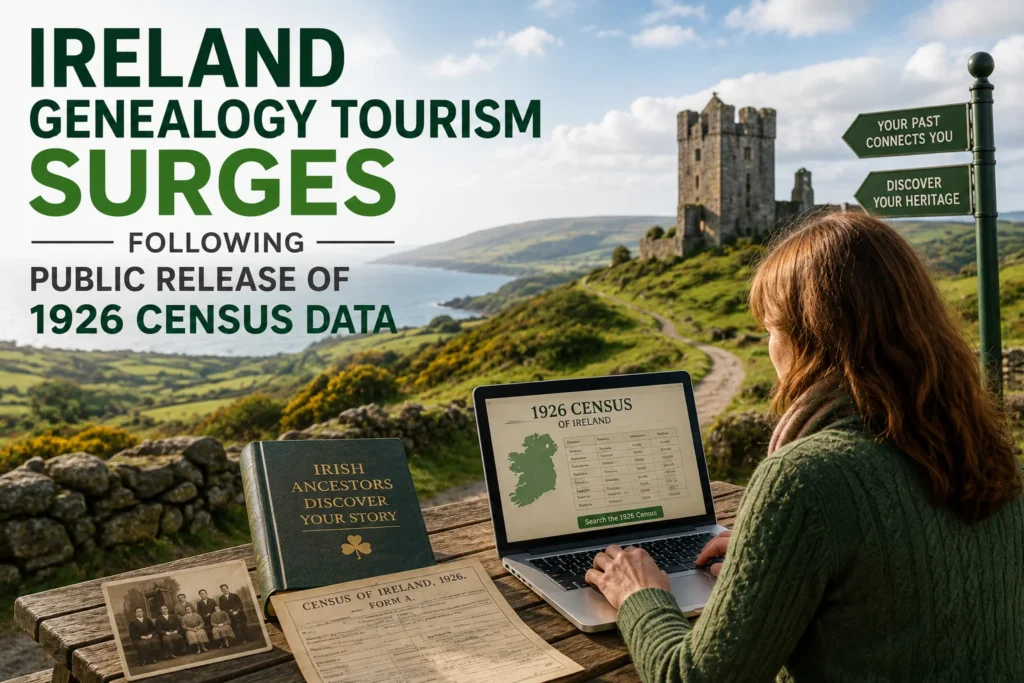
The ancestral tourism sector in Ireland is experiencing a significant expansion in 2026, driven by the release of the historic 1926 Census. Containing the detailed household records of nearly three million residents from a century ago, the document offers an unprecedented demographic snapshot of the early Irish Free State. By connecting a global diaspora estimated at 70 million individuals with their specific townlands and parishes, the public archive serves as a major driver for international heritage trips.
Through integrated digital mapping and archival access provided by state cultural institutions, the national travel framework aims to channel international visitors beyond established urban entry points. This genealogy-led strategy aligns with official economic goals to distribute tourist expenditure directly into rural regions, supporting local heritage conservation and family-owned enterprises.
Official Visitor Growth and Economic Performance Indicators
The launch of the historic records complements a broader recovery in Ireland’s international travel sector. Official data published by the Central Statistics Office (CSO) reveals that approximately 3.2 million overnight foreign visitors completed journeys to Ireland between January and June 2026. This figure represents a 15 percent increase compared to the corresponding six-month period in 2025.
Statistical reports for June 2026 show that the island welcomed 670,300 foreign visitors who spent roughly 696.8 million EUR (excluding airfares) across 5.1 million overnight stays, maintaining an average visit duration of 7.6 nights. Overall trip classifications indicate that holidays, leisure, and recreation accounted for 49 percent of foreign visits, while visiting friends and relatives represented 27 percent, and business travel made up 14 percent.
Economic Contributions of North American Diaspora Visitors
The North American visitor segment remains a cornerstone of Ireland’s heritage tourism economy. During June 2026, visitors originating from North America comprised 27 percent of total foreign resident arrivals. More importantly, this market generated 273 million EUR, which accounted for 39 percent of all foreign visitor expenditure recorded during that month.
Ancestral travelers from long-haul markets typically record extended lengths of stay as they explore regional archives, local church registries, and family homesteads. To capture this high-value demand, Tourism Ireland targets an annual overseas revenue threshold exceeding 10 billion EUR by 2031. To support this target, public funding allocations include 71.43 million EUR dedicated to the Overseas Tourism Marketing Fund under Budget 2026, alongside a 400 million EUR capital investment plan covering 2026 through 2030.
Dispersing Visitors into Rural Parishes and Small Enterprises
The release of the 1926 Census functions as a practical tool for regional economic development. When family history research pinpoints a specific village or rural townland, that localized setting becomes the primary focus of the visitor’s travel itinerary. This spatial shift redirects foot traffic away from congested urban hubs like Dublin toward smaller communities across the west, south, and midland counties.
Directing international visitors toward ancestral roots provides consistent revenue to regional bed-and-breakfasts, local transport operators, and village dining establishments. Small and medium-sized enterprises (SMEs) across the hospitality industry benefit directly from increased demand for localized historical tours, regional craft workshops, and rural cultural experiences.
Essential Visitor Guide: Archive Rules, Transport, and Local Cuisine
Planning a genealogy-focused journey to Ireland involves navigating archive protocols, coordinating regional transport, and enjoying traditional hospitality:
Accessing Census Archives: Search digitized 1926 Census records free of charge through the official National Archives of Ireland online platform. Visitors wishing to examine physical documents at the Reading Room in Dublin must apply for a Reader’s Ticket in person using valid government-issued photo identification. Strict archive conservation rules mandate that only pencils are permitted within research rooms; pens and erasers are strictly prohibited.
Coordinating Regional Transit: From Dublin Airport, express bus services provide direct transfers to central transport hubs like O’Connell Street and Connolly Station. For travel to western and southern counties, visitors can book advance train tickets through Irish Rail (Iarnród Éireann) online, with single fares from Dublin to Galway or Cork offering cost-effective transit options.
Sampling Traditional Culinary Specialties: Regional travel provides an opportunity to experience traditional Irish food culture. Visitors can sample slow-cooked beef and stout stew served with traditional soda bread, fresh coastal seafood chowder, or classic colcannon made with regional agricultural produce.
Sustainable Heritage Development and Future Tourism Outlook
The long-term resilience of Ireland’s ancestral travel sector relies on protecting cultural assets, supporting local historical societies, and expanding digital archive capabilities. Tourism Ireland works alongside municipal councils and historical registries to maintain unified digital databases that simplify heritage searches for international visitors.
Sustainable tourism initiatives emphasize restoring historic parish infrastructure, developing regional walking trails, and supporting community heritage festivals. By combining digital archival tools with community-led hospitality, Ireland continues to strengthen its connection with the global diaspora, building a sustainable and resilient future for rural tourism.
For more travel news like this, keep reading Global Travel Wire