A Dedication to Historic European Barns and Heritage Mapping
The centerpiece of this private museum is a specialized architectural niche: meticulous 1:100 scale replicas of historic European threshing barns. Each model captures the structural nuances, timber framing, and masonry of centuries-old agricultural sites with absolute precision.
Bonham’s journey into model building began following his retirement from a long career in education. The project took root during an educational consultancy assignment in Bristol, where he was accompanied by his wife of 54 years, Maggie. While traveling across the region, the couple embarked on a spontaneous detour to visit two renowned historic landmarks: the Ashleworth Tithe Barn in Gloucestershire and the Middle Littleton Tithe Barn in Worcestershire.
That single outing sparked a passion for active field exploration. What started as a casual regional excursion evolved into a 12-year quest across the countryside of Great Britain and continental Europe. Together, the couple sought out rare agricultural structures, documenting architectural features, measuring spatial proportions, and studying regional variations in barn design. Each site visit provided the raw technical data and inspiration required to construct scaled replicas back home in Birmingham.
Crafting Travel Memory Dioramas from Decades of Exploration
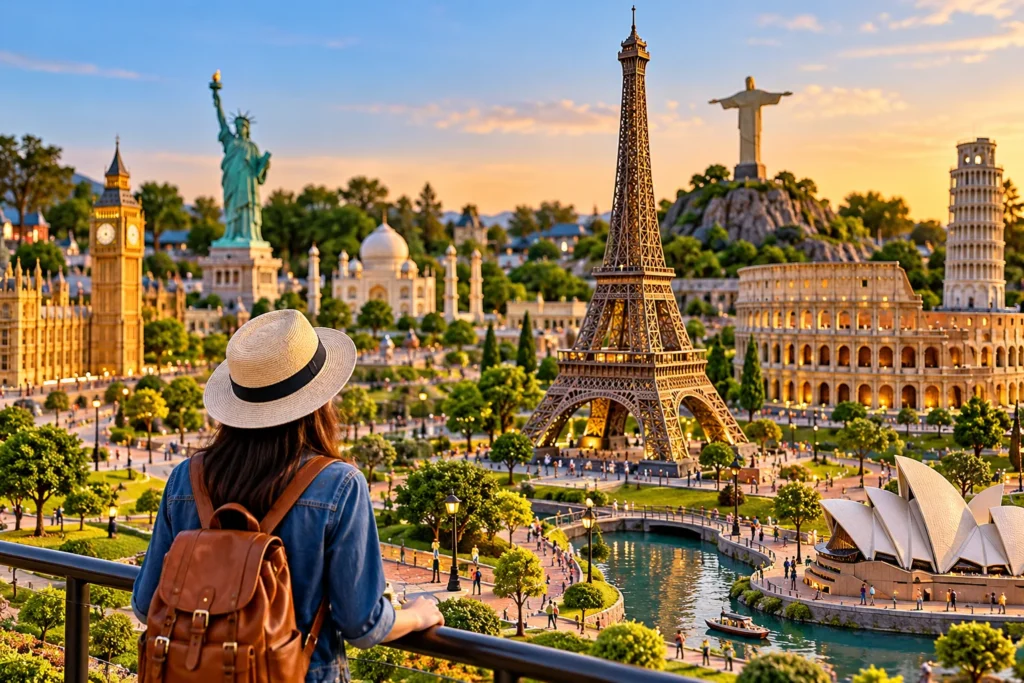
Beyond standalone timber structures, the flat functions as a living repository of domestic and international journeys. Through travel memory dioramas and handcrafted memory boxes, key destinations visited by the couple are encapsulated into three-dimensional narratives.
These displays bring together topography, localized architectural styles, and custom card modeling techniques. Rather than relying on traditional photograph albums or souvenir collections, the dioramas recreate entire geographic environments in miniature form. Visitors navigating the collection move through miniature towns, rural landscapes, and holiday displays that preserve decades of shared exploration.
The artistic process relies heavily on primary field research. Each miniature town or structural replica reflects accurate construction practices, matching the exact timber layouts, roof pitches, and stone textures found at the original heritage sites. This rigorous approach bridges the gap between creative craftsmanship and formal architectural preservation.
The Intersection of Personal Craft and Architectural Heritage
The collection demonstrates how cultural travel and heritage study can blossom into a life-long artistic pursuit. By focusing on historic threshing barns—structures that played vital economic roles in medieval and early modern European agriculture—the models draw attention to a essential segment of rural architectural history that is frequently overlooked by mainstream tourism.
Tithe barns, originally used to store agricultural tithes paid to the church or landlord, represent some of the largest timber-framed structures surviving in Europe today. Reconstructing these monumental buildings at a 1:100 scale requires translating complex timber framing systems into delicate, precise components. Through careful study and manual assembly, the resulting models act as educational tools that illustrate how medieval engineering adapted across different European regions.
The collection also highlights the evolving nature of post-retirement travel. For many travelers, geographic exploration serves as an avenue for creative expression and lifelong learning. By pairing active field trips with meticulous physical modeling, historic landmarks are preserved long after the physical journey ends.
Preserving Travel Legacies in Miniature Form
As interest in specialized heritage modeling and architectural appreciation grows, personal endeavors like this reflect a deep connection between travel experiences and physical creative output. The Birmingham flat stands as a testament to decades of discovery, capturing European agricultural history and personal travel milestones within a singular private space.
Through a synthesis of historical research, field documentation, and model making, decades of travel continue to live on, proving that even the grandest historic monuments can find a lasting home within the cozy confines of a one-bedroom flat.
For more travel news like this, keep reading Global Travel Wire