Managing regional transit requires precise planning, especially during high-traffic periods when subtle scheduling changes can cause significant adjustments to domestic travel itineraries. On June 20, 2026, passengers traveling through Mississippi‘s primary aviation gateway encountered notable operational adjustments. Official data confirms a series of Jackson-Medgar Wiley Evers Airport flight disruptions, characterized by selective route cancellations and delayed departures affecting key regional corridors.
As the central commercial air terminal linking Mississippi to the broader domestic airspace grid, Jackson–Medgar Wiley Evers International Airport (JAN) functions as a vital component of the state’s travel and economic infrastructure. When scheduling constraints arise at regional hubs, the effects are felt across hospitality operations, business travel commitments, and leisure vacation plans. By examining official administrative releases and airline operational statements, travelers can effectively navigate changing schedules and safely secure alternative transit options.
Breakdown of Regional Carrier Cancellations and Terminal Delays
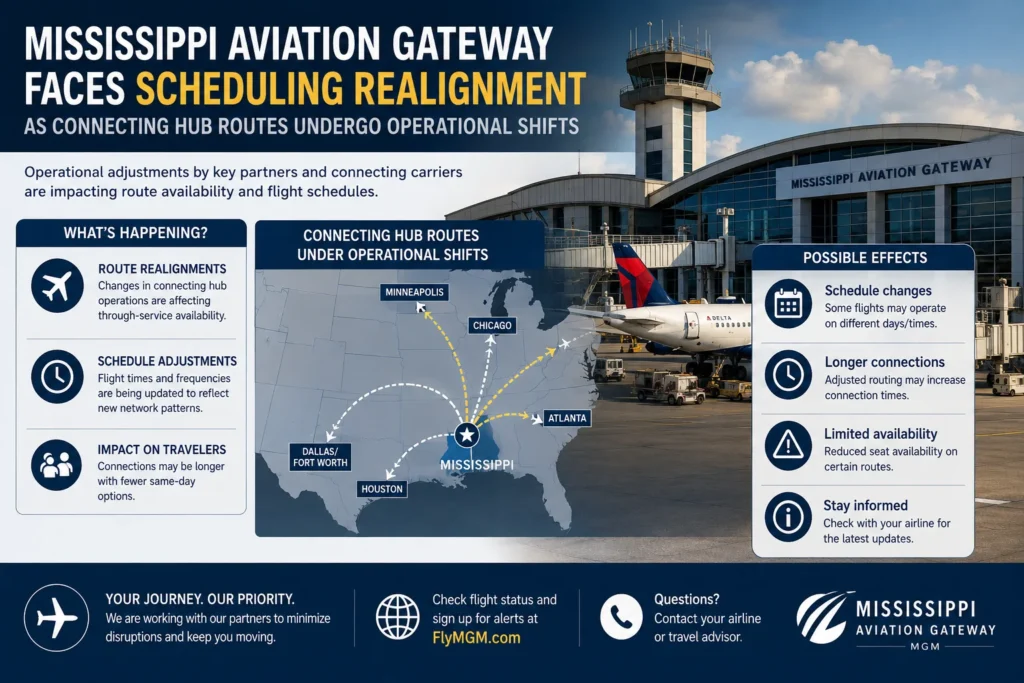
According to tracking documentation compiled within the national aviation framework, operations at JAN experienced specific scheduling pressures that impacted multiple domestic routes. Terminal operational updates logged five absolute flight cancellations alongside ten delayed operations. These adjustments primarily affected short-haul regional flights connecting Jackson to major multi-airline transfer hubs, including Charlotte, Dallas, Atlanta, Nashville, and Washington.
The specific impact across the individual carriers operating within the Mississippi terminal includes the following official statistics:
Piedmont Airlines Operations: The carrier experienced a complete suspension of its scheduled departures at the terminal, logging two grounded flights to record a temporary one hundred percent operational pause.
PSA Airlines Bottlenecks: Operating critical feeder services for nationwide networks, this carrier registered two cancellations, which represented approximately eleven percent of its local daily scheduled operations, alongside eight separate flight delays.
Delta Air Lines Schedule Modifications: Mainline operations recorded one cancellation, accounting for eight percent of its daily terminal footprint, while posting two delayed services.
Total Network Footprint: The combined adjustments resulted in five absolute cancellations and ten delayed departures, concentrating minor operational friction within the regional terminal lobby and gate waiting areas.
While standard airport infrastructure, security screening lines, and airfield ground handling systems remained fully open and functional throughout the day, the targeted schedule modifications required travelers on affected routes to coordinate structural rebookings directly with their carriers.
Analyzing the Centralized Nature of the Interconnected Air Grid
The recent operations at Jackson-Medgar Wiley Evers International Airport demonstrate how localized scheduling changes at smaller regional installations are structurally linked to the broader national airspace. The domestic aviation system relies on a tightly synchronized rotation of aircraft hulls and flight crews. Consequently, minor delays or equipment changes at a mid-tier airport can quickly ripple outward, affecting downstream gate availability, local baggage routing, and strict federal crew duty-hour limits across major connection points like Atlanta or Dallas.
Official administrative parameters from aviation regulatory bodies explain that air carriers prioritize safety guidelines and operational security above strict arrival punctuality. When carriers navigate unexpected constraints, such as shifting regional weather fronts, aircraft maintenance requirements, or logistical personnel reallocations, scheduling managers must balance itineraries dynamically. Modifying specific low-volume regional flights allows major network operators to prevent larger systemic logjams across their broader national frameworks.
For the regional tourism sector, these minor corridor constraints can lead to temporary delays in visitor arrivals at Mississippi landmarks, cultural sites, and business conferences. Delayed incoming flights can also restrict standard connection windows, making it essential for passengers to track real-time operational shifts via certified administrative channels.
Practical Advice for Managing Regional Flight Adjustments
Airlines and airport service personnel continue to coordinate rebooking processes to minimize passenger inconvenience and safely restore standard schedule frequency. For individuals currently navigating regional travel adjustments or planning upcoming itineraries, state aviation offices and customer service divisions recommend practicing several precise travel steps:
Track Automated Mobile Notifications: Travelers are advised to download their carrier’s official mobile application and enable instant push notifications. Digital reservation portals update gate reassignments and automated rebooking options faster than physical airport display boards.
Confirm Status Pre-Departure: Always verify your specific flight parameters online before departing for the airport terminal. This step helps avoid unnecessary wait times inside ticket lobbies during active scheduling re-alignments.
Leverage Digital Communication Portals: If terminal customer service desks experience standard peak queues, passengers can simultaneously access web-based chat systems or telephone helplines to expedite ticket changes.
Understand Carrier Service Commitments: Review your specific airline’s stated customer care guidelines regarding controllable and uncontrollable delays. Depending on the scenario, passengers may be entitled to alternative routing transfers, meal vouchers, or comprehensive reservation refunds.
Maintain Schedule Adaptability: Maintaining a flexible approach to timing during peak seasonal travel windows reduces transit stress and allows for seamless integration into updated airline scheduling patterns.
Long-Term Resilience of Mississippi Air Infrastructure
The Jackson Municipal Airport Authority continues to focus on enhancing terminal services and airfield operational capabilities to support growing regional transit demands. Ongoing investments in terminal facilities and regional airline partnerships aim to reinforce the airport’s long-term capability to manage unexpected air traffic adjustments smoothly.
As airline dispatch teams, aircraft technicians, and regional crew schedulers work to normalize standard rotations over the coming days, local terminal conditions are projected to stabilize fully. By relying exclusively on official public information, utilizing interactive mobile tools, and practicing proactive planning, travelers can confidently navigate the modern aviation grid while meeting their personal and professional journey goals.
For more travel news like this, keep reading Global Travel Wire