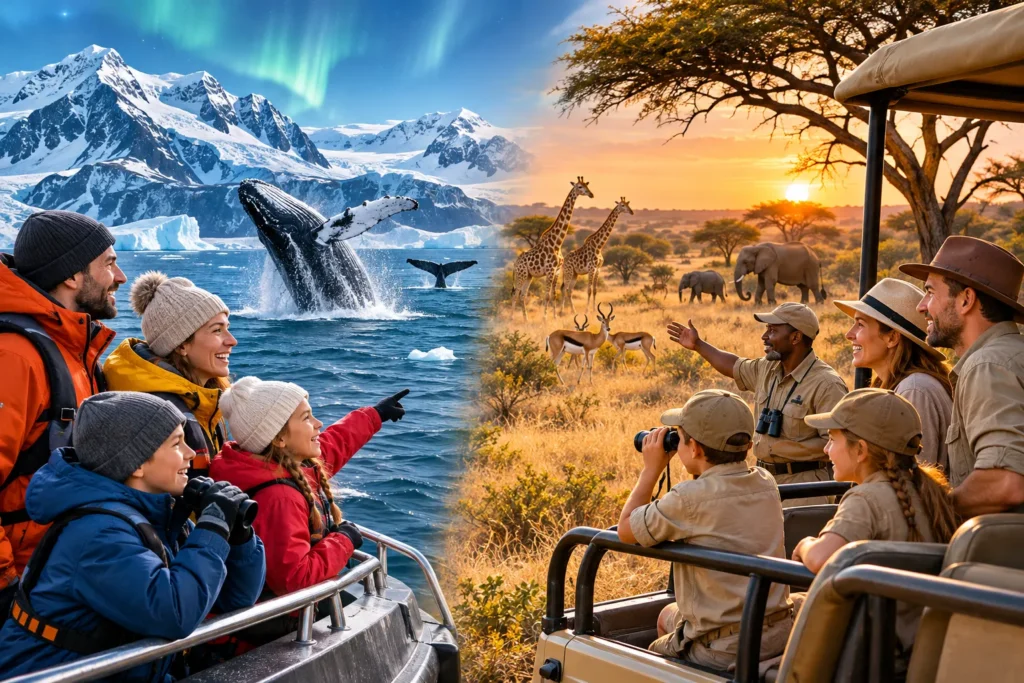
Global leisure travel in 2026 is witnessing a decisive shift away from crowded urban sightseeing toward meaningful, nature-based family travel and off-peak wilderness exploration. Rather than concentrating holidays around peak school vacation windows, multi-generational families—combining parents, young children, and grandparents—are increasingly opting for shoulder-season and off-season departures to experience pristine ecosystems without heavy tourist congestion. From Arctic fjords in northern Norway to malaria-free desert conservation reserves in South Africa, immersive wildlife encounters are redefining how families connect with the natural world.
Official tourism indicators confirm that experiential, nature-focused itineraries represent one of the strongest growth pillars in global tourism. According to UN Tourism’s 2026 travel assessments, international travelers are prioritizing authentic outdoor experiences, biodiversity conservation, and quieter regional destinations over traditional mass-market circuits. By traveling outside peak calendar periods, families with preschool-aged children gain unhurried access to fragile marine and terrestrial habitats while supporting local conservation economies year-round.
Responsible Marine Wildlife Encounters in Arctic Norway
In northern Norway, the Arctic gateway city of Tromsø exemplifies how multi-generational families combine accessible urban culture with extraordinary sub-Arctic marine adventures. Located well above the Arctic Circle, Tromsø allows families to pair child-friendly educational stops—such as regional Arctic aquariums showcasing native seal populations and public cultural spaces—with evening northern lights viewing under crisp winter skies.
Beyond aurora borealis observation, northern Norway’s coastal fjords serve as seasonal feeding grounds for migrating humpback whales and orcas. Under official marine wildlife guidelines issued by Norway’s Directorate of Fisheries and national tourism authorities, responsible boat excursions emphasize low-impact observation, strict vessel distance protocols, and quieter operational zones away from congested shipping lanes. When sea visibility and weather conditions permit, small-group operators guide experienced swimmers into calm Arctic waters alongside pods of humpbacks and orcas, offering a rare perspective on marine biodiversity while adhering to strict animal welfare standards.
Official figures from Innovation Norway and Statistics Norway highlight the sustained international appeal of northern Norway’s winter and shoulder-season nature offerings, with Arctic provinces recording steady year-on-year growth in international guest nights driven by aurora tourism, fjord excursions, and sustainable coastal experiences.
Conservation-Led Family Safaris in South Africa’s Kalahari
At the opposite climatic extreme, South Africa’s southern Kalahari region demonstrates how private conservation reserves cater specifically to multi-generational family travel. Spanning roughly 1,200 square kilometers—or 118,000 hectares—of red sand dunes, semi-arid savannah grasslands, and ancient Korannaberg mountains, Tswalu Kalahari Reserve stands as South Africa’s largest privately protected conservation area. Operating within a malaria-free zone, the reserve offers an accessible, low-density safari environment suited to families traveling with young children and older relatives.
Unlike high-volume safari circuits, low-impact conservation reserves limit guest capacity to maintain the lowest guest-to-land ratio in southern Africa. Every family booking includes a dedicated private safari vehicle, personal field guide, and specialist tracker, allowing daily game drives, guided bush walks, and Junior Ranger educational programs to proceed at a flexible pace tailored to children’s curiosity. Alongside iconic desert-adapted black-maned Kalahari lions and black rhinos, Tswalu is renowned for conservation research supporting elusive nocturnal and burrowing wildlife, including pangolins, aardvarks, brown hyenas, bat-eared foxes, and habituated meerkat colonies.
Official tourism performance data published by South African Tourism confirms that wildlife and nature-based experiences remain the primary motivator for international arrivals to South Africa, with private conservation reserves playing a central role in funding ecological restoration, scientific research, and rural community healthcare and education initiatives.
The Rise of Purposeful, Off-Peak Exploration
Whether floating silently in Arctic fjords or tracking rare desert wildlife across southern Africa, the convergence of multi-generational family travel and conservation-minded tourism underscores a broader evolution in global hospitality. Travelers increasingly measure the value of a journey not by luxury cabin tiers or checklist sightseeing, but by shared wonder, educational depth, and respect for wild ecosystems. As destinations across Europe and Africa strengthen sustainable visitor management and shoulder-season infrastructure, nature-based family travel continues to set the standard for transformative global exploration.
For more travel news like this, keep reading Global Travel Wire