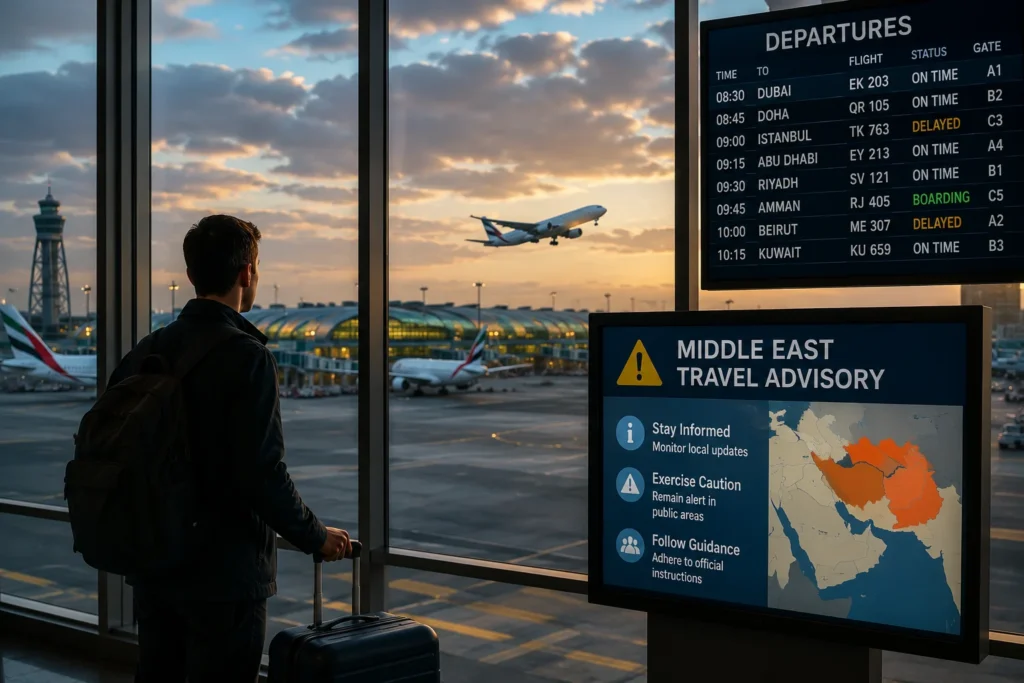
The global tourism and aviation sectors are adapting to a rapidly changing operational landscape following an intense period of geopolitical volatility in the Gulf region. In response to recent military actions and the persistent unpredictability of regional airspace, the Australian Department of Foreign Affairs and Trade has implemented a comprehensive tightening of its official travel guidance through the Smartraveller portal. This shift introduces significant updates for international leisure travelers and business commuters, particularly those utilizing the highly trafficked aviation corridors connecting Europe, Asia, and Oceania.
According to official governmental updates, the primary directive centers on the critical reality that transit is equivalent to travel. For millions of international passengers who rely on the ultra-modern hubs of the Gulf Cooperation Council nations to bridge long-haul journeys, these newly adjusted risk classifications demand a heightened state of personal vigilance, flexible scheduling, and meticulous cross-referencing of travel protection coverage.
Deciphering the Upgraded Risk Classifications and Country Directives
The July 2026 advisory updates represent a unified, protective posture by federal authorities designed to safeguard citizens against sudden airspace closures, itinerary diversions, and localized infrastructure challenges. The Australian government separates its directives into strict tiers based on thorough assessments of ongoing ground safety and aviation security variables.
Under the highest baseline restriction, a Level 4 “Do Not Travel” directive remains firmly in place for several nations experiencing intense volatility or localized conflict. Australian citizens are strongly advised to completely avoid travel to Iran, Iraq, Lebanon, Syria, Yemen, and the Palestinian territories. The government explicitly warns that its capacity to provide consular assistance in these territories remains severely restricted due to ongoing security limitations.
Concurrently, a significant hardening has occurred across the region’s primary tourism and transit gateways. Authorities have positioned the United Arab Emirates, Qatar, Bahrain, and Kuwait under a Level 3 “Reconsider Your Need to Travel” status. This specific classification also extends to Israel, Jordan, Oman, and Saudi Arabia. While a Level 3 status does not legally prohibit entry or signify an absolute stoppage of commercial flight paths, it serves as a formal recommendation to postpone non-essential holiday or business travel until regional stability stabilizes.
The Operational Ripple Effect Across Global Transit Hubs
The primary concern for the broader tourism market centers heavily on the logistical continuity of global transit hubs. The modern aviation networks of the Gulf—anchored by world-class installations such as Dubai International Airport, Abu Dhabi’s Zayed International Airport, and Doha’s Hamad International Airport—serve as the foundational backbone for international long-haul passenger movement.
Official aviation authority briefings note that following brief periods of airspace restrictions and heightened defensive monitoring over a recent weekend, full commercial operations successfully returned to normal parameters by Monday, July 13, 2026. However, despite the swift normalization of runway activities, the overarching governmental guidance remains firm in its caution.
Aviation planners emphasize that when an advisory urges travelers to reconsider their presence in a specific country, that caution applies equally to individuals changing planes at an airport gate. The primary operational risks facing transit passengers during periods of regional tension include sudden, short-notice closures of specific airspace corridors by civil aviation ministries. Such measures can prompt immediate rerouting, which automatically results in longer flight paths, increased fuel stops, delayed arrivals, and significant rebooking pressures for connecting passengers who miss their onward flights.
Essential Practical Protocols for Modern Long-Haul Travelers
For individuals who must travel or proceed with transit plans through the affected Gulf corridors, federal ministries and travel safety experts recommend adopting strict pre-departure protocols to mitigate potential disruptions.
First, passengers must maintain constant communication with their operating air carriers. Because airline flight paths and scheduling remain completely dependent on real-time security updates and international civil aviation directives, checking flight statuses multiple hours before heading to the departure terminal is essential. Travelers should ensure their contact information is fully updated within airline mobile applications to receive immediate notifications regarding delays or track adjustments.
Second, reviewing the precise legal terms of travel insurance policies has become non-negotiable. Many standard insurance products contain specific exclusion clauses that invalidate coverage if a traveler enters or transits through a nation that is actively designated under a Level 3 or Level 4 government advisory. Discerning travelers are urged to analyze the Product Disclosure Statements of their respective insurers to verify whether their policy covers expenses related to geopolitical flight cancellations, unexpected hotel accommodation costs during extended layovers, or medical evacuations.
Finally, while transiting through any destination subject to elevated warnings, passengers should keep their personal identification documents easily accessible, minimize unnecessary movements outside of secure airport perimeters during extended layovers, and stay closely informed by monitoring official alerts provided by local port authorities and administrative offices.
The Long-Term Outlook for Regional Maritime and Aerial Tourism
Despite the immediate friction introduced by these updated parameters, the long-term structural resilience of the global travel sector remains apparent. Regional tourism boards and airport corporate groups continue to invest heavily in advanced security technologies, infrastructure scaling, and diversified flight routing strategies designed to insulate commercial travelers from surface-level disruptions.
By providing clear, metric-driven safety benchmarks through official frameworks, government agencies ensure that the public can make deeply informed, logical decisions regarding their international movement. As the international travel community enters the latter half of 2026, maintaining structural flexibility, keeping abreast of verified ministry notices, and prioritizing comprehensive personal preparation will remain the defining capabilities for travelers navigating the global skies.
For more travel news like this, keep reading Global Travel Wire