The Ministry of Tourism and the Saudi Tourism Authority have released official statistics demonstrating unprecedented growth across the Kingdom of Saudi Arabia’s hospitality and travel infrastructure. Supported by strategic policy updates, new international flight routes, and streamlined visa issuing frameworks, Saudi Arabia continues to establish itself as a primary global hub for business, culture, and leisure travel.
Official data released by the Ministry of Tourism shows that total domestic and inbound tourism numbers have reached historic highs, keeping the nation firmly on track to meet its revised national economic goals. The strategic alignment between national carrier airlines, regional government bodies, and international hospitality brands has enabled rapid expansion in visitor arrivals across key cultural, heritage, and coastal destinations.
Record Domestic and Inbound Visitor Statistics
According to preliminary performance metrics published by the Ministry of Tourism, Saudi Arabia recorded robust visitor numbers across both domestic and international sectors. Inbound tourist arrivals reached unprecedented figures, supported by the expanded adoption of the electronic visa program and specialized transit package visas designed to simplify short-term visitor entry.
Official quarterly reports indicate significant growth in tourism expenditure, with total travel account revenue generating substantial trade surpluses. Domestic leisure travel has shown steady double-digit increases, driven by national promotional campaigns and seasonal event programming organized by the Saudi Tourism Authority.
Key urban and holy cities continue to lead in national accommodation occupancy rates. Performance indicators released by the Ministry of Tourism highlight high hotel occupancy in Madinah, Makkah, and Jeddah, alongside growing demand for leisure properties along the Red Sea coastline and historic regions such as AlUla.
Expansion of Global Aviation and Connectivity
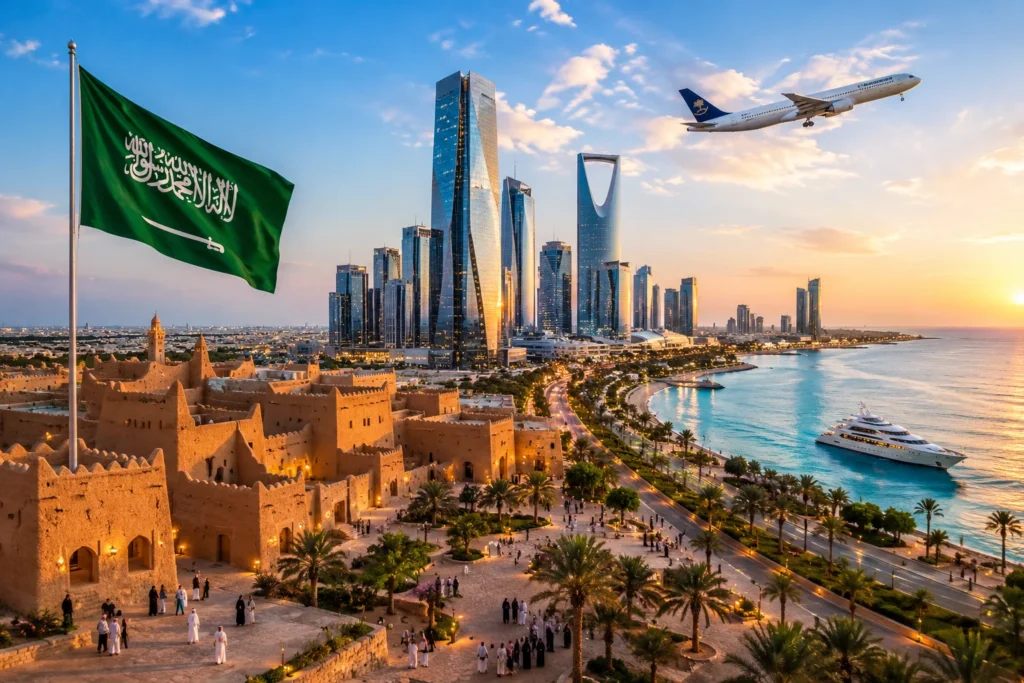
Air connectivity remains a foundational pillar of the Kingdom’s overarching tourism development model. In collaboration with national air carrier Saudia, the Saudi Tourism Authority has expanded direct global flights connecting major metropolitan transit hubs across Europe, North America, and East Asia directly to Saudi destinations.
The deployment of long-haul wide-body aircraft featuring specialized promotional branding serves to boost global awareness of the Kingdom’s diverse travel destinations. Official statements from Saudia and the Saudi Tourism Authority emphasize that expanded international flight capacity directly supports long-term target projections to welcome over 150 million combined annual visits by 2030.
Through targeted bilateral aviation agreements, international transit connections now facilitate direct access to regional airports including AlUla, Red Sea International Airport, and Dammam, alongside expanded capacities at King Abdulaziz International Airport in Jeddah and King Khalid International Airport in Riyadh.
Development of Strategic Giga-Projects and Heritage Sites
The transformation of Saudi Arabia’s physical tourism footprint is centered on large-scale sustainable giga-projects funded and managed through official national development funds.
The Red Sea Destination and Amaala
Developing multi-island ultra-luxury destinations focused on environmental conservation and marine preservation. The project operates using 100% renewable energy grids and strict ecological preservation protocols to offer zero-carbon hospitality experiences.
Diriyah Historical District
Restoring the birthplace of the Saudi state into an urban cultural landmark featuring world-class museums, traditional Najdi architecture, fine dining venues, and international hotel properties.
AlUla Cultural Heritage Zone
Preserving thousands of years of human history, ancient Nabataean architectural sites at Hegra, and natural desert landscapes through controlled, high-end cultural tourism initiatives.
NEOM and Sindalah Island
Constructing futuristic luxury destinations designed to integrate advanced smart technologies, sustainable urban architecture, and high-tech marine leisure facilities.
Enhancing Investment and Workforce Capabilities
To sustain long-term service quality and support international hotel brand expansion, the Ministry of Tourism has launched multi-faceted human capital development programs. Initiatives such as the Hospitality Ambassadors Program, developed in partnership with leading global hotel groups, focus on training thousands of Saudi citizens to fulfill specialized roles within the expanding tourism ecosystem.
Additionally, official investment frameworks presented by the Ministry of Tourism at international investor forums highlight significant investment pipelines open to global hotel developers, tour operators, and entertainment providers. Simplified licensing procedures, foreign investment incentives, and streamlined land acquisition protocols have established the Kingdom as one of the fastest-growing tourism development markets globally.
As Saudi Arabia continues to broaden its calendar of international sports tournaments, cultural festivals, and business conventions, the national tourism ecosystem remains focused on diversifying the economy, preserving natural heritage, and delivering authentic hospitality to travelers from around the globe.
For more travel news like this, keep reading Global Travel Wire