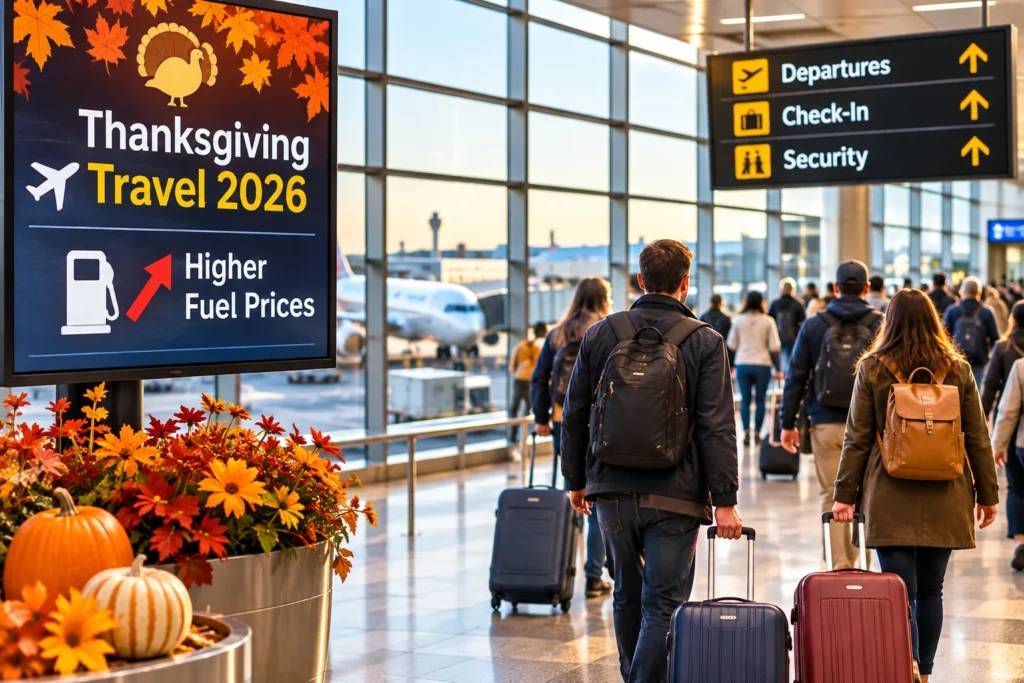
Elevated fuel expenses and higher transportation fares are prompting a modest pullback in United States holiday mobility this autumn, ending a three-year streak of record-breaking Thanksgiving travel volumes. According to official holiday travel projections released by AAA, 81.5 million Americans are expected to journey 50 miles or more from home during the seven-day Thanksgiving travel window running from Tuesday, November 24, through Monday, November 30, 2026.
The 2026 projection represents a slight 0.1% decrease compared with the 81.6 million travelers recorded during the corresponding period in 2025. While the numerical adjustment is marginal—leaving highways, airports, and cruise terminals operating near all-time peak capacity—it carries historical significance. Excluding the pandemic-disrupted travel season of 2020, this marks the first year-on-year decline in AAA’s Thanksgiving travel forecast since the 2008 economic recession, when comparable multi-day tracking methodologies are evaluated.
Breakdown by Mode of Transportation
Even with rising operating costs across the transport sector, nearly one-quarter of the United States population is still preparing to take a holiday trip. Official modal projections from AAA illustrate how travelers are adjusting their transportation choices in response to fuel prices and ticket costs:
Road trips continue to anchor domestic Thanksgiving mobility, accounting for nearly 90% of all holiday journeys. However, projected automobile volume dipped slightly from 73.1 million motorists in 2025 to 72.9 million in 2026 as drivers weigh higher pump prices against household budgets.
Record Thanksgiving Fuel Prices and Rising Airfares
Energy and aviation pricing data underscore why cost-conscious households have moderated their holiday plans. National fuel price tracking from AAA indicates that regular unleaded gasoline averaged $3.82 per gallon heading into the holiday period, up substantially from $3.08 per gallon a year earlier. Should current pump averages hold through the holiday weekend, motorists will encounter the highest Thanksgiving Day gasoline prices ever recorded by the organization, surpassing the previous holiday benchmark of $3.58 per gallon set in 2022.
Aviation travelers face similar cost pressures. Booking data compiled by AAA shows that round-trip domestic airfares for the Thanksgiving travel period average approximately $800 per ticket, representing a 17% increase over 2025 levels. As a result, domestic air passenger volume is forecast to ease slightly to 5.96 million flyers. Conversely, alternative surface and maritime travel—encompassing intercity buses, passenger rail, and ocean or river cruises—is projected to climb 4.1% to 2.6 million travelers, supported by strong demand for extended cruise vacations over the holiday week.
Top Domestic and International Thanksgiving Destinations
Despite modest headwinds from fuel and airfare costs, advance booking trends demonstrate resilient demand for warm-weather coastal hubs, theme park resorts, major sporting events, and European cultural itineraries.
Leading Domestic Hubs: Florida dominates domestic air and leisure rankings, with Orlando, Fort Lauderdale, and Miami securing the top three positions for Thanksgiving flights, driven by theme park attendance and Caribbean cruise departures. Detroit and Dallas also rank among the top ten domestic destinations as host cities for traditional Thanksgiving Day football fixtures. For car rental demand, advance reservation figures identify Orlando, Phoenix, Las Vegas, Atlanta, and Denver as the busiest pickup markets.
International Leisure Demand: Long-haul holiday bookings show strong interest in warm-weather Mexican beach resorts—led by Cancun and Puerto Vallarta—alongside European cultural capitals and seasonal holiday markets in London, Amsterdam, Rome, Munich, Basel, and Barcelona, as well as European river cruises across Hungary, Switzerland, and the Netherlands.
Peak Highway Congestion and Travel Timing Guidance
To capture modern holiday travel habits—where remote and flexible work arrangements encourage earlier departures and extended returns—AAA’s seven-day tracking window spans from the Tuesday before Thanksgiving through the following Monday. Transportation analytics data provided by INRIX indicates that road congestion will peak during afternoon and early evening hours on Tuesday, November 24, and Wednesday, November 25, as holiday travelers merge with regular weekday commuters.
Return traffic is expected to surge on Sunday, November 29, and Monday, November 30, particularly between early afternoon and early evening. Traffic analysts advise motorists to depart during morning hours prior to midday to avoid the sharpest delays, while Thursday, November 26, is projected to experience minimal highway congestion across major metropolitan corridors.
Overall, the Thanksgiving travel forecast 2026 highlights a remarkably resilient domestic and international tourism sector. While higher fuel and aviation expenses have marginally cooled three consecutive years of record expansion, total travel volume remains virtually level with historic highs as millions of households prioritize holiday gatherings and seasonal getaways.
For more travel news like this, keep reading Global Travel Wire