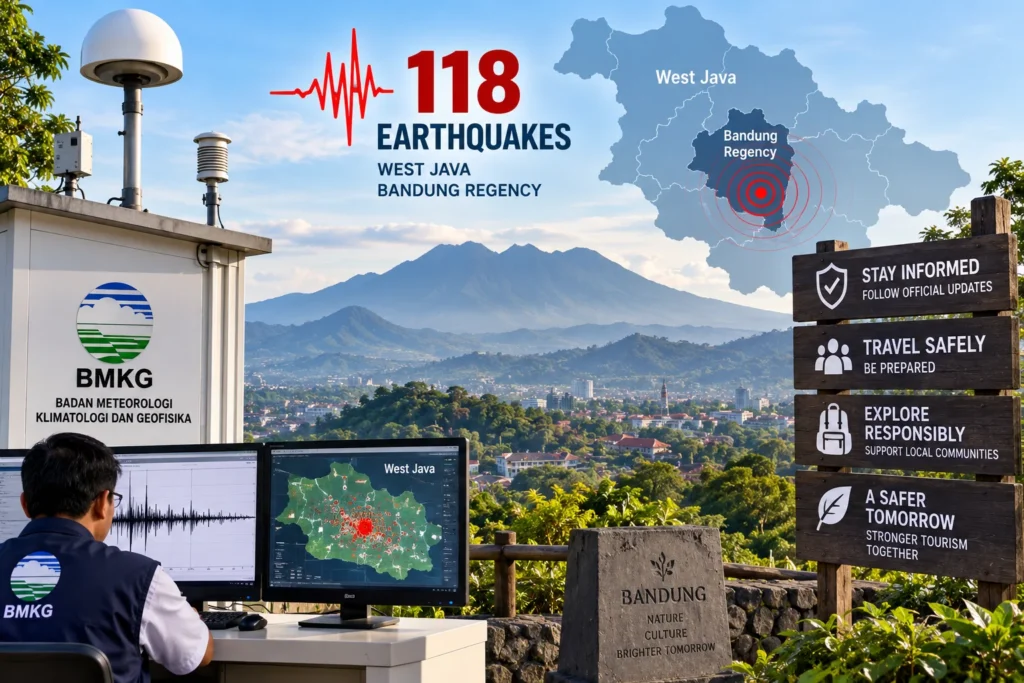
Indonesia’s national meteorological and geophysics authority, the Badan Meteorologi, Klimatologi, dan Geofisika, has recorded a sequence of 118 earthquakes across Bandung Regency over a five-week monitoring period. The sustained seismic cluster, tracked between mid-August and mid-September, has prompted tourism safety reviews and updated operational guidelines across the nature and adventure travel hubs of West Java.
While the vast majority of these low-magnitude tremors caused no structural damage, the concentration of shallow seismic activity near key eco-tourism districts—specifically Pangalengan, Talegong, and Cisewu—has placed local operators and disaster management agencies on heightened alert.
+------------------------+---------------------------------------+------------------------------------------+
| Regional Sector        | Seismic Impact & Fault Proximity      | Travel Safety Status & Visitor Guidance  |
+------------------------+---------------------------------------+------------------------------------------+
| Pangalengan Highland   | Epicenter cluster near Garsela Fault  | Attractions fully open; heightened       |
| Nature & Adventure Hub | segments; shallow depth (3-6 km)      | vigilance urged for outdoor activities   |
+------------------------+---------------------------------------+------------------------------------------+
| Cisewu & Talegong      | Low-magnitude felt tremors (MMI II-III)| Normal operations; local authorities     |
| Southern Border Zones  | associated with localized faulting    | monitor slope stability along roads      |
+------------------------+---------------------------------------+------------------------------------------+
| Bandung Municipality   | Located north of active seismic zone; | Unaffected urban sector; hotels, airport,|
| (Urban City Center)    | no felt shaking or disruption reported| and rail connections fully operational   |
+------------------------+---------------------------------------+------------------------------------------+
Localized Faulting Drives Shallow Seismic Activity in Southern Highlands
Official geophysics analysis indicates that the seismic cluster is driven by tectonic movement along unmapped local fault lines adjacent to the active Garsela Fault system. Data from 35 regional monitoring sensors confirm that the epicenters align along a southwest-to-northeast axis, positioned west of the Kendang segment and north of the Kencana segment.
The recorded events ranged between magnitudes M1.0 and M3.4, with hypocenters occurring at shallow depths of three to six kilometers. Due to this shallow origin, 13 of the 118 earthquakes produced noticeable shaking equivalent to Intensity II to III on the Modified Mercalli Intensity scale, describing vibrations felt indoors similar to the sensation of a passing heavy vehicle.
Geophysics officials emphasize that the phenomenon represents a localized earthquake swarm rather than a single major tectonic rupture. Because shallow micro-earthquakes can occur multiple times daily during swarm phases, continuous seismic monitoring remains active to evaluate ongoing crustal deformation.
Differentiating Urban Transit Centers from Rural Adventure Zones
To ensure smooth travel planning, official tourism statistics stress the importance of distinguishing between Bandung Municipality—the urban provincial capital—and Bandung Regency, the expansive rural administrative area where the seismic activity occurred.
Urban Infrastructure Unaffected: The city center of Bandung, including major international hotels, heritage sites, transit terminals, and commercial centers, remains completely unaffected by the localized tremors. Standard city tourism, conference facilities, and overland transport links operate without interruption.
Nature and Adventure Sectors Under Observation: The active seismic cluster directly overlaps with the southern highlands of Bandung Regency, a primary hub for West Java’s nature tourism. The district hosts over 6,500 registered tourism businesses and creative enterprises, supporting major outdoor attractions such as tea plantation estates, volcanic crater parks, crater lakes, and river rafting operations.
Official tourism performance data confirms high visitor mobility across the region, with domestic trips surpassing one million monthly arrivals during peak leisure periods. Local government bodies continue to balance economic continuity with visitor safety by issuing updated risk management protocols rather than enforcing general site closures.
Essential Travel Rules and Safety Guidelines for West Java Visitors
Travelers planning itineraries to the southern highlands of West Java should observe official travel rules and safety precautions:
Verify Official Information Outlets: Visitors should rely exclusively on verified updates issued by the national geophysics agency and the local disaster management office, ignoring unverified social media rumors regarding volcanic or seismic events.
Observe Outdoor Activity Precautions: Tourists participating in special-interest adventure activities—such as trekking, white-water rafting, or camping—should follow instructions from licensed guides and confirm that tour operators maintain clear emergency evacuation plans.
Monitor Accommodation Safety Protocols: Guests booking highland lodges, eco-resorts, or mountain homestays in Pangalengan or surrounding districts should familiarize themselves with emergency exits and designated open-air assembly points.
By staying informed through official government statements and maintaining standard safety precautions, domestic and international tourists can continue to explore West Java’s natural destinations safely.
Frequently Asked Questions
Are tourism destinations or hotels closed in Bandung due to the earthquakes?
No. Government authorities have not issued closure mandates for Bandung Regency or Bandung Municipality. Hotels, transportation links, and major tourist sites remain fully open and operational.
What is the difference between Bandung City and Bandung Regency regarding this seismic activity?
The earthquake swarm is concentrated exclusively in the southern rural regency around Pangalengan, whereas the urban city center of Bandung Municipality is located farther north and remains completely unaffected.
What precautions should adventure tourists take when visiting southern West Java?
Visitors engaging in hiking, camping, or rafting should use certified local guides, verify weather and seismic updates from official government channels, and ensure their accommodation facilities have clear emergency protocols.
For more travel news like this, keep reading Global Travel Wire