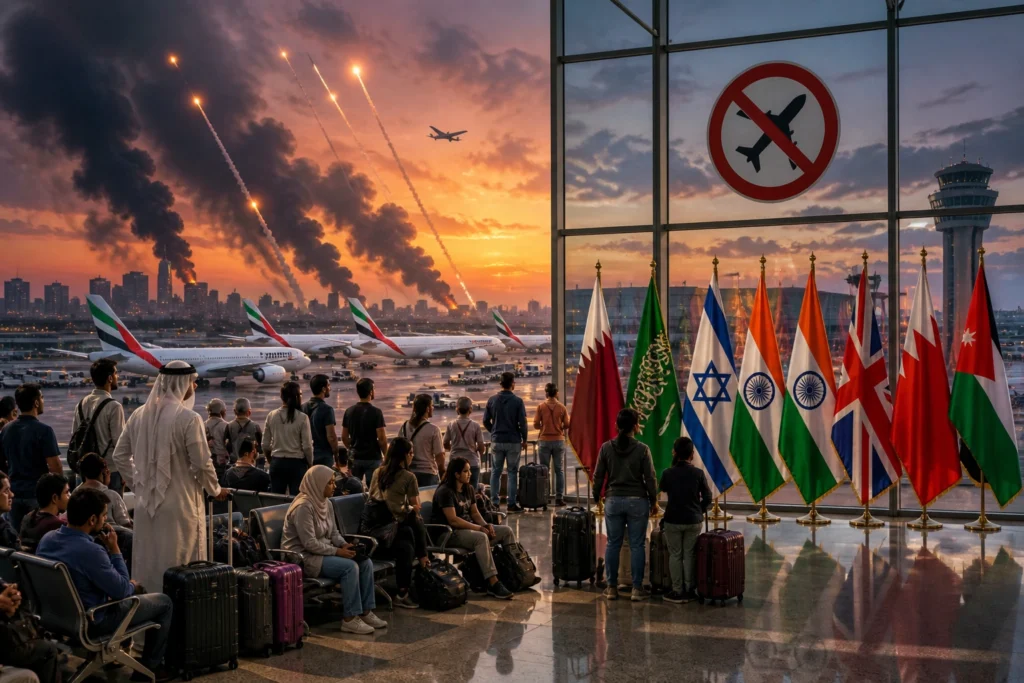
A sudden airspace shutdown in the United Arab Emirates has triggered a major global travel crisis, leaving thousands of passengers stranded and prompting urgent international collaboration among countries including Qatar, Saudi Arabia, India, the United Kingdom, Bahrain, Israel, and Jordan. The closure, effective from May 4 to May 11, 2026, has disrupted one of the world’s busiest aviation corridors, forcing airlines to reroute flights and suspend operations across key routes.
The unprecedented disruption comes amid escalating regional tensions and missile threats, significantly impacting global aviation, tourism flows, and passenger mobility across the Middle East.
UAE Airspace Closure Triggers Global Disruption
The UAE’s decision to restrict its Flight Information Region followed a series of missile and drone interceptions confirmed by national defense authorities. Hundreds of projectiles have been intercepted in recent weeks, raising serious safety concerns and prompting authorities to limit commercial air traffic.
Major airports in Dubai and Abu Dhabi have been overwhelmed, with stranded passengers facing delays, cancellations, and uncertain travel plans. Airlines have been forced to reroute flights through alternative corridors, increasing travel times and operational complexity.
The disruption has also affected global energy logistics, with key infrastructure sites targeted during recent strikes, further intensifying the crisis.
Qatar Leads Emergency Aviation Response
Qatar has emerged as a key player in the humanitarian and logistical response, mobilizing its national carrier to assist stranded passengers. Emergency flights have been arranged to transport travelers from the UAE to Doha, where temporary accommodations and support services have been established.
Qatar’s Ministry of Foreign Affairs has coordinated closely with international partners, providing medical assistance, housing, and logistical support for affected travelers. Special focus has been placed on assisting expatriate communities from Asia and other regions who rely heavily on Gulf transit hubs.
Saudi Arabia Expands Regional Support
Saudi Arabia has also played a central role, deploying its airline network to facilitate passenger movement across the region. Saudia has operated additional flights connecting stranded travelers to major Saudi cities, enabling onward travel to final destinations.
Emergency response teams have been established at airports across the Kingdom to assist passengers with transit arrangements, documentation, and accommodation. The Kingdom’s coordination with Gulf partners highlights the importance of regional cooperation during large-scale travel disruptions.
India and UK Prioritize Citizen Evacuations
India, with one of the largest expatriate populations in the UAE, has activated its diplomatic and aviation networks to evacuate stranded nationals. Air India and other carriers have coordinated repatriation flights, while consular teams provide on-ground assistance at airports and temporary shelters.
The United Kingdom has issued travel advisories and deployed diplomatic teams to support British citizens. Airlines have prioritized return flights, working alongside international partners to ensure safe passage for affected travelers.
These efforts underscore the critical role of government coordination in managing large-scale travel emergencies.
Israel, Bahrain, and Jordan Join Relief Efforts
Israel has contributed to humanitarian operations by facilitating alternative travel routes and providing medical support to affected individuals. Coordination with regional carriers has enabled the evacuation of foreign nationals despite complex geopolitical dynamics.
Bahrain’s Gulf Air has increased capacity to transport passengers through Manama, while Jordan has established task forces to assist its citizens and provide medical aid. These efforts have helped alleviate pressure on UAE airports and ensure continuity of travel for thousands.
Global Aviation Faces Ripple Effects
The UAE airspace closure has had far-reaching implications for global aviation. Airlines worldwide are adjusting schedules, rerouting flights, and managing increased operational costs. Key transit routes between Europe, Asia, and Africa have been disrupted, affecting both passenger and cargo operations.
Tourism sectors across the region are also feeling the impact, with cancellations and reduced bookings affecting hotels, tour operators, and local businesses. The crisis highlights the vulnerability of global travel networks to geopolitical disruptions.
Humanitarian and Industry Response Intensifies
International organizations and governments have stepped in to provide additional support, including temporary shelters, food distribution, and psychological assistance for affected travelers. Relief efforts are focused on ensuring safety, comfort, and timely repatriation.
The collaboration between countries demonstrates a unified approach to crisis management, prioritizing passenger welfare despite ongoing geopolitical challenges.
A Defining Moment for Global Travel Coordination
The UAE airspace closure crisis represents a critical test for international aviation and tourism systems. The rapid response from multiple nations highlights the importance of cooperation in maintaining global mobility during emergencies.
As the situation continues to evolve, airlines, governments, and tourism stakeholders are working to restore stability and minimize disruption. The lessons learned from this crisis are expected to shape future contingency planning and strengthen resilience across the global travel industry.
For now, the focus remains on ensuring the safe movement of passengers and maintaining essential connectivity in one of the world’s most strategically important travel regions.
For more travel news like this, keep reading Global Travel Wire