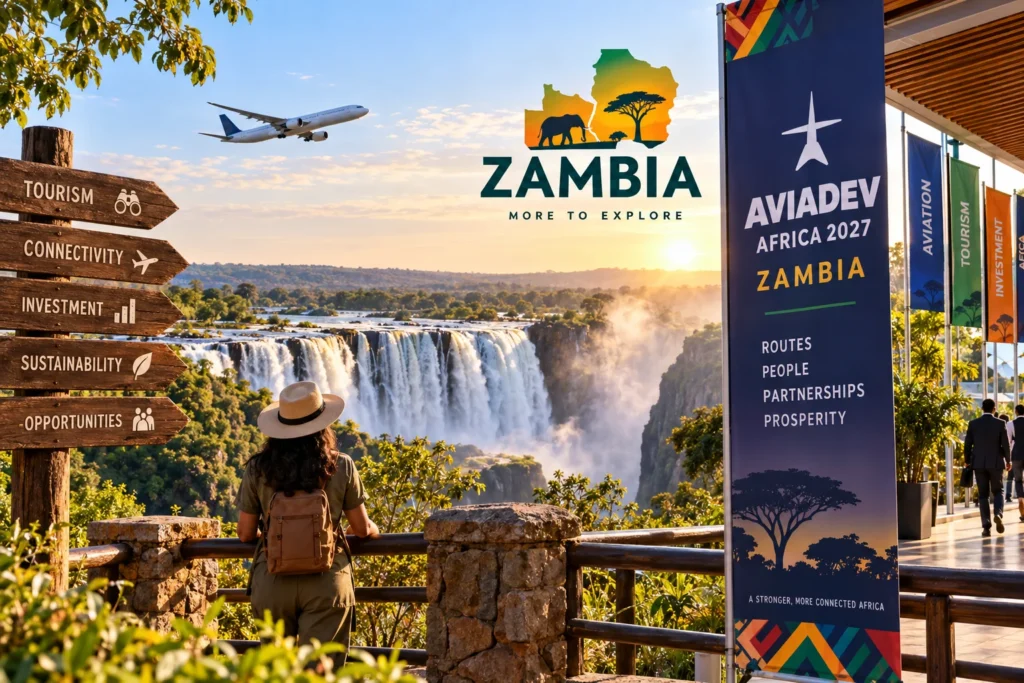
Zambia has been officially confirmed as the host country for AviaDev Africa 2027, marking a pivotal development in the nation’s strategic campaign to expand international air access and build a premier Southern African travel gateway. Scheduled to take place at the Lusaka International Convention Centre from June 9 to 11, 2027, the landmark conference will gather airlines, airport operators, civil aviation authorities, and tourism development boards from across the globe. The gathering focuses on formulating new route development strategies, optimizing regional flight networks, and driving intra-African connectivity.
The selection of Zambia by event organizers reflects the country’s accelerating momentum across both civil aviation and leisure travel sectors. Working in direct partnership with Zambia Airports Corporation Limited as the official host entity, public authorities are leveraging the event to position the landlinked nation as an accessible hub for international visitors and commercial air traffic.
Airlift Zambia Initiative Drives Air Route Expansion
The hosting confirmation aligns directly with the official rollout of the Airlift Zambia Initiative, a coordinated inter-agency strategy designed to address regional air connectivity gaps and attract new international carriers. By uniting government ministries, civil aviation regulators, and private hospitality stakeholders, the initiative seeks to establish non-stop passenger and cargo flights connecting Zambia directly to major continental and global markets.
Recent expansion by international and regional carriers underscores growing commercial confidence in the Zambian market. Scheduled passenger operations have expanded through added frequencies and new routes served by Qatar Airways, Uganda Airlines, Fastjet Zimbabwe, and Eswatini Air. Simultaneously, home-grown operator Proflight Zambia has broadened its regional route network. The carrier has introduced direct connections linking Kenneth Kaunda International Airport in Lusaka and Harry Mwaanga Nkumbula International Airport in Livingstone to key regional destinations, including Windhoek in Namibia and Gaborone in Botswana.
This expanded route network enables international travelers to combine professional engagements in urban centers with multi-day safari itineraries across the country’s natural reserves. Visitors entering through Lusaka can access iconic attractions, including the UNESCO World Heritage site at Victoria Falls, walking safaris in South Luangwa National Park, water-based game viewing along the Lower Zambezi, and expansive wilderness experiences across Kafue National Park.
National Budget Allocates Strategic Funding for Tourism Infrastructure
To reinforce this structural expansion, official national budget allocations demonstrate strong government backing for sector-wide development. Under national budgetary frameworks, public funding committed to the tourism sector has reached K1.5 billion. This financial commitment supports multi-faceted development priorities, including destination marketing, wildlife conservation programs, heritage protection, and critical infrastructure upgrades across key tourism circuits.
In parallel, targeted capital outlays exceeding K1.1 billion have been assigned to upgrade and modernize provincial airport facilities nationwide. By improving runway infrastructure, terminal facilities, and navigation technologies at secondary airfields, government planners aim to improve regional dispersal, allowing tourists to fly seamlessly into remote wildlife corridors and eco-tourism regions.
These public investments support defined growth projections set by the Ministry of Economy and the Ministry of Tourism. Following a strong recovery in international visitor volumes—which expanded from 1.1 million arrivals in 2022 to 2.3 million—official targets aim to welcome between 2.5 million and 3 million international visitors annually. Over the longer term, the government’s strategic plan aims to establish a US$1 billion annual tourism economy by 2031, positioning the sector as a main pillar of national economic diversification and job creation.
Upgraded Gateway Infrastructure Positioned to Capture Global Demand
Zambia’s main international gateways—comprising Kenneth Kaunda International Airport in Lusaka, Harry Mwaanga Nkumbula International Airport in Livingstone, Simon Mwansa Kapwepwe International Airport in Ndola, and Mfuwe Airport—are central to achieving these long-term target metrics. Modernized terminal spaces and increased apron capacities across these facilities provide the operational foundation necessary to accommodate additional long-haul and regional aircraft.
As preparations proceed for AviaDev Africa 2027, government agencies and airport operators are expanding bilateral air service negotiations with prospective airline partners. By bringing together top-level aviation executives, route planners, and tourism authority directors in Lusaka, the nation aims to secure sustainable flight routes that lower travel times and costs for international tourists.
Through a combination of targeted infrastructure funding, structured policy frameworks, and proactive air access partnerships, Zambia is strengthening its position within the international travel market. Hosting major aviation forums serves as both an operational platform for route network development and a showcase for the country’s natural leisure assets.
For more travel news like this, keep reading Global Travel Wire