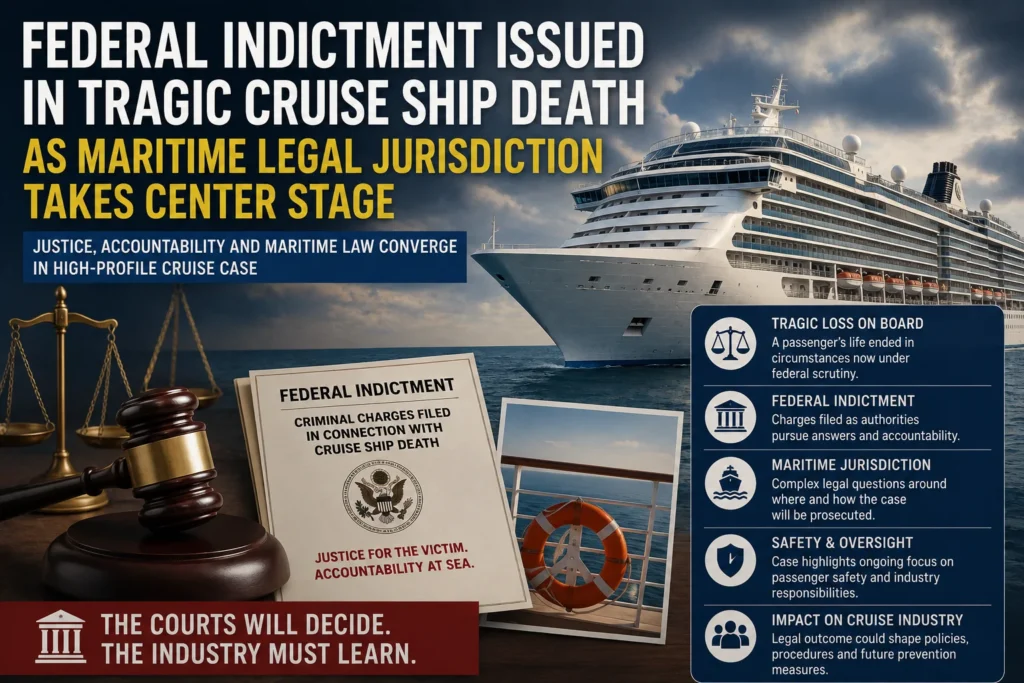
Federal prosecutors with the U.S. Attorney’s Office for the Southern District of Florida have formally unsealed a grand jury indictment charging a 16-year-old minor as an adult with first-degree murder and aggravated sexual abuse. The criminal charges stem from the death of 18-year-old Florida resident Anna Kepner, who was found deceased aboard the Carnival Horizon passenger vessel during an international Caribbean itinerary.
The incident occurred while the vessel was navigating in international waters en route to PortMiami. According to official federal court filings and statements released by the U.S. Department of Justice, medical examiners with the Miami-Dade County Medical Examiner’s Office determined the cause of death to be mechanical asphyxiation, ruling the case a homicide.
Federal law enforcement authorities, led by the Federal Bureau of Investigation (FBI) Miami Field Office, assumed immediate primary investigative jurisdiction over the maritime vessel upon its return to port.
Federal Maritime Jurisdiction and the Special Maritime and Territorial Jurisdiction Framework
Because the reported offenses occurred while the passenger vessel was navigating in international waters beyond state territorial borders, federal statutory frameworks govern the criminal prosecution. Under Title 18 of the United States Code, federal courts maintain criminal jurisdiction over crimes committed aboard U.S.-owned or U.S.-bound vessels operating within the Special Maritime and Territorial Jurisdiction of the United States.
Legal proceedings were initially handled through sealed juvenile court filings. However, following a judicial determination transferring the matter for adult prosecution under federal statutory guidelines, the indictment was formally unsealed in U.S. District Court.
Key statutory and jurisdictional elements shaping federal proceedings include:
Primary Investigative Authority: FBI Miami Field Office leads federal investigations involving serious crimes on international passenger ships bound for U.S. ports.
Statutory Framework: Federal grand jury indictment under 18 U.S.C. sections covering first-degree murder and aggravated sexual abuse within maritime boundaries.
Adult Transfer Order: District Court judicial transfer from juvenile proceedings to adult status under federal criminal procedure.
Penalties: Maximum statutory penalties for the unsealed charges include up to life imprisonment under federal sentencing guidelines.
Statutory Safety Requirements and Cruise Industry Governance
The criminal prosecution highlights the statutory security mandates governing commercial passenger ships operating out of United States ports. Under federal laws—including the Cruise Vessel Security and Safety Act (CVSSA)—commercial cruise lines operating in U.S. commerce must comply with mandatory crime reporting, security infrastructure, and evidence collection standards.
Mandatory security provisions mandated by federal cruise safety statutes include:
Mandatory Crime Reporting: Immediate reporting obligations to the FBI and the United States Coast Guard for serious crimes, missing persons, or suspicious deaths occurring in international waters.
Onboard Surveillance Standards: Mandated video surveillance coverage across passenger areas to assist federal law enforcement investigations.
Emergency Medical and Forensics Protocols: Requirements for trained medical staff, sexual assault forensic examination kits, and secure evidence storage capabilities aboard registered vessels.
Cooperation with Law Enforcement: Mandatory preservation of crime scenes and immediate vessel access for federal forensic teams upon arrival at U.S. ports of entry.
Federal prosecutors emphasized in public statements that all defendants remain presumed innocent unless and until proven guilty beyond a reasonable doubt in a court of law. Formal pre-trial hearings and proceedings remain pending within the U.S. District Court for the Southern District of Florida.
Federal Maritime Legal Case Summary
| Legal Parameter | Official Case Details |
| Jurisdiction | U.S. District Court, Southern District of Florida |
| Investigating Agency | Federal Bureau of Investigation (FBI) Miami Field Office |
| Primary Statutory Charges | First-Degree Murder, Aggravated Sexual Abuse |
| Governing Maritime Law | Special Maritime and Territorial Jurisdiction (18 U.S.C.) |
| Maximum Statutory Penalty | Life Imprisonment |
Frequently Asked Questions
Which agency has jurisdiction over crimes committed on cruise ships in international waters?
The Federal Bureau of Investigation (FBI) holds primary federal jurisdiction to investigate major crimes committed against or by U.S. citizens on passenger ships operating in international waters that depart from or arrive at U.S. ports.
What is the Cruise Vessel Security and Safety Act (CVSSA)?
The CVSSA is a federal law that regulates cruise ship security, requiring passenger vessels calling on U.S. ports to maintain video surveillance, implement strict crime-reporting protocols to federal authorities, and maintain forensic medical capabilities onboard.
Why are certain juvenile offenses transferred to adult federal court?
Under federal law, minor defendants charged with severe violent felonies—such as first-degree murder—can be transferred from juvenile status to adult federal prosecution following a judicial review of the charges, statutory factors, and severity of the alleged offense.
For more travel news like this, keep reading Global Travel Wire