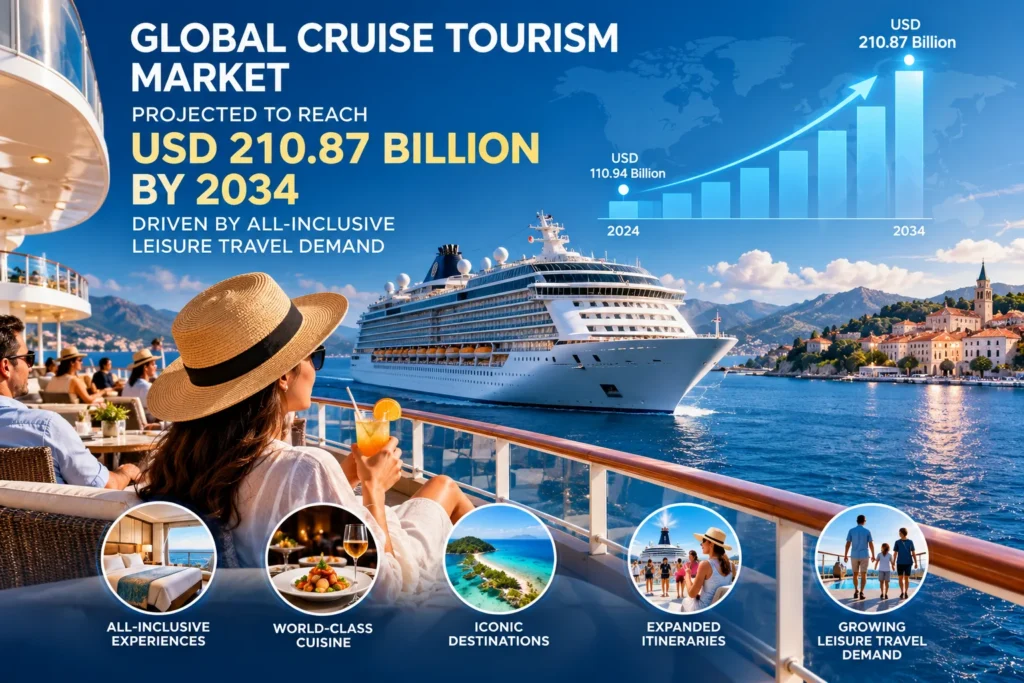
GENEVA — The global cruise tourism market is entering a strong growth phase, with its market valuation projected to climb from USD 97.66 billion in 2026 to USD 210.87 billion by 2034. According to official industry statistical frameworks, the sector is expanding at a Compound Annual Growth Rate (CAGR) of 10.10 per cent during the 2026–2034 forecast period, reflecting robust global demand for experiential maritime leisure travel.
The market previously reached a valuation of USD 88.70 billion in 2025, laying a strong baseline for long-term expansion across major ocean and river corridors globally. Regional trade statistics reveal that North America maintained its market dominance, capturing a 36.8 per cent market share in 2025. This market strength is supported by high consumer spending on leisure travel, established port infrastructure, and proximity to popular Caribbean and Alaskan sailing routes.
Standardized Trade Classifications and Industry Frameworks
Official economic tracking categorizes passenger vessel maritime activity under standardized international trade codes to monitor cross-border service flows and vessel procurement. Cruise ship construction, vessel leasing, and passenger transport operations fall under Harmonized System of Nomenclature (HSN) Code 8901, which covers cruise ships, excursion boats, and similar vessels designed for passenger transport.
On a industrial classification level, commercial marine passenger operations are tracked under Standard Industrial Classification (SIC) Code 4481, which governs deep-sea transportation of passengers (excluding ferry services).
These statistical definitions allow international transport authorities and economic monitoring bodies to accurately evaluate capital expenditures, port revenue generation, and global service trade volume generated by commercial passenger fleets.
Primary Drivers Shaping Global Market Expansion
The accelerated trajectory of the cruise sector is anchored in evolving consumer preferences toward hassle-free, multi-destination vacations. Several key industry drivers are maintaining strong passenger momentum across key international markets:
Demand for All-Inclusive Vacation Packages: Travelers are increasingly favoring consolidated travel arrangements where accommodation, fine dining, entertainment, and inter-destination transit are bundled into a single predictable cost.
Interest in Multi-Destination Itineraries: The ability to visit multiple coastal cities, islands, and historical ports in a single journey without repetitive logistics or hotel transfers remains a primary value proposition for passengers.
Expansion of Experiential and Themed Voyages: Cruise operators are expanding specialized sailings focused on wellness, culinary arts, music, eco-tourism, and educational expeditions to appeal to broader traveler demographics.
Enhancements in Onboard Amenities and Customization: Modern passenger vessels feature upgraded amenities, including smart-cabin technology, private balcony suites, luxury spa facilities, and personalized onshore excursion planning.
Regional Market Share and Growth Dynamics
While North America holds the largest overall share of passenger volume and industry revenue, secondary regions are witnessing accelerated infrastructure development. Tourism ministries across the Asia-Pacific, Latin America, and Middle East regions are actively funding deep-water port expansions and modern passenger terminal developments to accommodate larger multi-deck vessels.
Governments are increasingly viewing cruise terminal infrastructure as a key economic catalyst that generates localized spending in coastal hospitality, food supply chains, ground transportation, and local heritage tourism.
As the sector expands toward its projected USD 210.87 billion footprint by 2034, industry growth will depend on continuous investments in sustainable marine propulsion, digital passenger check-in frameworks, and expanded port handling capacity across both established and emerging maritime routes.
For more travel news like this, keep reading Global Travel Wire