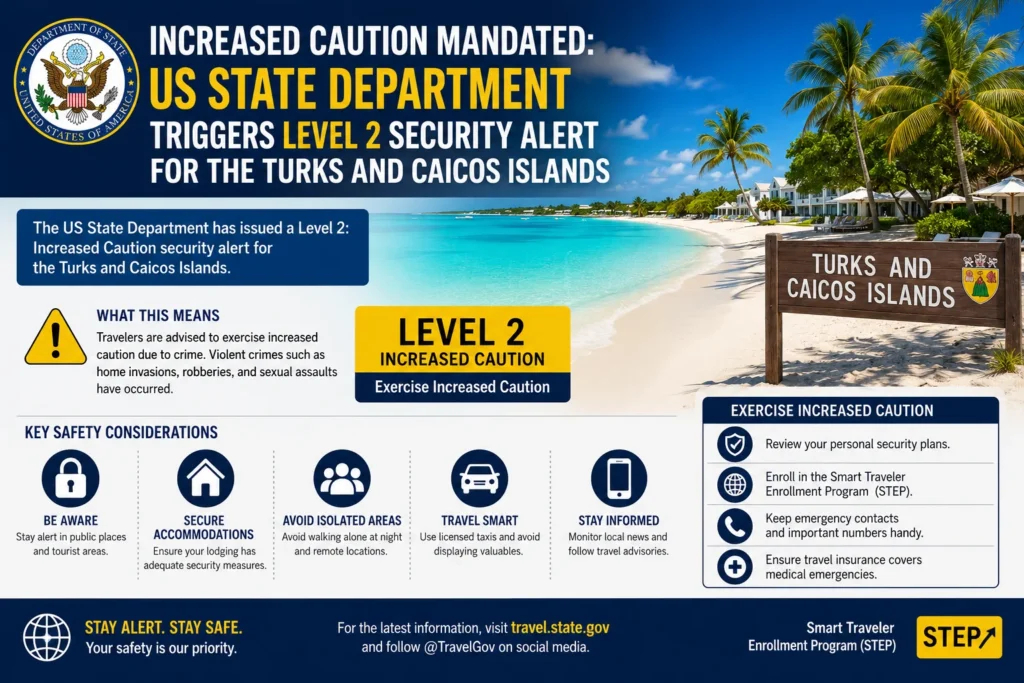
The administrative framework governing international leisure travel experienced a major shift when the United States Department of State officially modified its public security registry for the Caribbean. Bureaucrats in Washington updated the standard baseline clearance for the Turks and Caicos Islands, maintaining the territory under a designated Level 2 travel warning. This formal adjustment moves the pristine territory away from routine observation, placing it under a category that explicitly demands arriving citizens exercise increased caution throughout their stay. According to official regional data, this decisive policy update stems directly from a documented rise in local criminal incidents. Security experts monitoring regional statistics noted that a surge in crime data required an assertive administrative response to protect arriving passengers. This policy update matches similar security evaluations rolled out across other major vacation corridors, following parallel shifts that placed other popular tropical destinations under similar high-vigilance boundaries. Targeted Risks and Geographic Concentrations of Evolving CrimeThe adjustment to the public security registry was enacted by officials to address evolving risks in the region. By keeping the Turks and Caicos Islands at Level 2, the Department of State signals that the environment requires a higher degree of situational awareness than previously mandated. Government reports indicate that this policy update is a direct response to crime data concentrated in Providenciales, commonly known as Provo. As the central hub for major resorts and luxury travel, Provo has seen a spike in opportunistic incidents that necessitated a formal administrative response. While the vast majority of visits remain trouble-free, safety monitors highlight that petty theft, pickpocketing, purse snatching, and localized scams are becoming increasingly common in high-traffic tourist areas. Furthermore, international security updates have included explicit warnings regarding more severe safety threats, including documented reports of sexual assault within certain entertainment and nightlife districts. Tourists are also cautioned to remain highly aware of aggressive vendors in popular shopping areas. Some operators utilize predatory tactics, offering seemingly complimentary items that quickly transition into aggressive demands for cash payments, sometimes escalating to intimidation when visitors attempt to leave without paying. Strict Local Statutes and Severe Legal Risks for TouristsBeyond standard street crime, the updated government guidance places an extraordinary amount of emphasis on the territory’s rigid local laws regarding weaponry. The Turks and Caicos Islands, operating as a British Overseas Territory, enforces absolute zero-tolerance regulations against firearms and ammunition. International passengers who accidentally leave spent cartridges, loose bullets, or hunting components in their luggage face immediate arrest, severe detention periods, and mandatory minimum prison sentences of twelve years. Official statements from the consular bureau clarify that firearm licenses or permits obtained in the United States or any other home country carry no legal validity within the islands. Travelers are strongly urged to meticulously audit all checked baggage, carry-on bags, and clothing pockets prior to departure from their home ports, preferably utilizing entirely different travel bags than those used for domestic sporting or hunting activities. Operational Limitations and Remote Consular InfrastructureThe federal reclassification introduces a layer of deep hesitation for travelers mapping out regional itineraries. Cruise passengers booking voyages through major commercial liners are finding that their standard shore excursions now require a significant boost in situational awareness. Travelers note that navigating busy retail spaces or stepping onto local public transport requires moving past a casual vacation mindset to actively guard personal property from opportunistic theft. Furthermore, the structural reality of emergency support on the islands introduces an extra logistical challenge for visitors. Because the territory lacks a dedicated, standalone United States Embassy on its own soil, any citizen facing a legal or medical emergency must rely on remote assistance coordinated through the embassy in Nassau, The Bahamas. This geographic gap means that if a tourist falls victim to a financial scam, aggressive street vendors, or a medical crisis, securing immediate consular support involves complex, cross-border coordination that can disrupt holiday timelines. Local Enforcement Responses and Precautionary Travel StrategiesThe shift toward stricter travel warnings presents a complex challenge for cruise line executives and international resort developers, given how heavily the regional economy depends on its reputation for safety. In response to these growing concerns, local authorities in the Turks and Caicos Islands are actively increasing the visibility of security personnel to maintain tourist confidence. Specialized tourist police units have been deployed to popular beaches and entertainment zones, tasked with countering illicit activity and protecting international arrivals. For individuals proceeding with travel plans to the region, safety experts emphasize the necessity of strategic preparation. Travelers are strongly encouraged to register their itineraries through the free Smart Traveler Enrollment Program. This service links traveler data directly with regional consulates, providing instant notifications if security conditions change and allowing authorities to establish contact in an emergency. Additionally, visitors should monitor official public health platforms for real-time health notifications and secure comprehensive travel insurance that explicitly covers emergency medical evacuation. By balancing open exploration with informed caution, international travelers can effectively navigate the evolving security landscape of tropical tourism.
For more travel news like this, keep reading Global Travel Wire