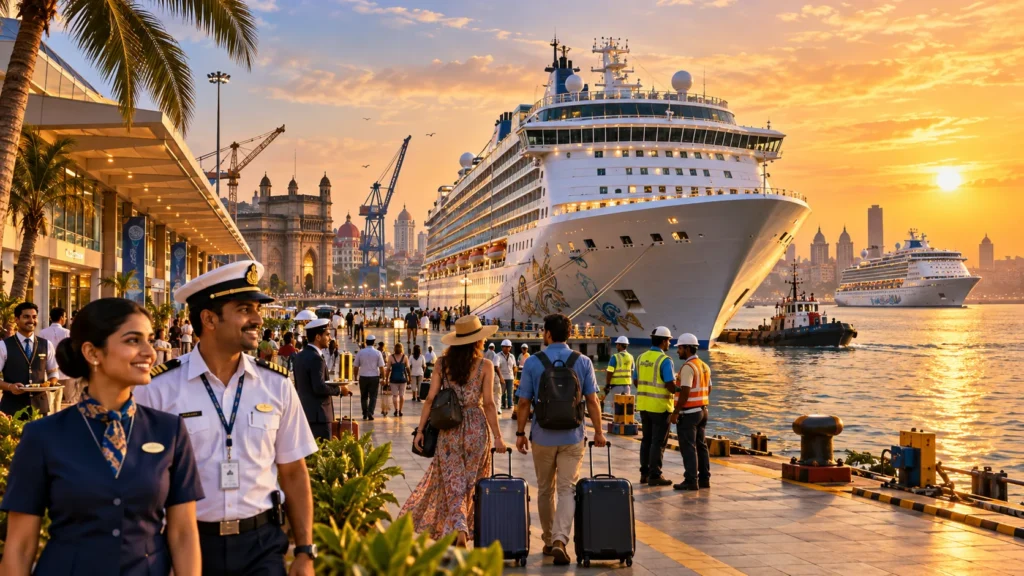
The momentum surrounding India cruise tourism has reached a decisive turning point as domestic passenger lines expand fleet capacities, commission larger modern vessels, and lay out long-term employment pathways along the nation’s extensive coastline. Following official operational announcements regarding fleet modernization and passenger network enhancements, maritime travel is steadily evolving from an emerging holiday concept into a cornerstone of coastal economic development. With thousands of kilometers of coastline and strategic access to the Arabian Sea, the Indian Ocean, and the Bay of Bengal, maritime tourism authorities and private operators are coordinating efforts to unlock commercial and leisure seafaring potential.
Central to this operational milestone is the entry of Cordelia Sky, a major addition to the domestic cruise inventory that significantly elevates passenger carrying capacity. Transitioning from initial single-ship operations to a multi-vessel fleet, the new ocean liner delivers a notable technological and structural upgrade over earlier vessels such as Cordelia Empress. Configured with approximately one thousand passenger cabins alongside an expanded proportion of private balcony staterooms and premium suites, the vessel features enhanced culinary venues, diverse entertainment lounges, and faster cruising speeds designed to expand regional coastal itineraries.
Expanding Maritime Employment and Domestic Skill Development
A primary pillar of the domestic cruise expansion lies in large-scale employment generation and skill development within the Indian maritime and hospitality sectors. Operating as a homegrown commercial cruise line that generates domestic revenue and contributes to local tax frameworks, the operator currently employs roughly two thousand five hundred personnel across shipboard operations and shore-side logistical facilities.
Long-term workforce targets released by corporate leadership project a ten-fold increase in direct employment, aiming to reach twenty-five thousand direct positions alongside approximately two hundred thousand indirect jobs across the wider economic ecosystem. This recruitment strategy emphasizes youth employment, absorbing graduates from domestic hospitality academies, culinary institutes, marine engineering colleges, and technical universities.
Beyond entry-level hospitality positions, structured maritime training initiatives are preparing Indian seafarers for executive deck and technical roles, including ship captains and chief engineers. Dedicated programs are actively training aspiring female maritime officers, supporting gender inclusion across leadership ranks within the commercial merchant fleet. The resulting workforce expansion bolsters coastal communities, port towns, and regional service vendors who supply provisioning, ground transport, and terminal operations.
Environmental Safeguards and Sustainable Maritime Operations
As cruise volumes scale across Indian territorial waters, rigorous ecological compliance and resource management remain essential operational priorities. State maritime directorates and environmental protection boards enforce comprehensive guidelines governing open-water discharges, waste processing, and port emissions.
In alignment with public environmental mandates, the newly introduced vessel operates under an absolute zero-discharge protocol into marine environments. Onboard environmental management systems include advanced reverse-osmosis desalination plants capable of producing fresh water directly from sea intake, substantially curbing reliance on municipal shore supplies. Comprehensive recycling facilities, strict waste sorting procedures, and coordinated efforts to phase out single-use plastics ensure that non-biodegradable waste is securely processed onboard or transferred to certified terrestrial waste management facilities upon docking.
Addressing operational safety and vessel life cycles, maritime safety authorities emphasize that regular technical maintenance, mandatory dry-dock refurbishments, and continuous safety audits govern seaworthiness. Routine modernizations of navigation technology, engine rooms, and life-safety systems ensure that established passenger liners adhere strictly to international safety benchmarks.
Navigating Regional Passenger Preferences and Seasonal Waters
India represents a culturally vibrant, multi-regional travel market where vacation habits vary considerably by geography and festival season. Sourcing travelers from major metropolitan and interior hubs such as Maharashtra, Rajasthan, Kolkata, and the southern states, operators have tailored dining, entertainment, and voyage lengths to local preferences.
Mumbai serves as a foundational homeport, offering the distinct geographic advantage of seamless highway and rail connectivity that enables residents across western India to embark without domestic air transfers. With nearly ninety percent of current passengers taking their first-ever cruise vacation, short two- to three-night weekend voyages serve as introductory experiences. Once familiar with ocean travel, passengers increasingly transition to longer itineraries, supported by specialized loyalty programs designed to build repeat holiday habits.
Operational planning in Indian waters requires sophisticated meteorological monitoring. Maritime operations utilize predictive forecasting software to manage seasonal weather patterns, monsoonal sea states, and maritime heatwaves. Onboard climate-control systems are engineered to counter high ambient summer temperatures, maintaining passenger comfort across changing sea conditions.
Policy Frameworks and Long-Term Regulatory Balance
The future expansion of India’s cruise landscape depends on transparent fiscal and regulatory policies. Industry representatives and transport analysts observe that domestic and foreign-flagged cruise lines operate under distinct regulatory realities, particularly regarding corporate taxation, cross-border payments, and foreign currency expenses tied to fuel, vessel insurance, and specialized equipment.
Domestic operators continue to advocate for a balanced, equitable fiscal environment that recognizes local capital investment, domestic job creation, and tax contributions. By addressing compliance hurdles and encouraging fair competition among all market participants, public policymakers can accelerate private investment, expand terminal facilities across secondary ports, and position the subcontinent as a leading destination for global and regional maritime tourism.
For more travel news like this, keep reading Global Travel Wire