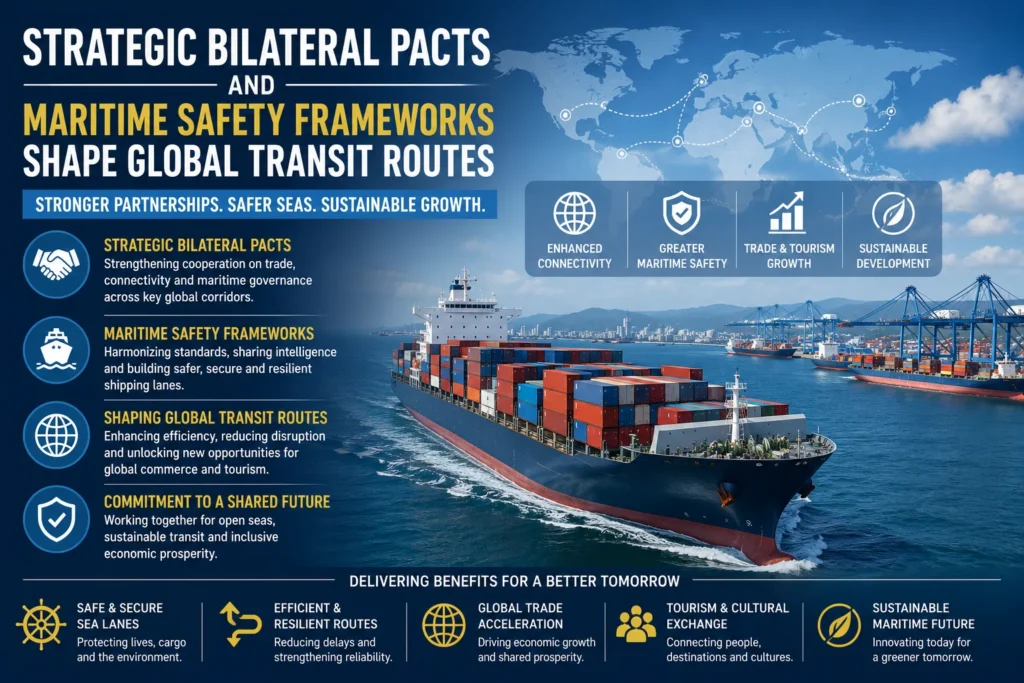
The evolution of international security agreements and regional defense frameworks continues to influence global maritime transit networks, commercial shipping lanes, and maritime travel safety protocols. Official government statements and diplomatic releases from major global powers highlight a shifting regulatory environment across critical waterways, including the Strait of Hormuz, the Caspian Sea, and adjacent trade corridors.
As national governments negotiate multi-decade strategic partnerships, public civil aviation and maritime authorities are actively updating compliance frameworks to ensure the safety, predictability, and uninterrupted operation of commercial passenger and cargo travel.
Bilateral Accords and Regional Transit Dynamics
Official state communications confirm the entry into force of the Comprehensive Strategic Partnership Treaty between the Russian Federation and the Islamic Republic of Iran. The bilateral agreement establishes a formal framework for long-term cooperation across economic, technological, energy, and defense sectors, while emphasizing regional stability across Eurasian transit routes.
| Policy Domain | Strategic Objective | Maritime & Travel Implications |
| Bilateral Security Accords | Formalized military-technical and technological cooperation | Enhanced security oversight along Caspian and Persian Gulf routes |
| Caspian Sea Protections | Preservation of regional waters exclusively for littoral states | Streamlined commercial shipping and localized passenger ferry transit |
| Maritime Advisory Standards | Adherence to international maritime safety and navigation rules | Updated insurance, routing, and transit compliance for commercial vessels |
Public declarations from official diplomatic channels emphasize that the treaty reinforces sovereign equality, economic integration, and regional coordination. At the same time, international regulatory bodies and global transport departments continue to issue guidance to ensure commercial vessels and passenger liners adhere to verified maritime safety protocols when navigating high-density maritime corridors.
Safeguarding Maritime Travel and Infrastructure
Maintaining robust maritime travel safety remains a primary objective for international transport ministries, port authorities, and global travel operators. In response to shifting regional dynamics, national maritime safety agencies have reinforced standard operating procedures for commercial vessels operating in international waters.
Primary compliance and risk mitigation guidelines include:
Real-Time Automated Tracking: Strict adherence to Automatic Identification System (AIS) transponder protocols to maintain clear operational visibility for commercial passenger and cargo ships.
Enhanced Navigation Advisories: Regular updates from international maritime organizations regarding designated transit lanes, routine naval exercises, and environmental hazards.
Infrastructure Security Frameworks: Coordinated international monitoring to safeguard civilian port facilities, energy terminals, and commercial transit hubs from potential operational disruptions.
Supporting Resilient Global Travel Infrastructure
The intersection of international diplomacy, defense policy, and global transport underlines the necessity of transparent regulatory frameworks. While sovereign states pursue bilateral strategic objectives, international civil aviation bodies and global maritime registries remain focused on preserving open, safe, and reliable transit for international travel.
By aligning commercial routing with verified government advisories and international maritime law, global transport operators continue to navigate evolving regional dynamics while maintaining high safety standards across international passenger and freight networks.
For more travel news like this, keep reading Global Travel Wire