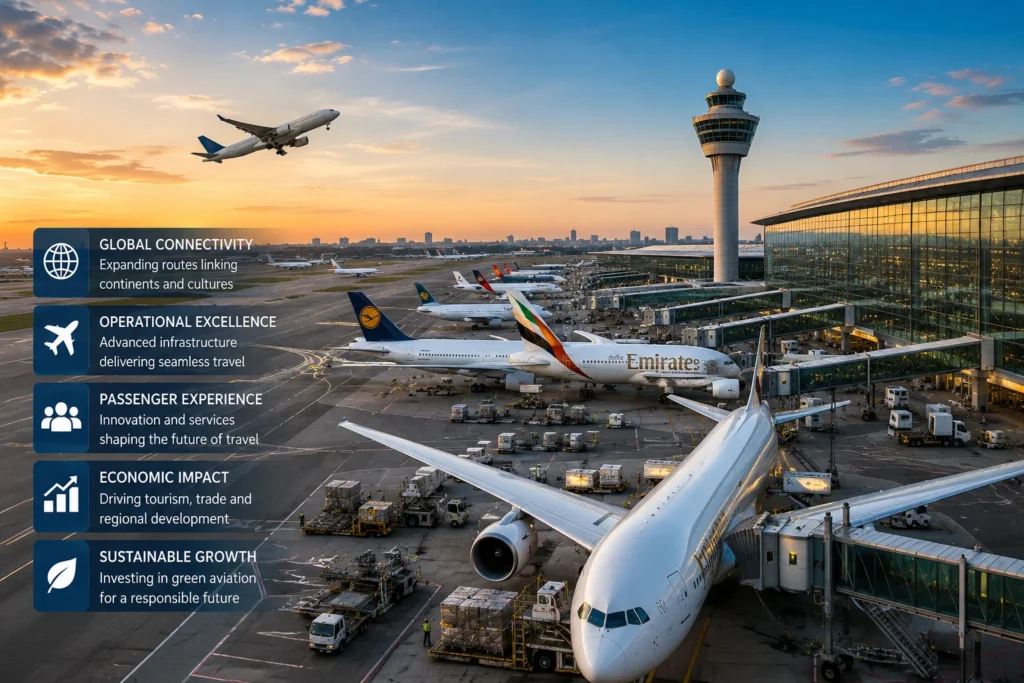
Civil aviation statistics highlight the dynamic balance between global cross-border passenger flows and massive domestic transit infrastructure. Official flight capacity tracking confirms that Dubai International Airport retains its position as the premier international gateway worldwide, while Hartsfield-Jackson Atlanta International Airport maintains its standing as the busiest airport hub overall when evaluating combined domestic and international seat capacity.
The operational figures demonstrate how strategic geographic positioning, long-haul airline route expansion, and regional domestic travel networks dictate global passenger movements across major international transit nodes.
Dubai Secures International Gateway Leadership
Dubai International Airport leads all global travel hubs in scheduled international seat capacity, offering four point three four million departing international seats during the monthly operational period. This capacity corresponds to approximately eight point six eight million total seats scheduled across arriving and departing international flights.
Despite regional operational adjustments, the airport’s robust long-haul connectivity continues to support high passenger volume across major continents.
Key operational performance figures for international travel hubs include:
Dubai International Airport: Retains the world’s top international ranking with four point three four million scheduled departing international seats.
London Heathrow Airport: Ranks second globally with four point zero seven million international seats, serving as a primary Atlantic transit hub.
Seoul Incheon International Airport: Secures third place with three point seven eight million international seats, achieving a notable nine percent year-on-year capacity increase.
Amsterdam Schiphol Airport: Positions fourth internationally, offering three point six nine million seats.
Istanbul Airport: Completes the top five global international gateways with three point five nine million seats.
Secondary growth across international travel networks shows strong performance in Asia and Europe, with Singapore Changi Airport advancing to sixth place globally, while Frankfurt Airport, Madrid Barajas Airport, and Seoul Incheon record substantial expansion in international passenger seat allocation.
Domestic Network Powerhouses Lead Overall Global Traffic
While international gateways facilitate cross-border travel, airports with extensive domestic feeder networks dominate total passenger capacity totals. Hartsfield-Jackson Atlanta International Airport leads overall global airport capacity, offering five point zero nine million scheduled total seats across domestic and international routes.
Major international airports in North America and Asia recorded significant upward momentum in overall traffic rankings:
Chicago O’Hare International Airport: Climbs into second place globally for overall total seat capacity, reaching four point eight nine million seats following an eleven percent operational capacity increase.
Shanghai Pudong International Airport: Secures third place overall with four point six two million total seats, matching an eleven percent expansion rate.
Tokyo Haneda Airport: Ranks fourth in overall traffic capacity, offering four point five seven million seats.
Guangzhou Baiyun International Airport: Surges into fifth place globally, recording four point five four million seats following a ten percent surge in scheduled route capacity.
The dramatic rise of major transport hubs in China and the United States reflects strong domestic travel recovery, expanding regional route frequency, and high-density feeder traffic supporting international connection points.
Regional European Infrastructure and Network Expansion
Across European air corridors, Istanbul Airport maintains its regional leadership position, recording four point five two million total scheduled seats. London Heathrow follows closely with four point three two million total seats, while Paris Charles de Gaulle ranks third regionally with three point seven nine million total seats.
European transport metrics indicate steady capacity adjustments across major national hubs:
Frankfurt Airport: Moves into fourth place across European gateways, scheduling three point seven three million seats.
Amsterdam Schiphol Airport: Ranks fifth in Europe with three point six nine million scheduled seats.
Istanbul Sabiha Gökçen Airport: Demonstrates the fastest growth rate among European secondary hubs, posting a nine percent capacity increase.
Regional aviation authorities continue to monitor passenger load factors, runway efficiency, and airspace management to accommodate expanding long-haul schedules.
Tourism Projections and Aviation Infrastructure Investment
Official transport data highlights the critical relationship between international airport capacity and regional tourism development. High-capacity hub airports function as major economic engines, driving international visitor arrivals, supporting hotel occupancy, and facilitating business travel expenditure.
To support projected long-term passenger growth, national civil aviation authorities and airport operators are committing capital toward major infrastructure developments. Projects include expanding smart terminal automation, upgrading baggage handling systems, constructing additional runway capacity, and integrating high-speed rail links to airport terminals.
As global airlines optimize fleet deployment and expand international route networks, world-class aviation hubs remain vital to sustaining international trade, cultural exchange, and global tourism expansion.
For more travel news like this, keep reading Global Travel Wire