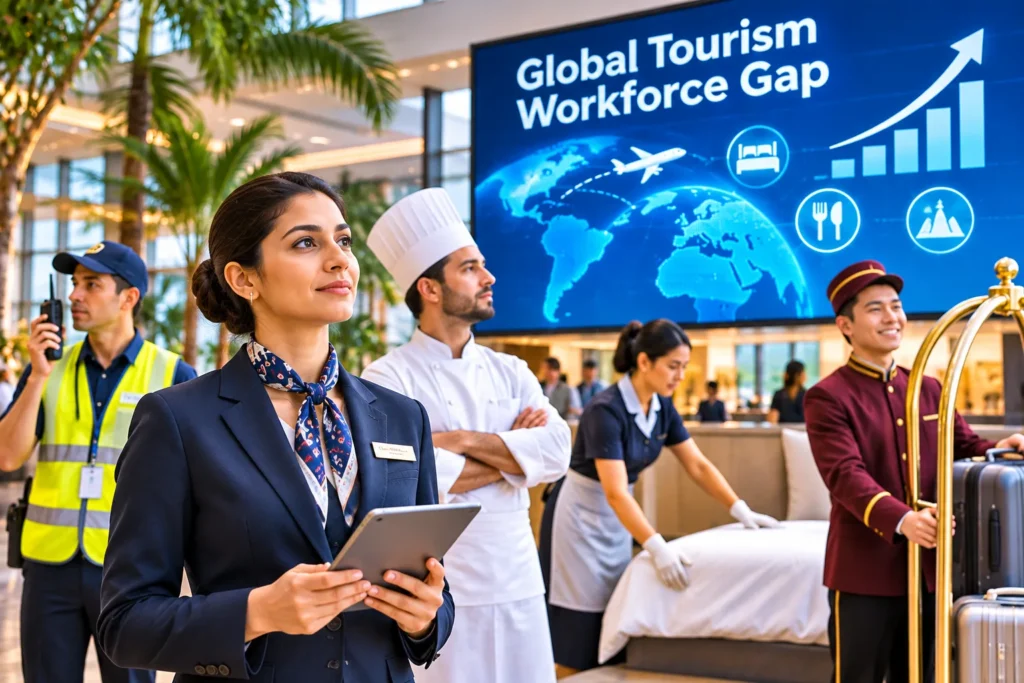
Riyadh, Saudi Arabia, November 25, 2026 — The international travel and hospitality industry faces a critical human capital bottleneck over the coming decade, with new research projecting a global tourism workforce shortage exceeding 43 million workers by 2035. Released by TOURISE, the global tourism platform powered by the Saudi Ministry of Tourism, in collaboration with travel intelligence firm Skift, the white paper titled The Talent Imperative: How Travel and Tourism Will Build Its Next Generation Workforce outlines urgent reforms required to attract, train, and retain skilled personnel.
Drawing upon empirical research and executive consultations across hospitality, aviation, cruise lines, online travel platforms, destination marketing organisations, and academic institutions, the report evaluates whether global talent pipelines can keep pace with surging international travel demand.
Official findings indicate that travel and tourism supported an all-time high of 366 million jobs globally in 2025. Over the next decade, the industry is projected to generate 91 million net new roles by 2035, representing one in every three new jobs created across the world economy. However, without systemic workforce interventions, labour supply is forecast to fall 16% short of employer demand, creating a structural deficit of more than 43 million workers.
Speed-to-Readiness Emerges as a Key Operational Hurdle
While recruiting staff to fill open vacancies remains a top priority for hotels, airlines, and tour operators, the research highlights that hiring alone does not guarantee operational readiness. Survey findings within the report reveal that 42% of hiring managers observe new employees taking between four and six months to achieve full productivity.
For hospitality executives planning new property launches or staffing ahead of peak holiday seasons, this extended ramp-up period carries major operational implications. Filling a hotel roster weeks before opening day is insufficient unless operators allocate structured time and resources for new hires to master property management systems, safety protocols, and service standards.
To compress this learning curve, the study recommends modernising onboarding frameworks alongside continuous skills training. It also identifies artificial intelligence as a valuable operational enabler—capable of automating repetitive administrative duties and accelerating digital staff training, thereby allowing employees to dedicate greater attention to guest engagement and complex service decisions requiring human empathy.
Career Mobility and Educational Partnerships Drive Retention
Retaining emerging talent requires aligning workplace structures with the expectations of younger generations entering the labour market. According to the report, Generation Z professionals prioritise schedule flexibility, authentic organisational values, and transparent opportunities for rapid advancement.
Within hotels and resorts, translating those expectations into practice means establishing clear internal progression ladders—such as mapping the exact competencies a front-desk associate needs to advance into a supervisory position or offering structured cross-training across food and beverage, revenue management, and guest relations departments.
Beyond internal workplace reforms, the report calls for closer coordination between tourism employers, secondary schools, vocational academies, and universities. Strengthening local training pipelines allows hospitality businesses to connect with prospective candidates earlier while providing students with practical, community-based career pathways. Simultaneously, coordinated international talent frameworks can help destinations tap into broader labour pools when local recruitment falls short.
Balancing Infrastructure Investment with Human Capital
Commenting on the release, His Excellency Ahmed Al Khateeb, Minister of Tourism of Saudi Arabia and Chairman of TOURISE, underscored that capital investment in physical destinations, airports, and resorts must be matched by equally committed investment in the people who operate them. He called on governments, private-sector operators, and educators to work together to build stronger entry pathways and lasting careers across the visitor economy.
Echoing this imperative, Skift Founder and CEO Rafat Ali noted that the industry’s ability to capture its projected economic expansion depends directly on developing workforce capabilities and designing roles that professionals want to build long-term careers in. With the next TOURISE Summit scheduled to convene in Riyadh from 23 to 25 March 2027, workforce transformation stands firmly at the forefront of global tourism policy and industry strategy.
For more travel news like this, keep reading Global Travel Wire