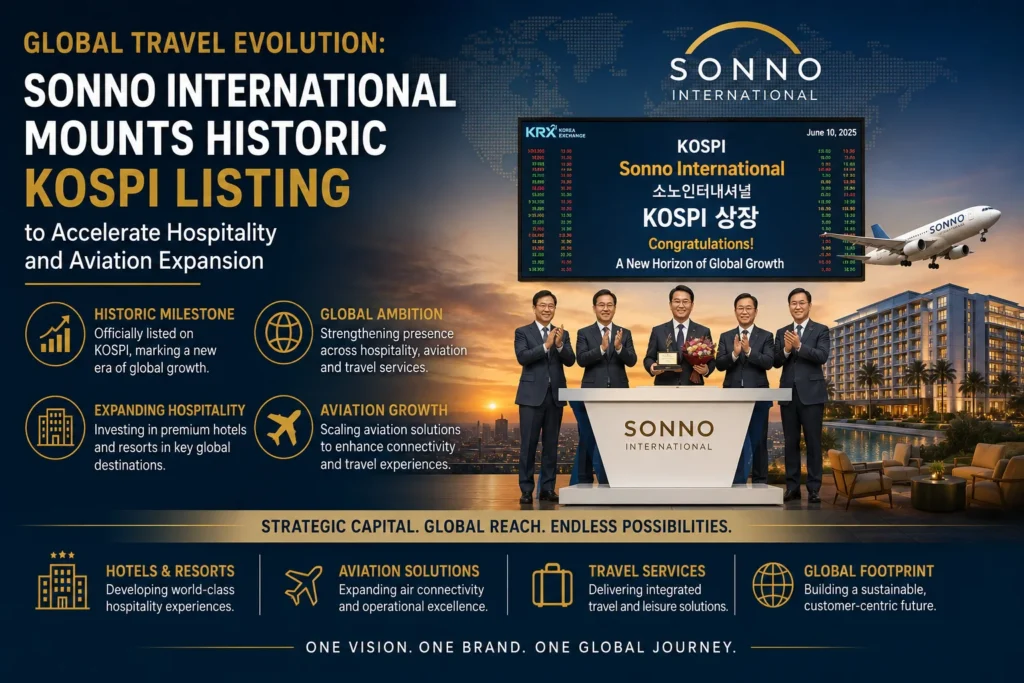
The South Korean tourism and leisure market is entering an unprecedented era of structural consolidation as one of its most dominant domestic forces transitions into a fully integrated global powerhouse. Sonno International, the prominent hospitality arm of the newly rebranded Sono Trinity Group, has officially initiated its listing process on the main board of the Korea Exchange, the KOSPI. The corporate submission of its preliminary public offering review has triggered immense interest across international investment corridors and regional tourism boards alike. The strategic focus on this public debut extends far beyond the traditional boundaries of regional resort management, underscoring a massive, multi-sector integration campaign designed to fundamentally reshape how domestic and international travelers experience outbound tourism.
Over the past several decades, the conglomerate firmly cemented its corporate foundation by building a massive domestic resort footprint, accumulating approximately 15,000 hotel and resort keys across 21 prime geographic zones inside South Korea. This extensive localized infrastructure provided the enterprise with a highly resilient recurring revenue stream. However, the organization’s overarching vision shifted significantly toward global expansion. The company launched its official international breakthrough in 2020 by securing the property management framework for Sonno Bell Haiphong in Vietnam. This initial Southeast Asian foothold laid the groundwork for a highly aggressive direct asset acquisition strategy, resulting in the successful buyout of luxury hospitality properties in core global tourism markets, including landmark locations in New York City, Hawaii, Washington D.C., and Paris.
The Aviation Pipeline: Integrating Trinity Airlines
The most definitive pivot in the corporate strategy materialized through the group’s dramatic entry into the commercial aviation market. Following a patient 14-year campaign that dates back to an initial acquisition attempt in 2011, the hospitality firm successfully secured major controlling equity in Trinity Airlines, the carrier formerly operating under the T’way Airlines banner. To ensure maximum operational clarity and optimal balance sheet allocation, the group executed a complete divestment of its secondary holdings in Air Premia. Financial leadership determined that managing two distinct mid-to-long-haul carrier operations concurrently would introduce unnecessary structural friction.
Instead, the modern strategy concentrates all aviation capital on refining the financial framework, route maps, and long-haul capabilities of Trinity Airlines. While the acquisition of prominent international hospitality properties and a commercial passenger carrier might superficially appear as disparate real estate and transportation maneuvers, they represent a highly integrated, cross-industry tourism ecosystem. By controlling both the transport mechanism and the destination infrastructure, the enterprise is structuring a seamless, closed-loop consumer pipeline. The ultimate objective is to govern the entirety of the consumer travel journey—capturing the customer from the exact minute they cross the airport boarding gate, through their international flight, and directly into the company’s overseas luxury rooms, specialized golf courses, and flagship water parks.
Capitalizing on a Loyal Membership Core
A primary structural advantage separating the enterprise from conventional international hotel chains is its massive, deeply entrenched domestic membership foundation. Built over decades of dominant performance within the regional resort sector, this core demographic presents consumer behaviors that vary significantly from typical transient hotel patrons. These dedicated members possess an exceptionally high propensity for repeat bookings and sustained brand loyalty.
With the systematic deployment of new international flight routes via Trinity Airlines alongside the continuous integration of properties in Europe and North America, the corporation is successfully extending its localized consumer touchpoints into the lucrative outbound international travel market. Very few hospitality developers within the Asian region possess this specific combination of pre-existing consumer membership pipelines, independent long-haul aviation assets, and wholly-owned international premier real estate.
Financial Performance and the Path to 2029
The decision to advance the initial public offering is directly tied to the capital requirements necessitated by an ambitious long-term global expansion roadmap. Official corporate financial disclosures reveal that the firm achieved record-breaking operational metrics during the past fiscal year, delivering a historically high revenue of 968.8 billion won alongside an operating profit of 248.2 billion won. This performance represents an exceptional operating profit margin exceeding 20 percent, illustrating a highly robust, self-sustaining financial posture.
While the organization is clearly not under immediate liquidity pressure to sustain its current domestic and foreign day-to-day operations, the capital generated via the public listing is strictly designated as long-term investment fuel. The enterprise has officially stated its intention to expand its overseas hotel and resort portfolio to a total of 55 operational locations by 2029, with a deliberate emphasis on capturing prime market share across the wider Asia-Pacific and Western travel corridors.
Following the successful execution of the KOSPI listing, the analytical benchmarks utilized by the financial community to evaluate the firm’s baseline valuation are projected to change entirely. Conventional hospitality metrics—such as localized room inventory counts, regional occupancy percentages, and domestic membership package sales—will no longer serve as the solitary markers of corporate health. Moving forward, the true market value of the enterprise will be heavily weighed against the capacity of its newly acquired Western properties to generate stable international profits, alongside the net operational performance, fuel efficiency, and global route expansion of Trinity Airlines. The transition from a domestic resort operator to a publicly traded, vertically integrated travel titan marks a defining chapter in the evolution of modern Asian tourism infrastructure.
For more travel news like this, keep reading Global Travel Wire