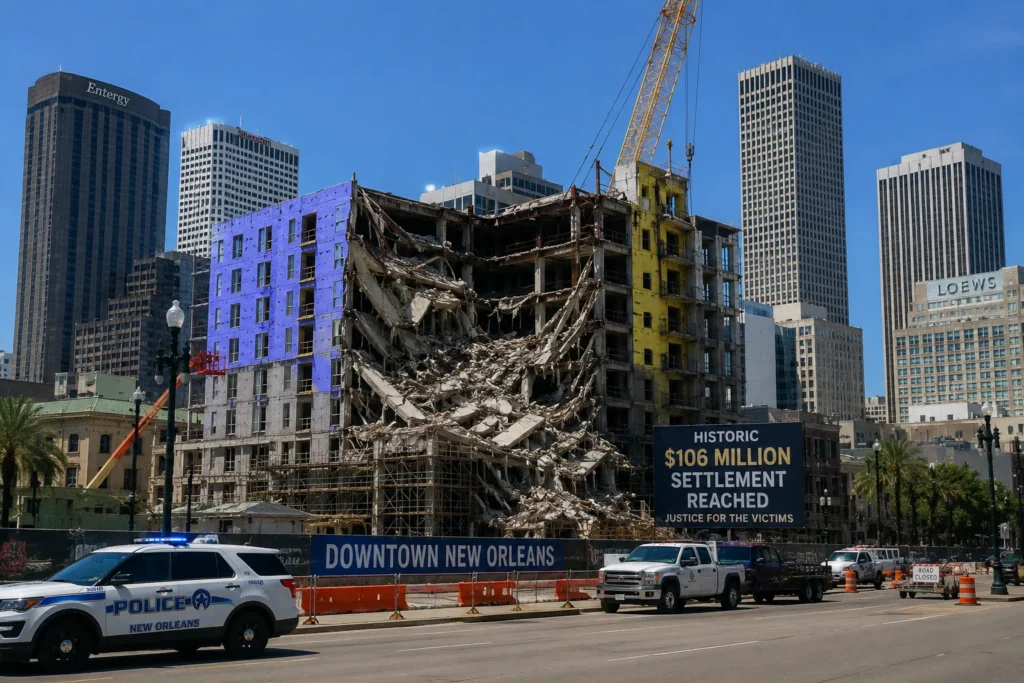
A major legal resolution has been finalized in downtown New Orleans as project developers, contractors, and insurers agreed to a $106 million global settlement resolving claims from nearly 500 plaintiffs stemming from the 2019 collapse of the 18-story hotel construction project at 1031 Canal Street. The judicial order, signed by Orleans Parish Civil District Court Judge Kern Reese, brings a formal conclusion to multi-year civil litigation involving injured workers, families of the deceased, nearby commercial business operators, and impacted property owners across the Central Business District.
A court-appointed special master mediator will now direct the structured allocation of settlement funds among the 490 registered claimants. The legal resolution marks a crucial landmark for the city’s primary tourism, retail, and hospitality corridor, providing closure to a tragic chapter that reshaped local municipal safety oversight, urban planning policies, and downtown transit operations.
Major Milestone for Downtown New Orleans Central Business District
The site at 1031 Canal Street occupies a pivotal position within New Orleans’ urban geography, situated at the intersection of North Rampart Street directly adjacent to the historic French Quarter, the downtown theater district, and major streetcar transit arteries. During the initial construction phase in October 2019, a catastrophic partial collapse of the upper floors of the high-rise structure killed three workers, injured dozens, and damaged surrounding commercial structures.
The incident necessitated immediate citywide emergency measures managed by the New Orleans Fire Department, the Office of Homeland Security and Emergency Preparedness, and municipal public safety agencies. Emergency responders established restricted safety perimeters, implemented multi-block traffic detours, and executed complex technical operations to stabilize compromised tower cranes overlooking Canal Street. Nearby cultural venues, including the historic Saenger Theatre, experienced temporary operational adjustments during public safety clearance efforts.
Following extensive structural evaluations and forensic engineering assessments, the compromised building framework was systematically dismantled and cleared. Two-way vehicular and transit operations along Canal Street were fully restored in April 2021, reopening a critical travel artery for residents, regional commuters, and millions of annual tourists visiting the Crescent City.
Public Safety Standards and Infrastructure Accountability
Regulatory evaluations conducted by the Occupational Safety and Health Administration (OSHA) highlighted several engineering and structural safety deficiencies during the original building assembly, prompting widespread revisions to municipal building review processes. In response to the collapse, the City of New Orleans instituted rigorous reforms targeting commercial construction monitoring, emergency site stabilization protocols, and third-party engineering inspections.
City officials and state licensing authorities implemented enhanced regulatory guidelines for multi-story hospitality and mixed-use developments. These measures ensure that future commercial hotel developments within the Central Business District adhere to strict structural engineering reviews, standardized safety checks, and transparent municipal oversight.
The legal settlement resolves remaining civil liability questions among the primary development entities, architectural design groups, structural engineering firms, and trade subcontractors. By concluding the prolonged litigation, local economic planning bodies can shift full focus toward permanent urban renewal strategies for the Canal Street corridor.
Honoring Heritage and Future Memorial Planning
As part of the urban recovery plan for the historic district, the New Orleans Central Business District Historic District Landmarks Commission officially designated the 1031 Canal Street parcel as a historic landmark site. The designation preserves the site’s cultural legacy while establishing a formal pathway for creating a permanent public memorial dedicated to the construction workers who lost their lives in the disaster.
Prior to the 2018 high-rise hotel development project, the location was historically occupied by a flagship Woolworth store dating to the 1930s, reflecting Canal Street’s long legacy as a major retail and social center. Municipal planning commissions, historic preservation organizations, and community advocates are now collaborating on long-term land-use concepts that honor local history while contributing positively to the surrounding streetscape.
Civic leaders emphasize that the creation of a respectful public memorial on the vacant parcel will provide a permanent place of reflection for community members and visitors while reinforcing the city’s commitment to worker safety and historical preservation.
Long-Term Outlook for New Orleans Hospitality and Travel
New Orleans continues to record strong growth across its travel, convention, and cultural tourism sectors, supported by sustained investments in airport infrastructure, historic hotel renovations, and world-class culinary experiences. The finalization of the Canal Street legal settlement removes long-standing administrative uncertainties surrounding one of the city’s most visible urban parcels.
Tourism leadership organizations and regional commercial authorities view the resolution as a key step in strengthening investor confidence throughout the downtown commercial footprint. As redevelopment plans for the 1031 Canal Street site take shape, city planners aim to integrate the property seamlessly into the broader revitalization of Canal Street, ensuring that the surrounding historic district remains a vibrant, safe, and welcoming destination for international travelers and local residents alike.
For more travel news like this, keep reading Global Travel Wire