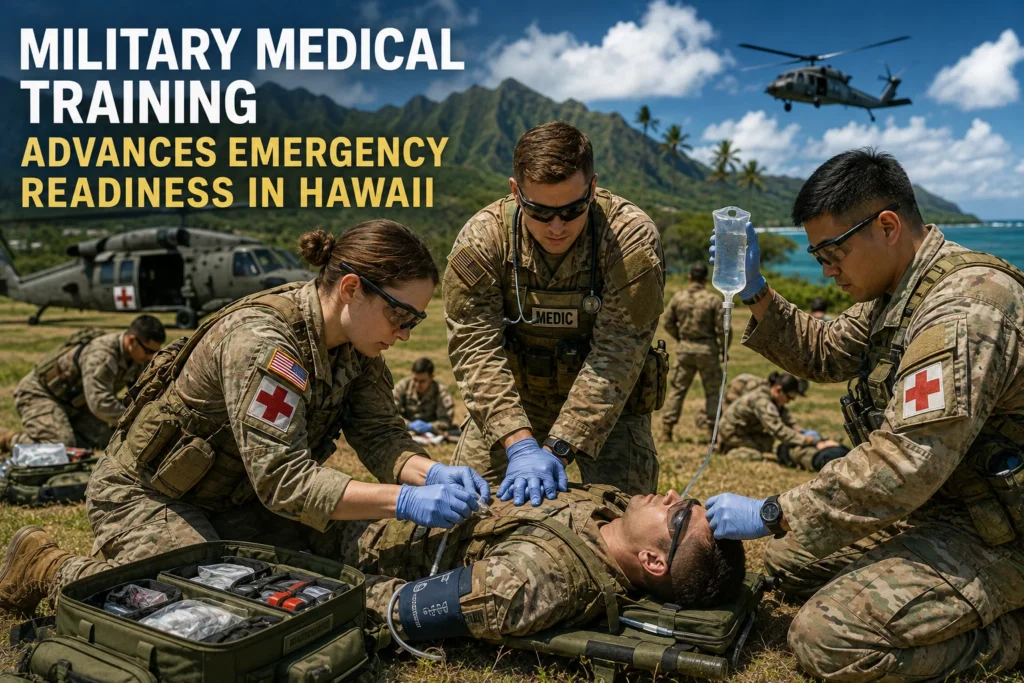
Airmen from the 124th Medical Group joined multi-branch military medical personnel in Hawaii to complete the Armed Forces Advanced Trauma Training course. Organized by the Global Training Institute, the program equips joint service members with advanced tactical procedures required to manage critical casualties during complex operational deployments and real-world emergencies.
Hosted across facilities at the Hale Koa Hotel in Honolulu and Marine Corps Base Hawaii, the curriculum combines academic instruction with intensive practical laboratories. By participating in rigorous hands-on clinical rotations, military personnel sharpen fundamental lifesaving capabilities under conditions designed to mirror high-stress emergency environments.
Official releases from defense medical leadership emphasize that specialized trauma courses bridge the gap between routine base exercises and real-world clinical demands, ensuring joint force personnel maintain operational readiness across all medical specialties.
Realistic Clinical Scenarios Enhance Tactical Healthcare Skills
Standard training protocols frequently rely on automated mannequins to simulate emergency interventions. While synthetic simulators provide valuable operational practice, they cannot fully replicate human tissue density, anatomical variations, or dynamic physical responses encountered during catastrophic injuries.
The Hawaii training initiative provides participants access to donated human tissue within a controlled instructional environment. Working directly with complex biological structures enables medical personnel to refine precise surgical and emergency procedures before encountering high-stakes casualty events in military or humanitarian operational zones.
During practical rotations, service members perform essential lifesaving techniques, including:
Hemorrhage control and advanced wound management
Airway management and emergency breathing stabilization
Ultrasound diagnostic imaging and vascular access placement
Fracture stabilization, surgical suturing, and chest trauma management
Navigating these detailed clinical exercises allows medical personnel to identify procedural nuances, refine manual dexterity, and build practical confidence under the direct supervision of experienced trauma instructors.
Joint Force Interoperability Strengthens Pacific Response Capabilities
Medical readiness in the Pacific theater requires seamless integration between diverse service branches. The trauma training program brings together personnel from the Air Force, Army, Navy, and Marine Corps, fostering inter-service collaboration and standardized emergency care protocols.
Training in non-mainland environments such as Hawaii introduces realistic logistical and environmental considerations. Operating outside home stations challenges medical teams to adapt rapidly to austere conditions, ensuring seamless joint force communication during joint military deployments, domestic disaster responses, or National Special Security Events.
Defense medical officials highlight that joint training environments refine procedural consistency across operational units, enabling multi-branch trauma teams to execute synchronized emergency care during high-stress operational deployments.
Building Long-Term Confidence and Sustained Operational Capability
Continuous hands-on practice remains critical to maintaining high-proficiency clinical skills over time. Defense training instructors emphasize that repetitive execution in realistic laboratory environments reinforces muscle memory, reducing response times when service members encounter severe injuries in real-world operational settings.
For newly assigned medical Airmen and seasoned military clinicians alike, realistic trauma training builds foundational confidence, ensuring that critical decision-making remains sharp under pressure.
As defense organizations continue prioritizing joint force readiness, specialized tactical medical programs ensure that military healthcare providers remain fully equipped to deliver high-quality emergency care across global operating environments.
For more travel news like this, keep reading Global Travel Wire