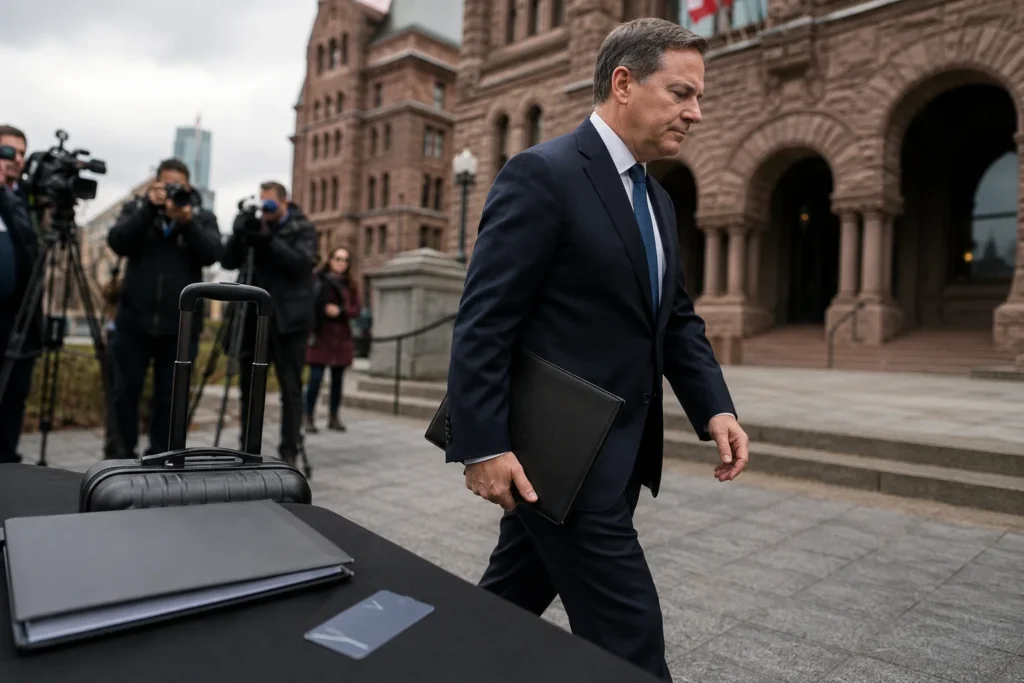
Ontario’s executive governance is facing an unexpected administrative vacancy following the sudden exit of a key leadership figure. Premier Doug Ford has formally accepted the immediate resignation of Stan Cho from his position as the Minister of Tourism, Culture, and Gaming. The cabinet shakeup follows an intense public and legislative review concerning substantial overnight accommodation claims billed to the provincial treasury.
According to verified public disclosure records and formal ministerial statements, the departure stems from thousands of dollars in taxpayer-funded hotel stays within downtown Toronto. The financial records drew strict scrutiny due to the close geographical proximity of the minister’s primary residence to the legislative assembly. In an effort to maintain institutional focus on regional economic development, the minister opted to step down from his portfolio, emphasizing the necessity of absolute accountability in public sector expenditure.
Understanding the Scope of the Accommodation Claims
The administrative controversy centered on the cumulative volume of overnight lodging claims submitted over a multi-year window. Official provincial expense registries indicate that the accommodation costs billed to the public totaled more than $16,000 across a three-year period.
A detailed breakdown of the publicly accessible internal records revealed a steep trajectory in the expensed amounts. The data showed that the lodging claims escalated from an initial $1,431 during the 2023 fiscal cycle to a much more substantial $11,691 during the subsequent 2025–2026 reporting frame. What intensified the policy debate was the location of the minister’s home constituency in the north Toronto riding of Willowdale, situated roughly six kilometers from the Queen’s Park legislative grounds. Under standard provincial guidelines, overnight housing allowances are heavily restricted for elected officials who live within reasonable commuting distance of the capital, unless specific extenuating parameters are met.
The Decision to Terminate Cabinet Responsibilities
The Premier’s Office issued an official communication confirming that the ministerial transition was finalized immediately upon receipt of the formal resignation letter. The government confirmed that while the portfolio change takes effect instantly, the representative will retain his seat as a Member of Provincial Parliament to continue representing his local constituency.
In a public letter addressing the decision, the outgoing minister explicitly stated that he chose to step aside to prevent internal administrative matters from overshadowing the government’s broader economic goals. Reflecting on the demanding nature of public service, he noted that late-night legislative sessions and an demanding schedule frequently kept him away from his young family. On evenings when debates concluded late, he chose nearby downtown lodging to simplify his schedule, acknowledging that he failed to properly evaluate how these taxpayer-funded choices would be viewed by ordinary citizens balancing rigorous shift work.
Regulatory Interpretations and Full Reimbursement Protocols
A central aspect of the administrative review involved checking the formal guidelines governing member reimbursements. The outgoing official clarified that a close review of the standard legislative manual indicated the filings technically fell within the allowable frameworks outlined in the members’ guide for late-night assembly sittings.
However, the minister conceded that relying strictly on the technicalities of the rulebook was a mistake. To resolve the issue and ensure total accountability, he confirmed that he has personally reimbursed the provincial treasury for the exact cumulative total of the hotel expenses. The Premier’s Office praised the swift move to repay the funds, reiterating that taking personal responsibility for administrative mistakes is a critical requirement for maintaining public trust in state institutions.
The Impact on the Regional Tourism and Gaming Portfolio
The sudden transition comes at a critical time for Ontario’s tourism, hospitality, and gaming sectors, which are major economic drivers for the province. The ministry is actively managing a variety of long-term infrastructure projects, regional cultural grants, and modernized regulatory updates for the provincial gaming framework.
Government spokespersons assured regional operators, festival coordinators, and corporate partners that everyday ministry functions will proceed without disruption under interim leadership. The province’s core economic goals—such as boosting international arrivals, supporting local arts organizations, and maximizing hospitality revenues—remain completely unchanged. The government expects to name a permanent successor to the tourism, culture, and gaming portfolio in an upcoming cabinet update, ensuring that Ontario’s multi-billion-dollar visitor economy continues to receive strong and steady administrative direction.
For more travel news like this, keep reading Global Travel Wire