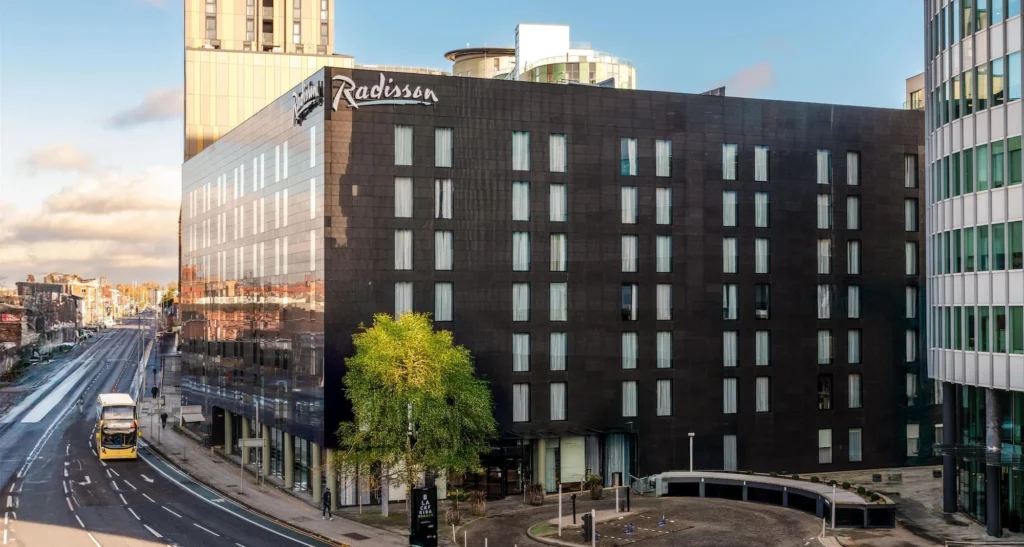
Radisson Hotel Group is accelerating its Verified Net Zero Hotels programme after early results showed sustainability influencing accommodation choices in Manchester and Oslo.
About 20% of surveyed guests at the two operational properties said they booked because of the hotels’ verified net zero status. Awareness of the initiative exceeded 70% at both locations.
The performance signals that independently verified environmental measures can influence travellers rather than remaining a background corporate commitment.
Radisson now aims to establish 100 Verified Net Zero Hotels by 2030. Its expansion roadmap covers the United Kingdom, Nordic countries, South Africa, Germany, Austria and Spain’s Canary Islands.
The programme supports the group’s wider target of achieving science-based net zero operations by 2050.
For travellers and meeting planners, the initiative promises accommodation and events with reduced emissions, measurable environmental performance and third-party verification.
Manchester and Oslo prove the concept
Radisson launched its first two Verified Net Zero Hotels in 2025. They operate in Manchester city centre and Oslo city centre.
The Manchester property shows how an existing urban hotel can transition towards lower-carbon operations. It uses 100% renewable energy and incorporates measures including electrification, heat pumps, low-carbon menus and waste reduction.
Radisson RED Oslo City Centre applies a similar operational model within the Norwegian capital. It provides net zero guest stays alongside meeting and event facilities.
Both properties were developed as proof that substantial decarbonisation can occur within operating hotels. The programme is not limited to newly constructed buildings.
The hotels address emissions across all three greenhouse-gas scopes. They eliminate Scope 1 and Scope 2 emissions through electrification, renewable heating or cooling networks and fully renewable energy sourcing.
They also significantly reduce operational Scope 3 emissions involving food, waste, laundry, amenities and business travel.
Any remaining footprint is addressed within the programme’s established methodology. Independent verification is provided by TÜV Rheinland.
Sustainable stays become a booking factor
The finding that approximately one in five guests selected the Manchester or Oslo hotel because of its net zero status carries commercial significance.
Travellers increasingly encounter broad sustainability claims when comparing accommodation. However, they may struggle to understand what those statements mean or whether environmental performance has been independently assessed.
Radisson’s verification framework gives customers a more clearly defined standard. It also introduces greater accountability by requiring each participating hotel to undergo external evaluation.
This transparency is particularly important for business travellers. Companies may need reliable accommodation data when measuring travel-related emissions or reporting progress against environmental commitments.
Leisure guests can also make more informed choices without independently examining every part of a hotel’s operations.
The early booking response suggests environmental performance can support occupancy, brand differentiation and long-term property competitiveness.
Meetings gain measurable sustainability tools
Meetings and events form a major part of Radisson’s net zero strategy.
Event organisers must consider more than guest-room energy. Conferences also generate emissions through catering, laundry, waste, transport and venue operations.
Verified hotels aim to reduce these impacts while providing measurable information for planners. Radisson can assess and report the environmental footprint of menus served during meetings and events.
Food is particularly important because ingredient selection, preparation and waste can substantially affect an event’s total footprint. Low-carbon menus give organisers another way to align hospitality choices with corporate sustainability policies.
Third-party verification can also reduce uncertainty for companies that need defensible data. It helps planners select venues without developing their own assessment systems for energy, catering and waste.
As corporate travel policies become more detailed, venues offering measurable performance may gain an advantage when competing for international conferences, incentives and meetings.
South Africa joins expansion roadmap
Radisson’s phased rollout begins with further development in Norway, followed by Denmark, Sweden, the United Kingdom and South Africa.
South Africa is expected to host the programme’s first Verified Net Zero Hotel in Africa. This expansion could introduce a new independently assessed accommodation option within an important tourism and business-events market.
Germany, Austria and the Canary Islands are also included in the five-year development roadmap.
The selection covers urban business destinations, leisure markets and regions with established sustainability demand. It gives Radisson opportunities to test the model across different climates, energy systems and hotel operations.
Each location will require cooperation between property owners, hotel teams, suppliers, technology providers and verification specialists.
Operations extend beyond renewable electricity
Radisson’s strategy recognises that renewable energy alone does not make an entire hotel operation net zero.
Hotels consume resources through kitchens, cleaning, laundry, heating, cooling, employee travel and supply chains. Waste management and food sourcing also affect their environmental footprint.
The Verified Net Zero framework therefore includes renewable power, electrification, low-carbon menus, reduced waste and operational efficiency.
Radisson’s 2025 performance showed a 23% reduction in emissions intensity per square metre against its 2019 baseline. The group also reported 78 hotels operating with 100% renewable electricity.
These changes support the company’s wider transformation while creating a practical model for individual properties.
Sustainable hospitality moves towards proof
Radisson operates and develops hotels across more than 100 countries. Scaling verified net zero operations across that network will require investment and local adaptation.
However, its Manchester and Oslo results demonstrate that environmental and commercial goals can support each other.
For travellers, the shift could make sustainable booking decisions simpler. For meeting planners, it offers measurable accommodation, catering and venue information within one programme.
The most important development is the move from broad promises towards verified performance. With 20% of guests already citing net zero status as a booking reason, sustainability is becoming a visible part of hotel competition rather than an optional extra.
For more travel news like this, keep reading Global Travel Wire