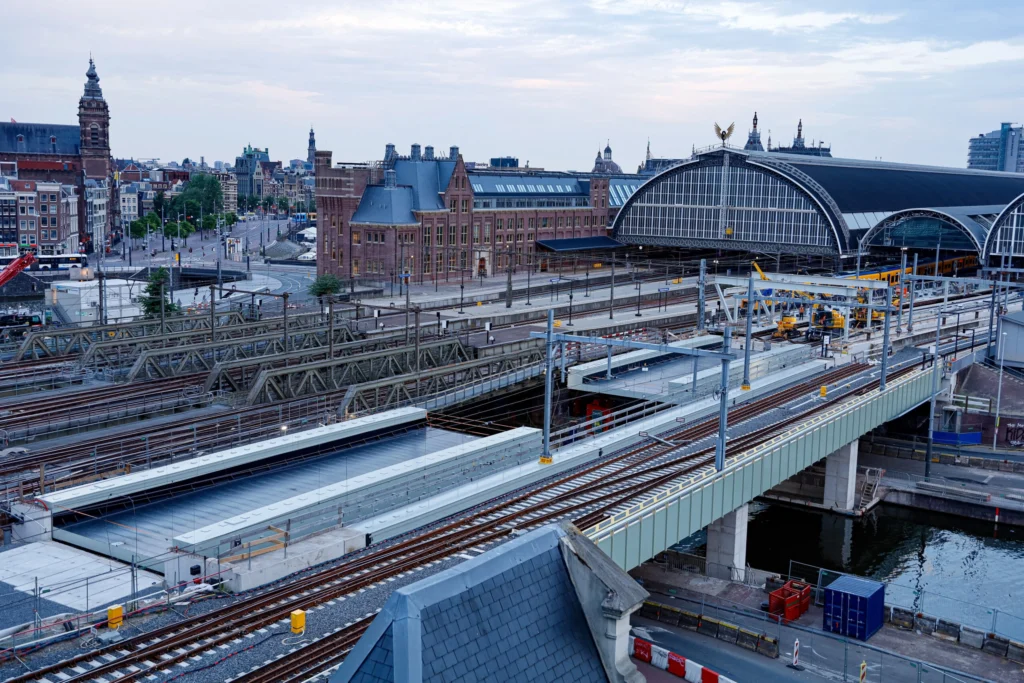
Amsterdam Centraal has reached a defining milestone in its long-term transformation after the second new railway bridge was successfully installed across the Oostertoegang, strengthening plans to accommodate more trains and passengers at one of the Netherlands’ most important transport gateways.
The operation involved three prefabricated steel sections, including two outer spans measuring approximately 28.5 metres and weighing 275 tonnes each. A 21-metre central section weighed about 175 tonnes.
Installed at the end of May and officially confirmed by ProRail in June 2026, the structure forms part of a five-bridge replacement programme on the eastern side of the station. The first bridge was completed in 2025, with further replacements scheduled as the broader Amsterdam Centraal modernisation progresses.
The project is being delivered for ProRail by Dura Vermeer, with Mammoet responsible for specialist transport and installation activities. Hollandia Infra manufactured the steel bridge components in the Netherlands.
For passengers, the milestone supports a wider programme intended to increase rail capacity, improve movement through the station and prepare Amsterdam’s principal railway hub for future demand.
Five Bridges Support Higher Train Capacity
The Oostertoegang works form part of the Dutch High-Frequency Rail Transport programme, which combines bridge renewal, track optimisation, platform alterations and station improvements.
Four steel railway bridges and one concrete structure are being replaced through a carefully sequenced, multi-year programme. Each new bridge must be inserted within a constrained urban environment while the wider station continues serving national, regional and international travellers.
Amsterdam Centraal already handles intensive train movements and connects passengers with destinations across the Netherlands and neighbouring European countries. Its strategic location also makes it an essential gateway for tourists travelling between the airport, Amsterdam’s historic centre and other Dutch cities.
Improving infrastructure capacity is therefore critical for both daily commuting and tourism. More reliable train movements can strengthen city-break travel, cross-border rail itineraries and connections to hotels, attractions, cruise facilities and regional destinations.
Water Transport Reduces Pressure on City Streets
One of the project’s most distinctive features is the use of Amsterdam’s waterways to move exceptionally heavy bridge sections into the city.
The components were loaded onto flat-top barges and transported by water from their production location toward Amsterdam Centraal. This strategy avoided the need to move oversized loads through narrow, busy streets around the historic centre.
Before reaching the installation area, the barges had to pass beneath low infrastructure. Water was pumped into the vessels to increase their weight and lower them sufficiently for the bridge sections to clear the restricted space.
The controlled ballasting process demonstrated how inland waterways can support major construction projects in dense European cities. It reduced dependence on road closures, limited pressure on surface traffic and allowed the large structures to arrive close to their final position.
For destinations such as Amsterdam, where transport construction must coexist with residents, businesses and millions of visitors, water-based logistics provide an increasingly valuable alternative to conventional heavy road haulage.
Hydraulic System Delivers Precision Installation
The second bridge required a revised installation method because space between the existing and newly constructed structures was extremely limited.
During the earlier bridge operation, Mammoet used its Mega Jack 300 system alongside self-propelled modular transporters. For the latest installation, engineers deployed a four-point hydraulic lifting system assembled beside the station.
Synchronised hydraulic cylinders allowed the bridge sections to be raised and aligned with high precision. Self-propelled modular transporters were also used to rotate and move the components through the restricted work zone.
The outer spans were initially placed on temporary supports. Teams then constructed the supporting central column before the bridge sections could be lowered into their permanent positions.
Each installation phase required close coordination between transport specialists, structural engineers, contractors and railway planners. After the bridge was positioned, work continued on completing the structure and rebuilding the railway tracks above it.
Rail Investment Strengthens Amsterdam Tourism
The upgrade has important implications beyond engineering. Amsterdam Centraal is a primary arrival point for visitors exploring the Dutch capital’s museums, canals, cultural districts and waterfront attractions.
A more spacious and efficient station can improve the arrival experience while supporting the Netherlands’ wider efforts to encourage rail as an alternative to short-distance road and air travel.
Improved capacity will also help international operators expand cross-border services as demand grows for lower-impact journeys between major European cities.
The five-bridge programme demonstrates that large railway structures can be renewed within a functioning urban hub through prefabrication, water transport and precision lifting.
As the remaining bridges are replaced, Amsterdam Centraal is establishing a practical model for other historic European stations facing similar challenges: limited construction space, rising passenger demand and the need to modernise without disconnecting the city from its rail network.
For more travel news like this, keep reading Global Travel Wire