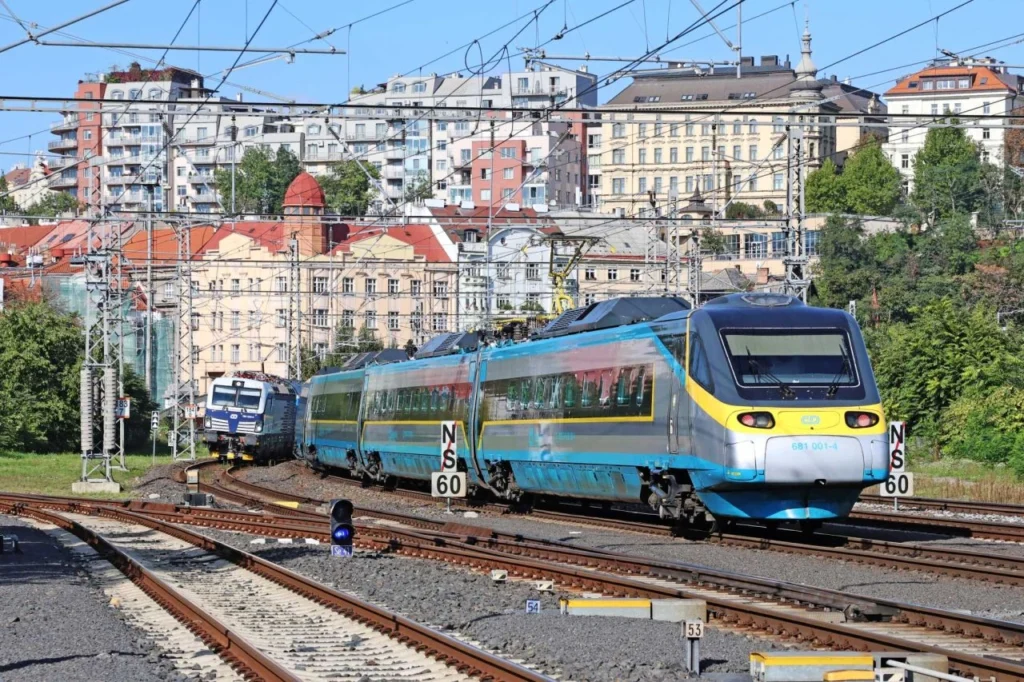
The Czech Republic has introduced 5G coverage in its first railway tunnels, strengthening mobile connectivity for passengers travelling along important routes associated with Prague, Brno and Ostrava.
The confirmed rollout covers the Vítkovský and Krasíkovský railway tunnels and represents an initial stage rather than nationwide tunnel coverage. Valued at CZK72,925,200, the project is designed to improve voice calls and mobile data while preparing railway infrastructure for future operational communications.
The development addresses one of the most persistent weaknesses in modern rail travel: sudden signal loss inside tunnels. For passengers using digital tickets, journey-planning applications, mobile payments, cloud services or live travel alerts, even short connectivity black spots can interrupt the wider journey experience.
By targeting these difficult enclosed sections, Czech railway authorities are strengthening the digital performance of rail on a corridor serving major centres of government, commerce, education, industry and tourism.
Prague, Brno and Ostrava Gain Stronger Links
Prague, Brno and Ostrava form one of Czechia’s most important travel and economic axes.
Prague is the country’s principal international gateway, supporting aviation, culture, meetings, government activity and urban tourism. Brno is a major technology, university and conference centre, while Ostrava contributes industrial, cultural and cross-border travel demand.
Stronger mobile continuity between these destinations can make rail more attractive to business travellers who need to remain connected during journeys. It can also support international visitors managing hotel reservations, attraction bookings and onward transport through mobile applications.
Tour operators and group-travel organisers may benefit from more reliable communication with passengers during tunnel sections, especially when coordinating transfers, schedule changes or digital documentation.
The upgrade therefore has significance beyond faster mobile browsing. It adds a new competitive advantage to rail as Czechia promotes convenient and more sustainable travel between its cities.
Tunnel Infrastructure Supports Reliable Mobile Service
Conventional outdoor mobile coverage often weakens or disappears once a train enters a tunnel. The Czech project addresses this through infrastructure designed specifically for enclosed railway environments.
Radiating cables installed inside the tunnels distribute mobile signals along the route. Optical connections support the transmission of high-capacity data, while technology bases near tunnel portals provide the foundation required by mobile operators to activate services.
For passengers, the outcome should be fewer interrupted calls, stronger data performance and a more consistent digital experience.
However, tunnel coverage is only one part of the connectivity chain. Signal quality inside trains can also be affected by the construction of modern carriages, particularly windows and body materials that restrict mobile reception.
Czech transport modernisation programmes have therefore also considered onboard solutions such as signal repeaters and specially designed windows that improve network penetration into passenger compartments.
Together, tunnel systems, trackside mobile infrastructure and coach-level technology can create a more complete connected journey.
Upgrade Prepares Railways for FRMCS
The new infrastructure is also intended to support the future introduction of the Future Railway Mobile Communication System, known as FRMCS.
FRMCS is expected to replace the existing GSM-R communication standard used by railways. It will provide the higher data capacity required for increasingly digital railway operations, including advanced signalling, train control and communication between infrastructure managers, drivers and operational teams.
The Czech tunnel project has been developed with compatibility for this transition in mind. It is also relevant to routes using the European Train Control System, which depends on accurate and dependable operational communication.
This future readiness means the investment serves both passenger connectivity and the wider modernisation of railway safety and management systems.
As European railways become more automated and data intensive, digital communications will become as important as tracks, stations and rolling stock.
National Corridor Programme Extends to 2031
The first two railway tunnels form part of a longer-term effort to improve mobile service at problem locations across the Czech rail network.
Plans call for connectivity improvements at 158 locations by the end of 2031. Corridors identified for future work include Prague–Cheb, Prague–České Budějovice, Prague–Děčín and Přerov–Břeclav.
Each route carries important tourism and cross-border value.
The Prague–Cheb corridor supports access toward western Czechia and its historic spa destinations. Prague–České Budějovice strengthens travel into South Bohemia, while the route toward Děčín supports links with northern Czechia, the Elbe corridor and Germany.
The Přerov–Břeclav route is important for Moravian travel and onward connections toward Austria and Slovakia.
Digital Connectivity Strengthens Sustainable Tourism
Reliable mobile service can influence how passengers perceive the convenience of rail compared with driving or flying.
Travellers increasingly expect uninterrupted access to digital tickets, disruption updates, maps, entertainment, customer support and accommodation services throughout a journey. Removing tunnel black spots reduces friction and makes rail more suitable for both productive business travel and relaxed leisure trips.
For Czechia’s tourism sector, stronger rail connectivity can support multi-city itineraries while encouraging visitors to travel beyond Prague.
The country’s first 5G-enabled railway tunnels therefore represent more than a telecommunications milestone. They mark an early step toward a smarter national rail system in which passenger convenience, operational technology and sustainable mobility develop together.
For more travel news like this, keep reading Global Travel Wire