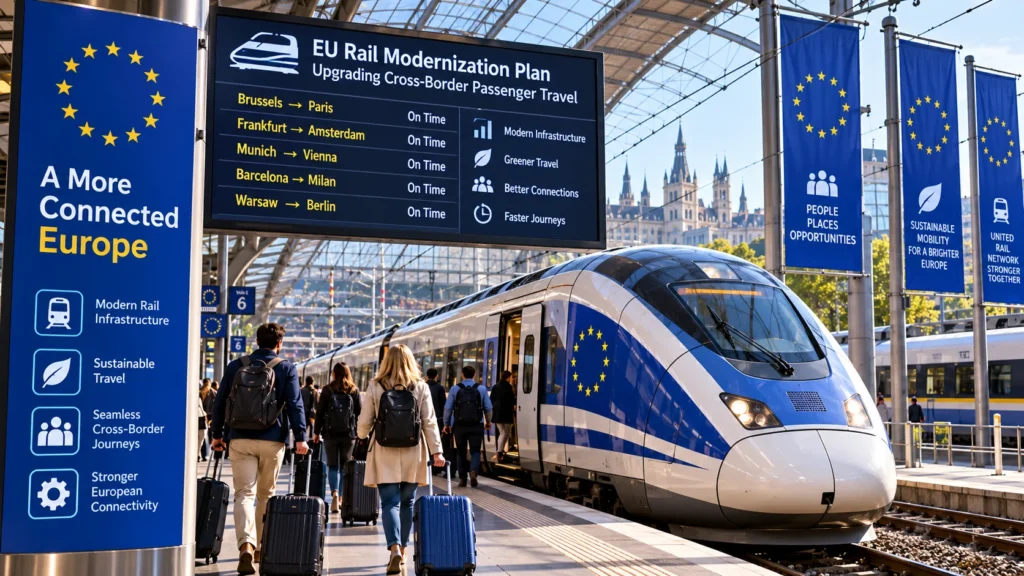
European transport leaders, rail operators, and policy representatives gathered in Brussels for a high-level summit hosted by Europe’s Rail Joint Undertaking to advance the European Commission’s landmark signaling modernization framework. Held during Connecting Europe Days at the Infrabel Academy, the assembly convened roughly two hundred key stakeholders to tackle structural bottlenecks and establish unified technical standards across the continent’s passenger and freight rail networks.
The primary objective of the gathering centered on accelerating the rollout of the European Rail Traffic Management System, an advanced digital signaling framework designed to replace legacy national signaling software. Historical fragmentation across individual member states has required cross-border trains to carry multiple onboard safety systems, increasing operational expenses and slowing down international passenger corridors. By establishing a unified deployment model, European aviation and rail regulators aim to drastically reduce equipment costs and enhance train frequency across international borders.
Under the European Commission’s newly proposed framework, the strategy relies on three main foundational pillars. The plan introduces a standardized European blueprint for digital signaling installations, ties future regional development funds directly to unified compliance standards, and establishes a fast-track approval process through the European Union Agency for Railways. These measures are designed to eliminate localized technical hurdles, ensure hardware compatibility between trains and track infrastructure, and streamline approval timelines for regional train operators.
Executive leadership from the European Commission’s Directorate-General for Mobility and Transport opened the session alongside regional infrastructure directors, emphasizing that harmonized digital signaling represents a vital step toward creating a truly unified European rail area. Industry leaders highlighted that transition delays undermine the competitiveness of eco-friendly rail transport compared to domestic short-haul flights and road travel. Rapid implementation of digital signaling allows tracks to safely accommodate higher traffic volumes, reducing travel times between major European capitals.
Panel discussions featuring international passenger operators, rolling stock leasing firms, and rail technology providers explored practical solutions for accelerating fleet upgrades. Key industry leaders noted that operators managing cross-border passenger fleets face significant capital expenses when retrofitting existing trains. Establishing a clear, standardized technical blueprint provides investors and commercial carriers with long-term regulatory certainty, encouraging private capital investment in modern passenger rolling stock.
A second high-level panel focused on regulatory implementation and financial oversight, bringing together safety executives, signaling directors, and infrastructure managers. Discussions emphasized the necessity of synchronized trackside installation alongside onboard equipment upgrades. Regulatory representatives noted that establishing streamlined approval pathways will prevent administrative delays, allowing newly retrofitted passenger trains to enter cross-border service without undergoing redundant national certification procedures.
For international travelers and leisure tourism across Europe, the accelerated transition to a unified signaling platform promises a more reliable and efficient long-distance rail network. Unified digital signaling directly increases track capacity, minimizes border delays caused by system transitions, and improves overall punctual performance. As European authorities work toward achieving net-zero transport targets, modernizing digital rail infrastructure serves as a critical driver for shifting passenger traffic onto high-speed, environmentally sustainable rail corridors.
For more travel news like this, keep reading Global Travel Wire