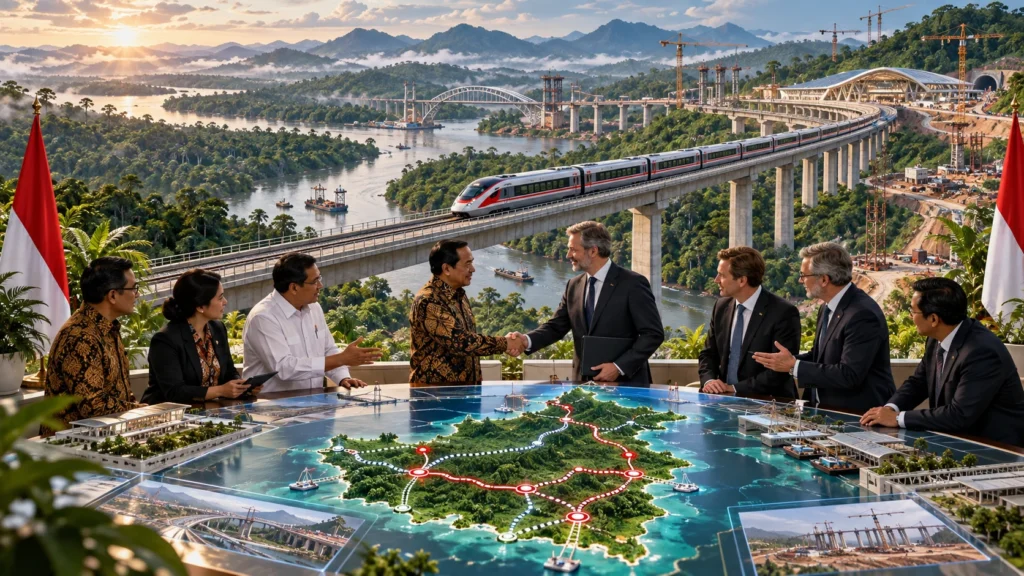
The Indonesian government is actively exploring domestic and international investment options to fund the development of the planned Trans-Kalimantan railway network. Designed as a long-term infrastructure initiative spanning thousands of kilometers across the Indonesian portion of Borneo, the ambitious project seeks to establish the first operational public rail transit network on the island, connecting resource-rich hinterlands, major coastal trade hubs, and Nusantara, the nation’s planned capital city.
Official announcements from the Ministry of Transportation confirm that preliminary discussions have commenced with foreign partners, including entities from China and Russia, to evaluate commercial viability and technical execution strategies. As Indonesia advances its National Railway Master Plan through 2030 and beyond, building sustainable mass transit across Kalimantan represents a critical priority for expanding regional tourism, lowering national logistics overheads, and decentralizing economic growth beyond Java.
Driving Eco-Tourism and Connectivity Across Nusantara and Borneo
Kalimantan, renowned for its ancient rainforests, rich biodiversity, and iconic wildlife reserves, has historically faced transportation constraints due to a heavy reliance on riverways and regional road networks. The construction of the Trans-Kalimantan railway network is expected to revolutionize passenger mobility by establishing reliable, low-carbon transit corridors connecting key provincial urban centers, including Banjarmasin, Palangkaraya, Tanjung, and Samarinda.
Beyond improving freight movement for regional commodities, the railway network holds significant strategic value for Indonesia’s evolving visitor economy. Key tourism development objectives supported by the proposed rail system include:
Ecotourism Gateways: Providing seamless rail access to protected national parks, wildlife sanctuaries, and remote eco-lodges situated deep within Borneo’s interior.
Nusantara Transit Integration: Connecting the future capital district with surrounding regional cities, international airports, and maritime passenger terminals.
Cross-Border Travel Corridors: Supporting multi-destination itineraries by linking Indonesian transit hubs with neighboring nations on Borneo, fostering broader Southeast Asian regional travel.
Public tourism statements highlight that rail-based mass transit offers an environmentally responsible alternative to road expansion, helping preserve delicate forest ecosystems while opening up new destinations for nature tourism and cultural heritage exploration.
Technical Capabilities and Geotechnical Challenges in Alpine and Wetland Terrains
Constructing a high-capacity railway network across Kalimantan requires overcoming substantial geographical and geotechnical hurdles. Unlike the densely populated, urbanized terrain of Java, Kalimantan features vast expanses of tropical peatland, unstable wetlands, and dense jungle topography.
Engineers evaluating the project note that successful execution will depend on deploying specialized construction techniques designed for high-humidity, soft-soil, and flood-prone environments. Key technical requirements under review include elevated viaduct structures to cross fragile peat ecosystems, specialized track foundation stabilization, and low-maintenance electrification systems suited for remote tropical operations.
International partners participating in preliminary feasibility evaluations bring extensive technical experience in executing complex rail infrastructure across challenging topographies. Modern rail systems require a complete ecosystem—spanning feasibility studies, environmental impact assessments, advanced rolling stock deployment, and long-term operational maintenance protocols—to ensure long-term structural integrity and passenger safety.
Balancing Commercial Viability with Public Infrastructure Goals
Recent directives from the Indonesian executive branch emphasize that railway development across major islands must prioritize public utility, economic inclusion, and affordable transit access for local communities. While high-speed passenger corridors between major urban centers generate significant headline visibility, regional networks in Sumatra and Kalimantan are designed primarily as mixed-use systems serving both passenger travel and freight logistics.
As state rail operator PT Kereta Api Indonesia (KAI) and the Ministry of Transportation advance project roadmaps, official policy focuses on balancing commercial investment returns with long-term sovereign debt sustainability. Lessons learned from previous major infrastructure projects across Java and regional transit initiatives in provincial destinations have led national planners to adopt rigorous risk-assessment frameworks.
Financial modeling for the Trans-Kalimantan line focuses on evaluating clear demand forecasts, phased construction milestones, and transparent public-private partnership terms. By structuring financing models that distribute risk equitably between state entities and foreign concessionaires, Indonesia aims to guarantee project completion without compromising fiscal stability.
Transforming Indonesia’s Regional Mass Transit Landscape
The expansion of the Trans-Kalimantan railway network aligns with Indonesia’s broader national goal of operating over 10,000 kilometers of active rail track nationwide. By extending modern rail infrastructure beyond its traditional stronghold in Java, the Indonesian government is laying the foundation for a more interconnected, equitable, and sustainable national economy.
As foreign investors evaluate commercial proposals, the project stands as a benchmark for large-scale tropical infrastructure development. When completed, the Trans-Kalimantan railway will not only redefine regional freight logistics and urban commuter transit but also unlock Kalimantan’s potential as a world-class destination for sustainable nature tourism.
For more travel news like this, keep reading Global Travel Wire