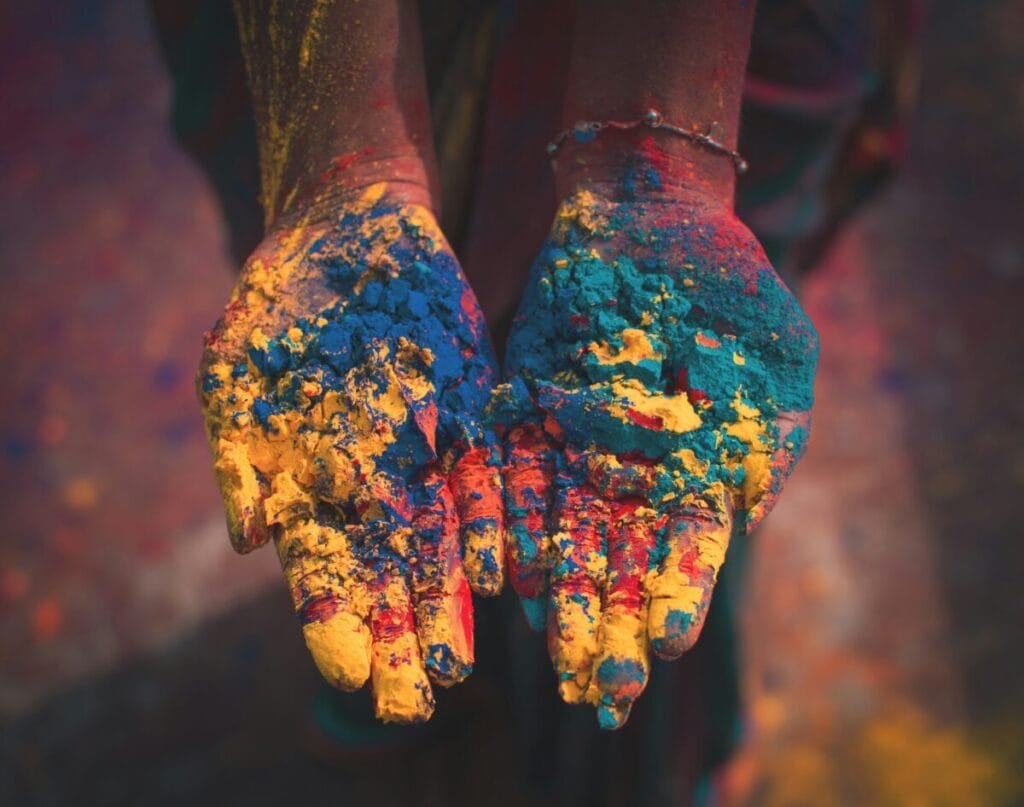
There are festivals – and then there is Holi in India.
A celebration so exuberant, so drenched in colour and emotion, that it feels less like a date in the calendar and more like a full-bodied experience of life itself. From the royal courtyards of Rajasthan to the temple towns of Uttar Pradesh, Holi unfolds differently across states. Yet nowhere does it burn brighter, louder or more beautifully than in Vrindavan.
Vrindavan, you beauty.
The Sacred Origins: More Than Just Colour
Holi marks the arrival of spring and the triumph of good over evil, rooted in the ancient legend of Prahlad and Holika. But beyond mythology, it is deeply entwined with the playful love story of Lord Krishna and Radha.
Nowhere is this connection more alive than in Vrindavan and nearby Barsana in Uttar Pradesh – the land where Krishna is believed to have spent his childhood.
Here, Holi is not merely celebrated. It is relived.
A Kaleidoscope Across States: How India Paints Holi Differently
India doesn’t do uniformity – and Holi proves it.
Rajasthan: Royal Revelry
In Jaipur and Udaipur, Holi arrives with regal flair. Elephants adorned in vibrant textiles, traditional folk dances and palace celebrations add a stately charm. The atmosphere is festive but polished – colour meets royalty.
West Bengal: Artistic Elegance
In Shantiniketan, Holi is known as Basanta Utsav. Inspired by Rabindranath Tagore, it blends poetry, music and graceful performances. Students dressed in yellow welcome spring with refined showers of colour – a cultural Holi that feels almost theatrical.
Punjab: Warrior Spirit
In Anandpur Sahib, Hola Mohalla follows Holi with a display of Sikh martial arts. Expect mock battles, fearless horsemanship and powerful processions. It’s a high-energy celebration that swaps powdered pigments for displays of strength and skill.
Maharashtra & Goa: Coastal Cheer
In Mumbai and Goa, Holi becomes a street carnival. Beach parties, music festivals and youthful exuberance fill the air. It’s loud, liberating and joyously chaotic.
Yet for all this diversity, there’s a gravitational pull that draws travellers to one place in particular.
Vrindavan: Where Holi Becomes Devotion
Vrindavan isn’t just another stop on the Holi trail – it is the emotional epicentre.
Located in Uttar Pradesh along the Yamuna River, this ancient temple town transforms into a living canvas for nearly a week before the main festival day.
Banke Bihari Temple: A Divine Colour Storm
Inside the famed Banke Bihari Temple, the air thickens with anticipation. Priests hurl vibrant clouds of gulal (coloured powder) over ecstatic devotees. Flowers rain from above. Drums beat relentlessly. Chants of “Radhe Radhe!” ripple through the crowd.
You are not watching a festival.
You are inside it.
The colours here feel sacred. Strangers embrace like old friends. Time dissolves. Devotion and celebration merge into one.
Barsana’s Lathmar Holi: Playful, Powerful, Unforgettable
A short drive from Vrindavan lies Barsana, birthplace of Radha. Here, Holi takes on a theatrical twist known as Lathmar Holi.
Men from neighbouring Nandgaon arrive in procession, teasing the women of Barsana. In response, women playfully chase them away with sticks (lathis). It’s spirited, humorous and surprisingly symbolic – a re-enactment of Krishna’s playful visits to Radha’s village.
Expect laughter, drumbeats, swirling saris and a spectacle unlike anything else in the world.
Widow’s Holi: A Moving Reclamation of Joy
Until recently, widows in Vrindavan were forbidden from participating in festivities. That changed in 2013 when widows began celebrating Holi publicly for the first time.
Today, at temples such as Gopinath Temple, widows dressed in white joyfully throw colour and flower petals – a deeply moving sight that symbolises dignity, inclusion and renewal.
It is Holi at its most powerful.
The Sensory Symphony: What It Feels Like
Holi in Vrindavan is not gentle.
It is colour in your hair for days.
It is pink-stained cheeks and purple-splashed clothes.
It is music vibrating through temple walls.
It is sweet thandai laced with spices.
It is marigolds underfoot and rose petals in your hands.
And it is connection – profound, unfiltered, human connection.
Visitors often arrive as observers and leave as participants. There is no staying on the sidelines.
Practical Tips for Experiencing Holi in Vrindavan
If you’re planning to witness this spectacle, preparation matters:
- Arrive early: Festivities in Vrindavan begin several days before the main Holi date.
- Wear old clothes: You will not rescue them.
- Protect electronics: Waterproof covers are essential.
- Stay respectful: Temples are sacred spaces – follow local guidance.
- Book accommodation in advance: Rooms fill quickly in March.
Safety has improved significantly in recent years, with increased police presence and organised temple events. Still, travel in groups where possible and remain aware of your surroundings.
Why Vrindavan Steals the Show
Holi across India is vibrant, diverse and unforgettable. Yet Vrindavan offers something deeper – a spiritual immersion layered beneath the colour.
Here, every splash of pink tells a story.
Every chant carries centuries of devotion.
Every street feels like a stage for divine play.
It is chaotic, yes. Intense, certainly. But it is also breathtakingly beautiful.
In a world that often feels divided, Holi in Vrindavan reminds us of something essential – beneath our differences, we are all just human beings longing for joy, warmth and connection.
And for a few gloriously colourful days each spring, Vrindavan delivers exactly that.
So if you ever find yourself wondering where to experience Holi in its purest, most electrifying form, follow the colours.
They will lead you to Vrindavan.
And trust me – you beauty – you won’t forget it.