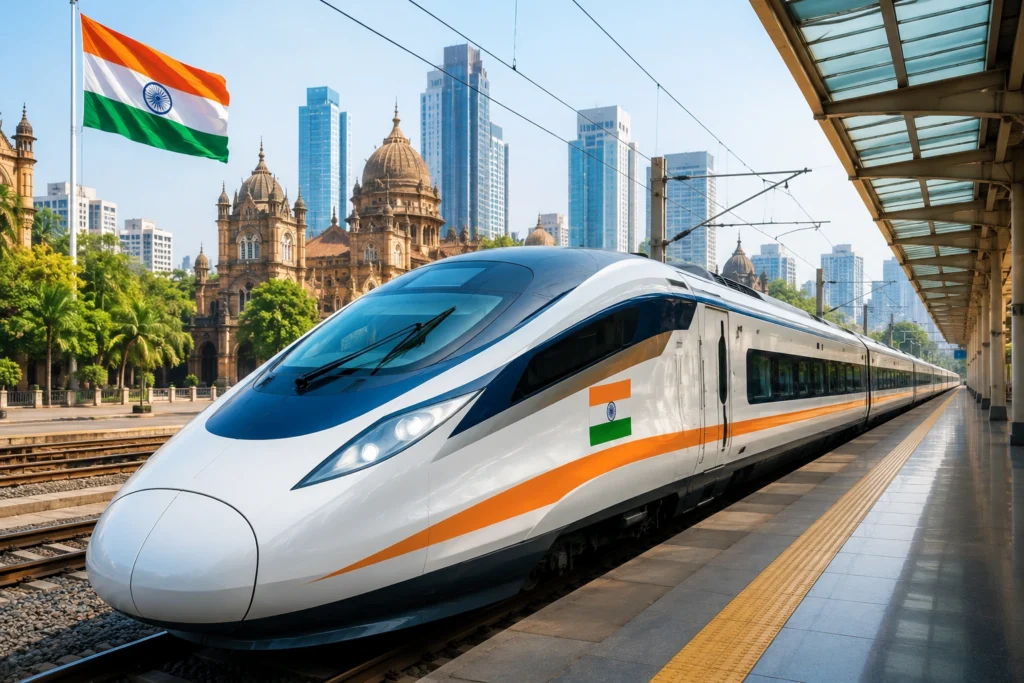
India is preparing to enter a new era of transportation with the planned launch of its first bullet train service in 2027, marking one of the country’s most ambitious infrastructure and mobility projects in modern history.
The Mumbai–Ahmedabad high-speed rail corridor will become India’s first operational bullet train route, introducing high-speed rail travel capable of dramatically reducing journey times while transforming domestic tourism, business travel, and regional connectivity.
The project is expected to redefine long-distance transportation across India by offering faster, more efficient, and technologically advanced rail services connecting some of the country’s most important economic centers.
Once operational, the high-speed corridor is anticipated to become a major catalyst for tourism growth, commercial expansion, and sustainable transport development across western India.
Mumbai–Ahmedabad Corridor Will Become India’s First High-Speed Rail Route
The inaugural bullet train service will operate between Mumbai and Ahmedabad, covering approximately 508 kilometers through one of India’s busiest economic and industrial regions.
The corridor will connect major urban centers including Surat, Vadodara, and Vapi, significantly improving travel efficiency between Maharashtra and Gujarat.
Currently, conventional rail journeys between Mumbai and Ahmedabad can take up to seven hours depending on service type and route conditions.
The new bullet train is expected to reduce travel time to approximately two to three hours, fundamentally changing how passengers move between the two cities.
Officials expect the corridor to eventually handle more than 70 million passengers annually, highlighting the strong demand for faster and more reliable intercity transportation in India.
The route is also expected to reduce congestion across highways and airports by shifting a significant portion of short-haul domestic travel toward high-speed rail.
Bullet Train Speeds Will Reach Up to 320 Kilometers Per Hour
India’s first bullet trains will feature advanced B28 trainsets developed through collaboration with Japanese high-speed rail technology partners.
The trains are designed to achieve maximum speeds of up to 320 kilometers per hour, although operational speeds during the initial phase are expected to average approximately 280 kilometers per hour for safety and efficiency purposes.
At these speeds, the Mumbai–Ahmedabad route will become the fastest ground transportation option between the two cities.
Compared with air travel, the bullet train is expected to offer a more seamless travel experience by reducing airport wait times, security procedures, and boarding delays often associated with short domestic flights.
Travel experts believe high-speed rail could increasingly compete with airlines on medium-distance routes where convenience and city-center connectivity provide significant advantages.
Ticket Pricing Expected to Compete with Domestic Airlines
Although official fares have not yet been finalized, estimates suggest standard-class ticket prices may range between ₹2,000 and ₹3,000.
Business-class and premium seating options are expected to be priced higher, offering upgraded amenities and additional comfort for corporate and luxury travelers.
The projected pricing positions the bullet train competitively against domestic airlines operating between Mumbai and Ahmedabad, where airfare often fluctuates between ₹3,000 and ₹8,000 depending on travel season and booking periods.
For travelers, the combination of reduced travel time, lower stress, and competitive pricing could make high-speed rail an attractive alternative to both flying and long-distance road travel.
Industry analysts expect the service to appeal strongly to business commuters, tourists, families, and daily travelers seeking efficient and reliable transport solutions.
India Introduces Advanced Rail Technology and Modern Passenger Facilities
The Mumbai–Ahmedabad bullet train project represents one of the most technologically advanced transportation developments ever undertaken in India.
The trains will feature modern passenger amenities including high-speed Wi-Fi connectivity, advanced air conditioning systems, spacious seating layouts, digital information displays, and energy-efficient engineering systems.
Stations along the route are being developed with international-standard infrastructure designed to enhance the overall passenger experience.
Travelers can expect features such as digital ticketing systems, modern waiting lounges, smart baggage handling, automated information services, and upgraded security systems.
The project also aligns with India’s broader infrastructure modernization goals under the “Make in India” initiative, with manufacturing support involving Indian companies including BEML Ltd and the Integral Coach Factory.
The emphasis on domestic production and advanced engineering is expected to strengthen India’s long-term rail manufacturing capabilities and support future high-speed rail expansion.
High-Speed Rail Expected to Transform Tourism and Business Travel
The introduction of bullet trains is expected to create substantial benefits for India’s tourism and hospitality industries by making regional travel significantly faster and more convenient.
Destinations across Gujarat and Maharashtra could experience increased tourist arrivals as shorter travel times encourage weekend tourism, business events, leisure travel, and multi-city itineraries.
Hotels, restaurants, retail centers, conference venues, and local tourism operators are all expected to benefit from stronger intercity connectivity.
Business travel is also expected to evolve rapidly once the corridor becomes operational.
Faster access between Mumbai and Ahmedabad could improve commercial efficiency across finance, manufacturing, technology, trade, and industrial sectors while supporting stronger economic integration between major urban centers.
The project is also anticipated to create employment opportunities across construction, engineering, tourism, hospitality, operations, and transport services.
India Plans Future Expansion of High-Speed Rail Network
The Mumbai–Ahmedabad corridor is widely viewed as the first phase of a much larger high-speed rail vision for India.
Government planners have already explored future bullet train routes connecting cities such as Delhi, Bengaluru, Chennai, Hyderabad, and Kolkata as part of a broader national transportation modernization strategy.
If successful, India’s bullet train network could eventually reshape domestic travel patterns in the same way high-speed rail transformed transportation across countries including Japan, France, China, and Spain.
The expansion of high-speed rail may also contribute to India’s sustainability goals by reducing dependence on domestic aviation and road transport while supporting lower-emission transportation alternatives.
India’s First Bullet Train Marks a Historic Turning Point for Transportation
The launch of India’s first bullet train in 2027 is expected to represent a historic milestone for the country’s transportation sector and wider economic development ambitions.
By combining cutting-edge rail technology, modern infrastructure, competitive pricing, and dramatically reduced travel times, the Mumbai–Ahmedabad corridor is set to transform how millions of Indians travel between major cities.
As India accelerates investment in high-speed transportation infrastructure, the country is positioning itself among the world’s emerging leaders in modern rail mobility, creating new opportunities for tourism, commerce, and sustainable urban connectivity.
For more travel news like this, keep reading Global Travel Wire