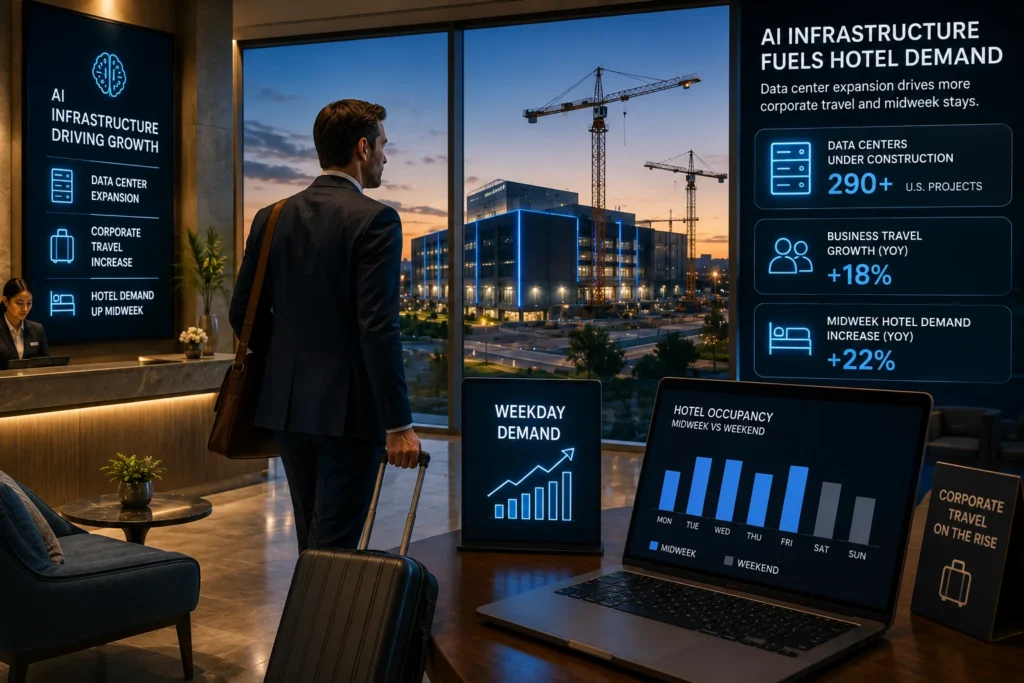
The global surge in artificial intelligence development and large-scale data center construction is emerging as a primary catalyst for international lodging demand. Official financial disclosures and public earnings reports from leading global hotel operators show that capital expenditure directed toward cloud computing facilities, semiconductor fabrication plants, and energy infrastructure is actively generating consistent midweek room nights. As technology corporations and utility providers invest hundreds of billions of dollars into regional technology hubs, hotel brands are recording sustained increases in business transient travel, extended-stay occupancy, and local corporate spending.
This infrastructure-driven boom is expanding beyond traditional tech hubs into secondary and tertiary markets across North America, Europe, and Asia-Pacific. Engineers, construction management crews, electrical contractors, and software specialists moving through multi-year planning, facility build-out, and system commissioning phases are creating structural, recurring lodging demand.
Midweek Business Transient Growth Driven by Technology Infrastructure
According to official corporate disclosures from Hilton Worldwide Holdings, midweek business travel has experienced significant acceleration across regions anchoring major data center projects. In quarterly financial statements submitted to market regulators, the hospitality leader highlighted that system-wide Revenue Per Available Room (RevPAR) expanded by 3.9 percent year-over-year, supported by a 5.4 percent RevPAR increase in North American markets. Global business transient RevPAR alone rose by 5.7 percent, driven largely by commercial project activity and corporate travel.
Public executive statements during quarterly investor briefings emphasize that large-scale infrastructure projects—including multi-billion-dollar data center campuses and regional power grid modernizations—are altering corporate travel patterns. Unlike seasonal leisure getaways or weekend leisure trips, infrastructure-driven travel generates sustained, multi-day bookings from Monday through Thursday. Because major data center developments represent multi-year capital commitments, hotel operators view this corporate activity as a durable source of structural demand rather than a short-term cyclical spike.
The Midscale and Upper-Midscale Sector Surge
A defining characteristic of this technology-driven travel wave is its widespread benefit for midscale and upper-midscale lodging properties. Official earnings reports indicate that while luxury and lifestyle segments continue to capture high-spending international travelers, project teams and technical specialists working on data center construction sites predominantly utilize mid-tier hotel brands.
In official quarterly statements, hospitality leaders described a notable performance shift across mid-market hotel tiers. Midscale and upper-midscale brands, which previously experienced flat or slightly declining growth during prior quarters, reversed course to achieve room revenue growth ranging between 4 percent and 6 percent. Construction crews, specialized technicians, and operational staff requiring comfortable, reliable accommodations near industrial parks and technology corridors are maintaining high occupancy levels across these select-service and extended-stay properties.
This trend is particularly pronounced in regional markets that have approved dense clusters of data center construction, fiber-optic network expansions, and clean energy grid upgrades. By providing convenient lodging proximate to major build sites, mid-tier properties are capturing a substantial share of total project expenditure.
Constrained Supply Dynamics and RevPAR Expansion
The influx of AI-driven corporate travel coincides with a period of historically tight new hotel supply growth. Public financial filings across the commercial real estate and lodging sectors confirm that overall net unit growth across major markets remains below 2 percent annually, constrained by elevated borrowing costs and tight commercial lending conditions.
With room supply growing at modest rates while demand from technological infrastructure projects expands rapidly, hotel operators possess enhanced pricing power. Official corporate guidance updates reflect this favorable market dynamic, with major hotel chains raising full-year global RevPAR growth projections to between 3 percent and 3.5 percent. Solid midweek room rates, combined with strong group booking pipelines, continue to drive system-wide profitability and operational resilience.
Similar demand patterns are emerging internationally across Western Europe and key East Asian economies. As governments establish national digital transformation frameworks and approve localized data center development zones, regional hotel markets surrounding these facilities are benefiting from heightened long-haul business travel and corporate lodging demand.
Digital Innovation and Direct Booking Ecosystems
To maximize returns from this expanding traveler base, global hospitality corporations are simultaneously deploying proprietary artificial intelligence capabilities within their consumer booking channels. Official company releases outline investments in enterprise AI tools designed to streamline property searches, personalize room recommendations, and simplify corporate booking workflows for business travel planners.
By combining internal digital innovation with external market tailwinds created by physical data center construction, major hotel groups are optimizing the entire travel lifecycle. Automated planning interfaces reduce booking friction for corporate travel managers, while direct digital channels increase customer retention and reduce distribution costs.
As capital continues flowing into global AI infrastructure, technology parks, and supporting energy grids, the hospitality sector stands to maintain a reliable baseline of high-yield corporate transient demand. For global lodging networks, the physical expansion of artificial intelligence represents a structural economic driver that reinforces hotel occupancy, supports steady rate growth, and underpins long-term industry expansion.
For more travel news like this, keep reading Global Travel Wire