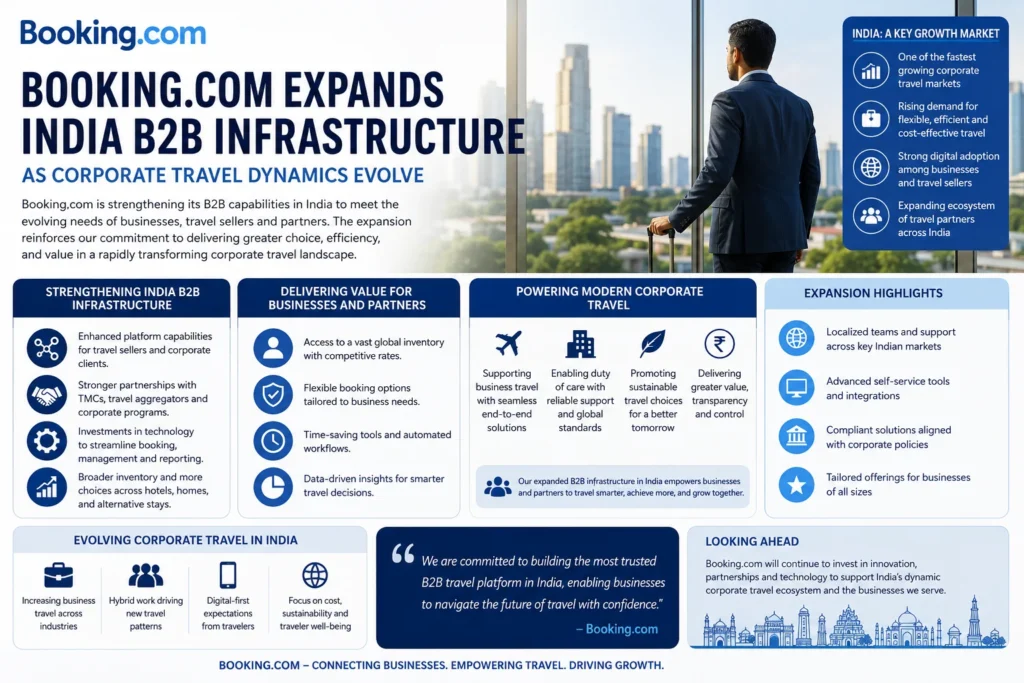
A fundamental shift is sweeping across the South Asian corporate landscape as technological innovation and economic growth redefine employee mobility. Booking.com has initiated a major infrastructure expansion targeting its business-to-business (B2B) platform services within India. The strategic initiative responds directly to long-term structural trends that are rapidly democratizing professional transit solutions beyond traditional fortune-level multi-national conglomerates.
According to regional economic analyses and international hospitality development trackers, India’s corporate travel management segment has emerged as one of the fastest-growing professional markets globally. Historically, comprehensive automated booking frameworks were the exclusive domain of enterprise giants possessing extensive, dedicated procurement operations. The modern landscape, however, features a swift decentralization, with mid-market corporations, fast-growing technology startups, and small-to-medium enterprises actively integrating enterprise-grade travel infrastructure into their daily operational models.
AI Integration Transforms Managed Travel Into a Strategic Advantage
The deployment of advanced artificial intelligence is changing corporate travel from an administrative task into a highly responsive asset. Modern digital architectures utilize machine learning algorithms to predict employee accommodation preferences, optimize airline routing schedules, and negotiate institutional tariffs automatically. Rather than relying on multi-tier manual email requests and prolonged internal authorization chains, corporate travelers now interact with predictive booking engines that automatically match itineraries against internal company governance policy.
A critical element of this platform expansion involves the seamless harmonization of diverse digital business systems. Next-generation B2B travel networks integrate directly with existing corporate expense accounting systems, financial software packages, and corporate employee smartphones. This centralized connectivity delivers immediate operational advantages:
Complete elimination of manual expense data entry and receipt logging
Instant validation against corporate travel policy constraints
Accelerated employee reimbursement cycles via automated approvals
Real-time visibility into active departmental travel expenditures
Furthermore, digital automation tools operate continuously to resolve basic booking issues, handle itinerary alterations, and manage cancellation workflows in multiple regional languages. This automated support model reduces reliance on traditional localized call centers, ensuring corporate travelers receive uninterrupted operational support regardless of time zones or geographic locations.
Strategic Cross-Border Localization Across the South Asian Region
The expansion methodology deployed by major global distribution platforms underscores a profound institutional confidence in India’s structural development path. Successful market penetration relies heavily on rigorous localized adaptation. Platforms are investing heavily in integrating local payment gateways, adapting interfaces to support regional dialects, and forging operational alliances with localized corporate travel consultancies.
This hyper-localized strategy recognizes that corporate travelers operating within the Indian market must navigate unique regulatory compliance frameworks, including strict Goods and Services Tax (GST) invoicing rules. Corporate dashboards are engineered to automatically capture, categorize, and archive compliant tax data by department, individual employee, and third-party vendor. This functionality dramatically simplifies the year-end financial auditing process for corporate procurement divisions.
Strategic distribution alliances with domestic financial technology firms and enterprise software networks embed travel tools directly into everyday corporate operational workflows. By integrating booking capabilities within the primary applications that businesses already use to manage human resources and payroll, platform providers create resilient service ecosystems that deliver lasting value to commercial clients.
Economic Development and the Transition to Sustainable Corporate Travel
Long-term economic data released by national statistics bureaus highlights a sustained upward trajectory for commercial travel spending across the country. Robust foreign direct investment inflows continue to necessitate frequent international business development missions, while the rapid geographical expansion of domestic corporations drives unprecedented inter-city employee movements.
Simultaneously, changing regulatory environments increasingly favor end-to-end digital transparency and automated audit trails. The ongoing national push toward digital documentation and financial clarity directly benefits software ecosystems that offer automated tracking platforms.
Corporate sustainability mandates are also emerging as a major factor influencing modern procurement decisions. Commercial enterprises are actively monitoring the carbon footprints generated by their operational travel programs, frequently favoring lower-emission transit alternatives. Next-generation travel platforms are responding by integrating transparent carbon-tracking metrics directly into their main recommendation engines, allowing corporate travel managers to choose environmentally conscious itineraries without sacrificing mandatory cost controls.
While the adoption of remote virtual communication tools remains high, continuous commercial data suggests that physical face-to-face engagements remain foundational to securing long-term business partnerships, finalizing intricate trade negotiations, and aligning cross-border corporate strategies. As a result, the core demand for robust, secure, and highly automated corporate travel management frameworks is projected to remain exceptionally strong, steering the future development of the travel sector for years to come.
For more travel news like this, keep reading Global Travel Wire