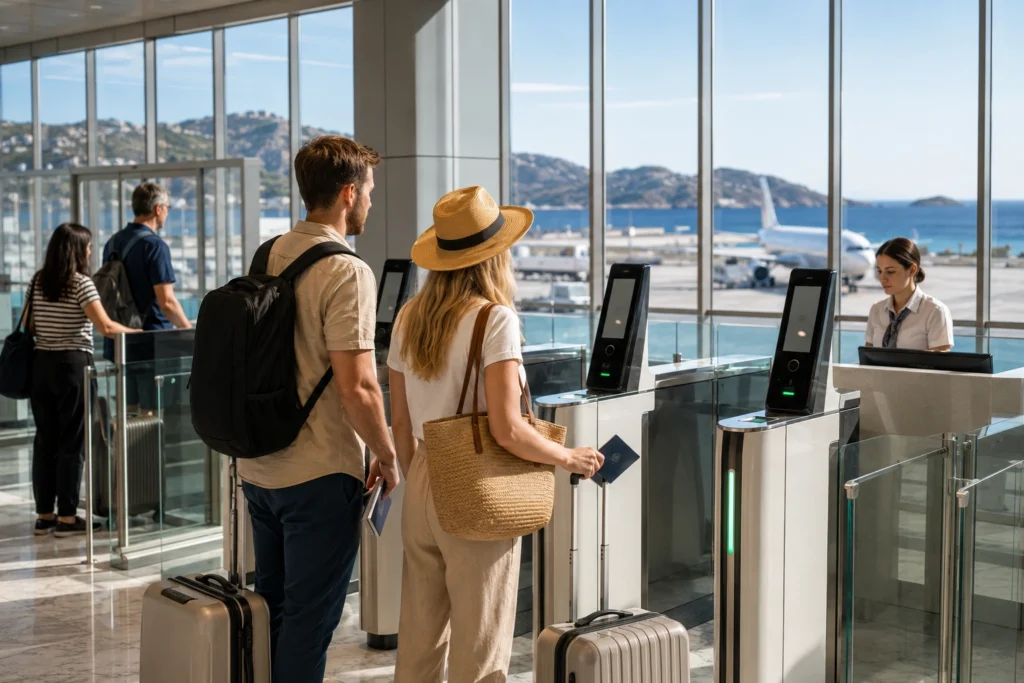
British tourists travelling to Greece this summer are being advised to follow local airport instructions carefully as Europe expands its digital Entry/Exit System across the Schengen area. However, the latest official guidance provides an important Greece-specific update: Greek authorities have indicated that fingerprints and photographs will not be collected from UK travellers as part of the EES process.
The clarification offers welcome relief for British holidaymakers heading to Greece during the busy Mediterranean summer season. It also highlights the need for travellers to check destination-specific procedures before departure, as the wider European border system continues to reshape airport arrivals for millions of international visitors.
The European Union’s Entry/Exit System became fully operational at external Schengen border points on April 10, 2026, following a progressive rollout that began on October 12, 2025. The system replaces routine passport stamping with digital records of entries, exits and refusals of entry for non-EU nationals visiting for short stays.
Greece Maintains a Different Process for UK Visitors
Across the Schengen area, eligible travellers may be asked to create a digital record at an airport, port or land border. This can include a passport scan, a facial photograph and fingerprints. The registration process is intended to improve border security, reduce identity fraud and help authorities track permitted stays more accurately.
Greece has introduced the EES at its air border crossing points. Nevertheless, British travellers visiting the country should follow the latest instructions provided by authorities on arrival, as Greece has indicated that biometric data will not be collected from UK visitors as part of the system.
This distinction matters for the tourism industry. Greece remains one of the most popular Mediterranean destinations for British holidaymakers, with demand extending across Athens, Crete, Corfu, Rhodes, Zakynthos, Santorini and other island gateways. A smoother arrival process could help reduce pressure at airport immigration halls during peak travel periods.
British Travellers Should Still Prepare for Border Checks
Although biometric collection may not apply to UK visitors entering Greece, British tourists should not assume that all border procedures have disappeared. Passports must still meet entry requirements, and travellers should keep documents accessible when arriving at Greek airports or ports.
Visitors should also follow instructions from airlines, airport teams and border officers, particularly during busy periods. Families, tour groups and travellers with onward transport bookings may benefit from allowing extra time after landing.
The Greece-specific arrangement does not automatically apply elsewhere. British passport holders travelling to other Schengen countries may still be required to provide fingerprints and a facial image when entering the region. This is particularly relevant for travellers combining Greece with another European destination or connecting through a Schengen airport before arriving in Greece.
For example, a passenger flying from the United Kingdom to Greece through another Schengen hub may complete border formalities at the first Schengen entry point. Procedures can therefore depend on the route, not only the final destination.
Digital Records Support the 90-Day Travel Rule
The EES is designed to record short stays automatically and support enforcement of the Schengen 90-day rule. British travellers can generally visit Schengen countries for up to 90 days within any rolling 180-day period without a visa.
Frequent visitors should continue tracking their travel dates carefully. The limit applies across the Schengen area as a whole rather than separately for each country. Previous trips to Spain, France, Italy, Portugal or other participating destinations can affect the number of days available for a holiday in Greece.
British citizens who are legally resident in Greece or another Schengen country should carry their residence documentation and present it at passport control. Long-term residents and certain other travellers may be exempt from EES registration.
Tourism Industry Prepares for a Digital Travel Era
For airlines, airports, hotels, cruise operators and tour companies, the wider EES rollout marks a significant shift in the European visitor journey. The system may add processing time at some border points, particularly for travellers completing first-time registration.
A second digital requirement is also approaching. The European Travel Information and Authorisation System, known as ETIAS, is expected to begin operations in the final quarter of 2026. Once introduced, eligible visa-exempt visitors will need to obtain an online travel authorisation before departure.
For now, Greece continues to welcome British tourists with a comparatively streamlined arrival process. The key message for travellers is clear: check the rules for every country on the itinerary, allow sensible connection times and follow local instructions at the border.
For more travel news like this, keep reading Global Travel Wire