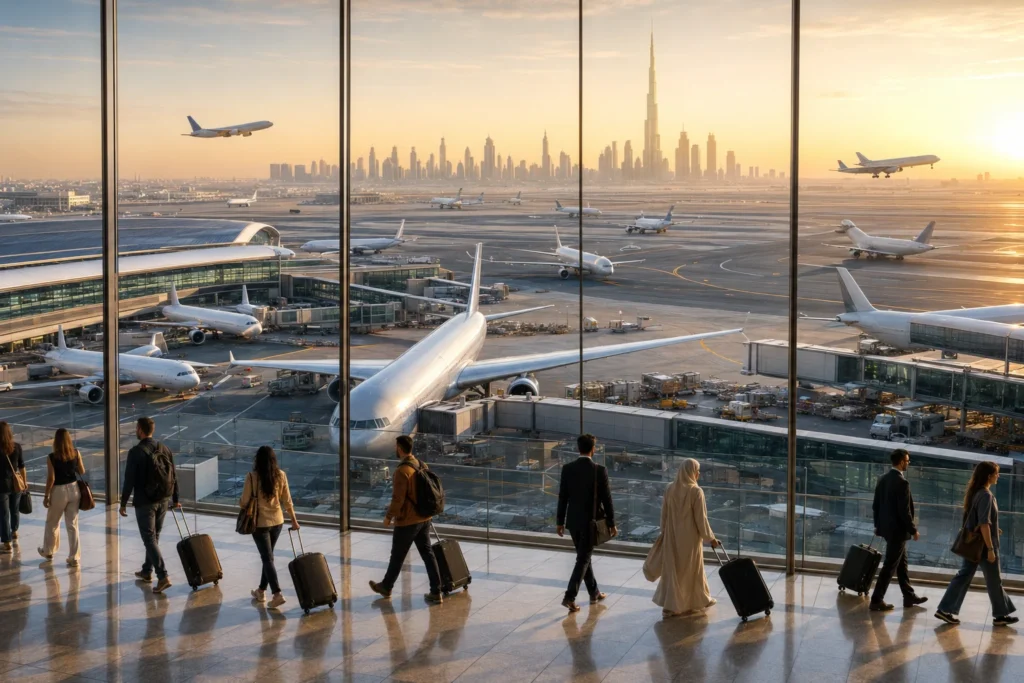
Official aviation data releases and public statements from regional transport authorities confirm that Dubai International Airport has secured the top global position for scheduled international seat capacity. Official schedules disclose that the international hub offered 4.35 million scheduled international seats, reflecting strong year-on-year growth and placing the United Arab Emirates’ primary aviation gateway ahead of major transit centers in Europe and Asia.
State aviation figures indicate that this milestone builds on sustained long-haul international travel demand and strategic network expansions. Following record-breaking annual passenger volumes, official updates demonstrate that the hub continues to expand its global connectivity while integrating advanced passenger processing infrastructure to manage high-volume passenger flows.
Official Rankings and International Seat Capacity Comparative Statistics
Published official aviation analytics compare international passenger capacity across major global hubs, highlighting the relative operational volume maintained by primary transit airports:
Dubai International Airport: Secured first position globally with 4.35 million scheduled international seats, driven by an eighteen percent year-on-year capacity increase.
London Heathrow Airport: Ranked second in international seat volume with 4.23 million scheduled seats.
Amsterdam Schiphol Airport: Held third position offering 3.82 million scheduled international seats.
Incheon International Airport: Recorded 3.75 million international seats, maintaining stable operating levels across Asian long-haul routes.
Paris Charles de Gaulle Airport: Reached 3.70 million scheduled international seats across global flight schedules.
Official historical releases show that this operational performance follows consistent international leadership recorded earlier in the year. Official statistics confirm the hub handled 95.2 million total passengers in 2025—its strongest annual volume on record—before processing 18.6 million passengers during the first quarter of 2026.
Advanced Biometric Infrastructure and Automated Border Processing
To efficiently manage surging passenger volumes and prevent terminal congestion, official airport administrators, working in coordination with the General Directorate of Residency and Foreigners Affairs, have deployed expanded biometric clearance systems and digital verification tools.
Key technological measures detailed in official aviation releases include:
Integrated Biometric Smart Gates: Registered international travelers complete passport control procedures in six to fourteen seconds using advanced facial and iris recognition scanners without presenting paper documentation.
The Red Carpet Travel Corridor: Launched as a multi-passenger clearance system, this automated corridor allows grouped passengers to undergo simultaneous biometric verification, reducing processing times during peak departure windows.
Pre-Travel Eligibility Verification: A centralized digital tool allowing departing and transiting passengers to confirm smart gate access permissions prior to arriving at passport control.
Off-Site Baggage Services: Initiatives permitting travelers to check luggage at remote transit points or designated hotels hours before departure to streamline terminal check-in queues.
Official airport statements emphasize that modernizing airside infrastructure and border processing automation remains essential for maintaining rapid aircraft turnarounds, preventing baggage processing bottlenecks, and upholding high passenger satisfaction ratings.
Essential Guidance for International Transit Travelers
Tourism boards and aviation security officials recommend proactive planning strategies for international passengers transiting through high-volume airport hubs during peak operational periods.
Official passenger guidelines advise travelers to follow established transit protocols:
Verify Smart Gate Eligibility: Access official digital airport portals prior to travel to confirm automated border clearance status.
Utilize Real-Time Luggage Tracking: Monitor checked baggage status using official airport mobile application tools throughout flight connections.
Leverage Digital Wayfinding Systems: Utilize interactive airport terminal maps to navigate transit gates, lounge facilities, and dining sectors.
Allow Ample Transit Window Time: Schedule international connections with sufficient buffer times to accommodate peak-hour terminal movement across major concourses.
Long-Term Strategic Outlook for Regional Aviation Growth
Official announcements from transport ministries reaffirm that ongoing investments in terminal digital ecosystems, off-site luggage handling, and smart border technologies underpin the nation’s long-term tourism and economic diversification targets.
By combining expansive global airline route networks with automated passenger processing, civil aviation authorities aim to maintain a resilient, secure, and highly connected international travel network. As global passenger demand continues to expand, official Dubai international airport capacity disclosures demonstrate how modern digital infrastructure supports sustained leadership in global transportation.
For more travel news like this, keep reading Global Travel Wire