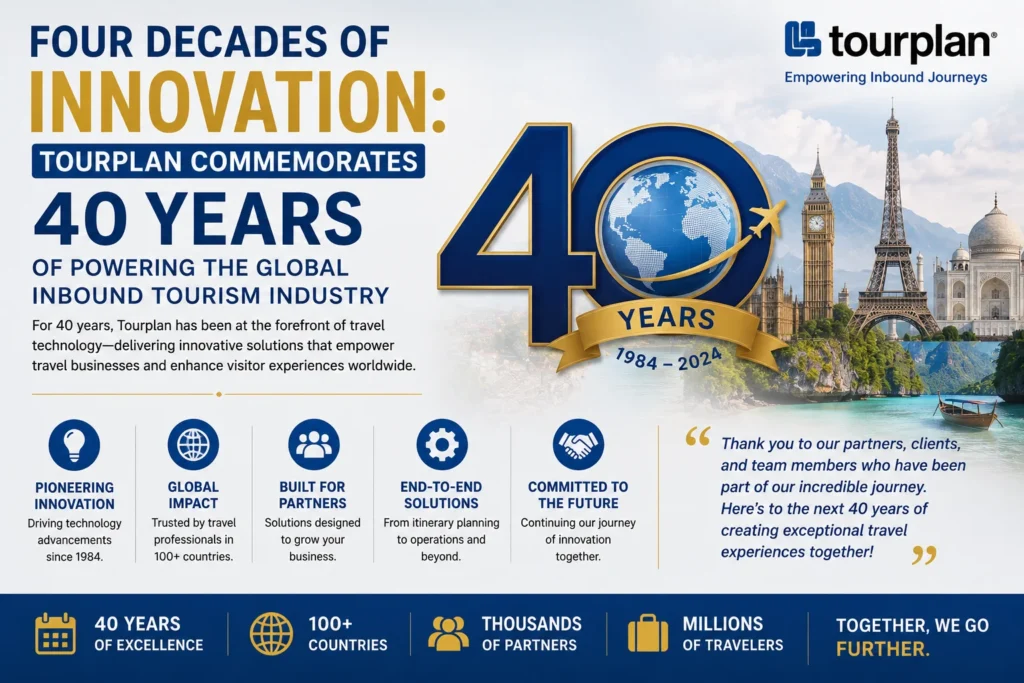
The structural backend of international destination management is observing a historic milestone as a pioneering technology enterprise marks four decades of uninterrupted operation. Tourplan, a globally recognized provider of comprehensive inbound tourism technology solutions, has launched an expansive international brand campaign to celebrate its 40th anniversary. Conceived in Christchurch, New Zealand, in 1986, the firm has quietly evolved into an essential digital foundation for hundreds of leisure travel companies, streamlining the complex mechanics that make experiential transcontinental vacations possible.
From its modest beginnings supporting a single localized client and twenty-nine foundational users, the platform’s footprint has grown significantly. Today, the software environment underpins the daily operations of more than 450 major inbound tour operators, specialized destination management companies, and regional travel specialists spanning seventy-five countries. With over 10,000 daily active power users and five dedicated regional corporate offices strategically scattered across four continents, the company’s growth directly parallels the modern evolution of the international travel technology sector.
From Early Web Booking Systems to Cloud-Based Ecosystems
The operational history of the platform serves as a clear historical record for the broader travel tech landscape over the past forty years. During the initial dawn of the internet age in the mid-1990s, the enterprise stood at the forefront of the industry by engineering some of the earliest web-based booking interfaces available to wholesale travel coordinators. This proactive deployment allowed long-haul destination handlers to easily transition away from manual fax transmissions and physical ledgers, setting new standards for rapid booking turnarounds.
As corporate hardware systems advanced, the company executed a comprehensive software rewrite in the early 2000s, shifting to an optimized desktop environment to manage expanding relational databases. In the contemporary era, this infrastructure has progressed into a highly modular, cloud-based Software-as-a-Service Enterprise Resource Planning system. This agile architecture enables independent boutique operations and multi-national tourism groups alike to centralize their sales, accounting, supplier contracts, and client itineraries within a single secure ecosystem.
Empowering Destination Management with Integrated Workflows
Operating an inbound tourism enterprise requires the continuous management of highly volatile, localized product inventories. Destination management companies must coordinate hundreds of unique accommodation allocations, multi-tiered transport logistics, dynamic pricing rules, and custom experiential tour itineraries simultaneously. Modern technology alleviates these administrative friction points by integrating every backend operation into a unified database.
The flagship software enables sales departments to instantly generate content-rich, brochure-quality digital proposals for business-to-business and business-to-consumer clients. Built-in pricing rules engines provide complete operational flexibility, allowing businesses to adjust date-sensitive margins, calculate complex commission structures, and apply market-specific markups effortlessly. Once a quote is accepted, the reservation module automatically routes booking demands to localized suppliers, significantly reducing human error and preventing accidental double-bookings or reservation gridlocks.
Strategic Global Presence and Proximity-Led Support Architecture
A central component of the company’s long-term retention framework—which boasts a high client consistency rate across several decades—is its strict adherence to a proximity-led customer support philosophy. Rather than routing technical challenges through single, detached offshore call centers, the firm has systematically established independent regional offices across Africa, the Americas, Asia, Europe, and the Pacific.
This multi-hub corporate structure places local software specialists and tourism industry experts inside the exact same time zones and cultural markets as the businesses they support. Whether managing complex group travel manifests, organizing high-profile corporate incentive journeys, or coordinating niche safari itineraries, regional teams provide tailored consultancy and implementation advice that reflects local market conditions. This structure ensures that emergency support remains active 24/7, providing a crucial safety net for high-volume operators handling thousands of international arrivals daily.
Next-Generation Automation and the Strategic Vision Beyond 2026
As the enterprise enters its fifth decade of continuous operation, its technical roadmap is heavily focused on deploying high-capacity automation enhancements designed to shield travel operators from rising labor costs. Corporate development plans detail the systemic integration of artificial intelligence tools within the core ERP module. These tools are engineered to automate routine client communications, optimize inventory distribution across external bedbanks, and dynamically suggest custom itinerary paths based on historical passenger data patterns.
By transforming its core software application into a completely interconnected travel technology ecosystem, the company continues to lower entry barriers for emerging tourism markets while maximizing profitability margins for established players. As global destination boards focus heavily on modernizing regional travel infrastructure, utilizing reliable, data-driven systems ensures that local ground handlers can scale up their operations fluidly, maintaining a stable link between initial transcontinental travel ideas and flawless on-the-ground vacation delivery.
For more travel news like this, keep reading Global Travel Wire