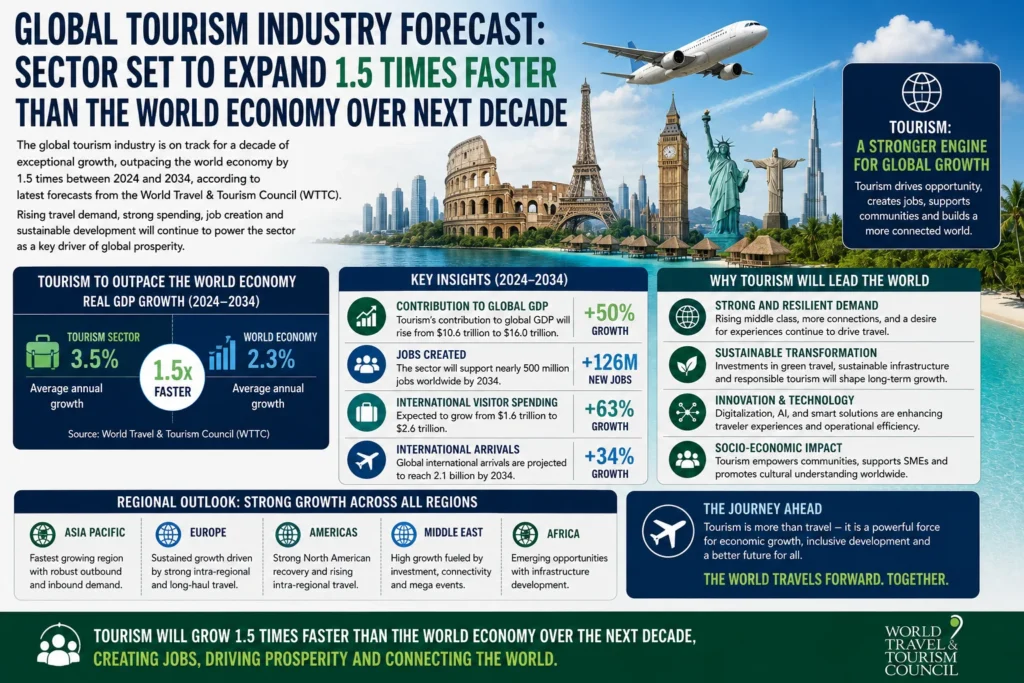
The international travel and hospitality landscape is on track for a prolonged period of historic expansion, positioned to significantly outpace the broader global economic landscape over the next ten years. Official macroeconomic data outlines a highly optimistic trajectory for international transit, leisure, and business travel. Despite broader macroeconomic headwinds, shifting consumer priorities are channeling capital directly into experiences, transforming tourism into an indispensable pillar of international wealth generation.
Comprehensive economic data reveals that global travel and tourism will continue its upward momentum. The sector is officially projected to contribute a staggering US$12 trillion to the global economy. This massive financial influx will represent roughly 9.9% of total global gross domestic product (GDP).
The industry is structured to achieve an annual growth rate of 3.2%. When contrasted against the baseline global economic growth projection of 2.4%, the tourism sector’s resilience and consumer demand become undeniably clear.
Sustained Job Creation and Long-Term GDP Trajectory
The human capital requirement necessary to sustain this level of international mobility is equally massive. The global travel framework is anticipated to directly support 376 million jobs worldwide. This employment density means that approximately one out of every nine active workers globally will be employed within the travel ecosystem, spanning from aviation operations and hospitality management to localized destination services.
Looking down the road at the ten-year horizon, the industry’s capacity for job creation remains unmatched by almost any other major economic sector. Between now and 2036, the tourism ecosystem is forecast to generate nearly 89 million entirely new jobs across the globe.
This volume represents approximately one-third of all newly created employment opportunities anticipated across the entire global economy during this period. Over this extended decade-long observation window, travel and tourism GDP is projected to maintain an average annual growth rate of 3.6%, consistently outstripping the wider global economy’s projected 2.4% baseline expansion.
To successfully anchor and support this long-term upward trend, global tourism boards and national ministries emphasize that strategic public and private investment must remain aggressive. Key development areas required to sustain this momentum include:
Substantial capital injections into physical transportation infrastructure, including airport expansions, high-speed rail corridors, and eco-conscious cruise terminal facilities.
Broad deployment of advanced digital technologies and artificial intelligence to refine operational efficiency, manage high passenger volumes, and optimize local supply chains.
Advanced destination management programs designed to prevent overcrowding while actively preserving natural and historical assets.
Comprehensive workforce vocational training initiatives to ensure hospitality staff are highly equipped for modern service standards.
The continuous expansion of international aviation connectivity to open up emerging tourist source markets.
European Tourism Surge Defies Regional Economic Slump
The regional performance metrics emerging out of Europe provide an excellent case study of the tourism sector’s unique economic independence. While the wider European continental economy struggles with modest growth, its internal tourism sectors are exhibiting remarkably robust health.
Overall European GDP growth is projected to crawl forward at just 1.0%. In sharp contrast, Europe’s dedicated travel and tourism GDP is modeled to surge by 3.6% over the same timeframe.
This continental resilience is heavily driven by international visitor spending patterns, which are forecast to rise by 7.1% across Europe. This rate sits comfortably above the projected global average visitor spending increase of 3.7%.
Public data suggests that this localized spending surge is a direct result of altering travel behaviors. Amid ongoing global geopolitical fluctuations, international and domestic vacationers are increasingly prioritizing regional travel and selecting destinations closer to home, benefiting stable European markets.
Southern European Gateways Lead the Charge
Southern European destinations continue to serve as the primary engine room for the continent’s travel economy. Spain’s national travel and tourism sector is on track to expand by 3.7%, while neighboring Italy is modeled to achieve an even higher growth rate of 3.8%. Additionally, international visitor spending inside Spain’s borders is set to grow by an impressive 5.3%.
This sustained growth follows an exceptional performance cycle. Official immigration and tourism board records confirm that Spain welcomed a historic 96.8 million international visitors, cementing its position as an premier European vacation destination.
This record-breaking influx generated a massive €115.1 billion (equivalent to approximately US$130.1 billion) in pure international visitor spending. Tourism ministry statements reiterate that as wider economic growth slows, the travel sector remains a foundational driver of national employment and commerce. Maintaining this long-term momentum will depend heavily on relaxed visa protocols, smart infrastructure investments, and optimized cross-border transit policies.
For more travel news like this, keep reading Global Travel Wire