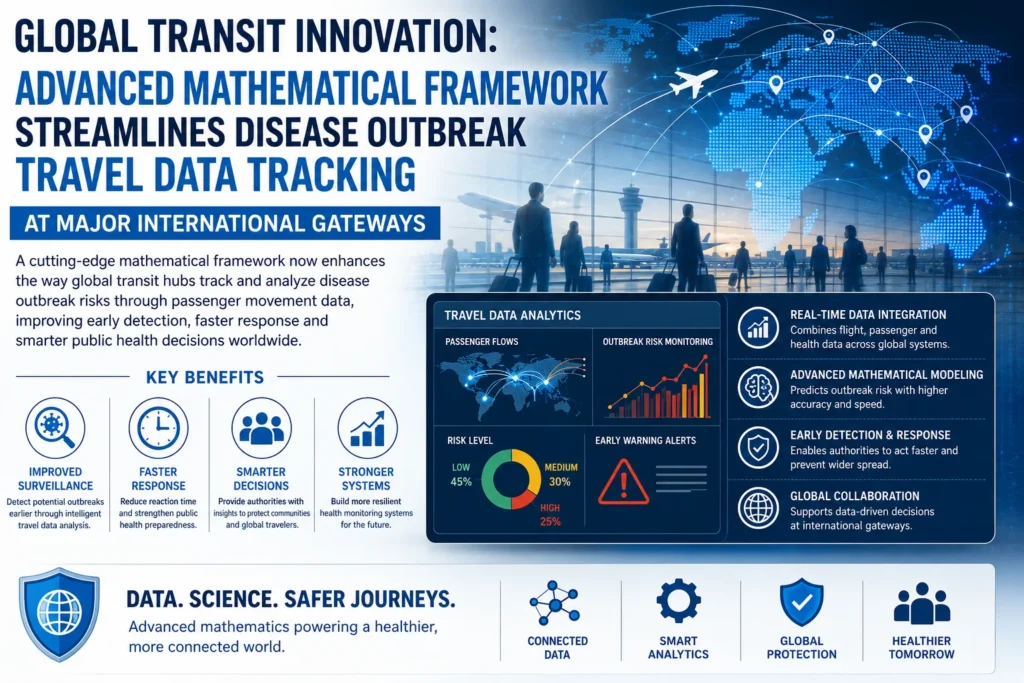
A major technological milestone has emerged from the intersection of computational data science and global transport logistics, offering public health sectors an optimized framework to protect international travel corridors. A collaborative study published in the peer-reviewed scientific journal Nature Communications introduces a scalable mathematical algorithm designed to significantly accelerate genomic pathogen surveillance without requiring expanded public financing. Developed by data scientists, the computational system targets a historic vulnerability in global transit networks: the lag time between a localized viral variation and its international tracking.
By integrating high-resolution international air travel datasets with dynamic epidemiological indicators, the network model enables aviation hubs to serve as proactive screening gates rather than passive transit points. The localized tracking model provides transport ministries and health organizations with the statistical ability to anticipate variant pathways across geographic sectors in real time, reshaping how border safety and global travel connectivity are managed during unexpected biological disruptions.
Overcoming Computational Limitations Across Connected Global Transit Hubs
Traditional computational models engineered to track pathogen progression across multiple cities frequently suffer from severe data processing constraints. Standard methodologies, such as the basic Sequential Monte Carlo (SMC) or particle filter framework, are historically effective only when applied to isolated, small-to-medium geographical regions. When processing the massive, multi-dimensional networks that define modern global aviation, traditional tracking tools struggle under a statistical phenomenon known as the curse of dimensionality, where calculation errors grow exponentially alongside the number of interconnected travel variables.
To make legacy systems work, researchers previously had to separate large-scale maps into isolated localized grids. However, this fragmented approach fundamentally fails when applied to the aviation sector because it forces the artificial separation of highly active travel corridors. The newly introduced Iterative Block Particle Filter algorithm resolves this technical limitation. The mathematical framework processes continuous streams of logistical data sequentially, where the statistical outputs of one municipal region instantly serve as the input metrics for the next.
This iterative structure allows tracking models to remain highly localized, controlling data filtering errors within specific transit zones while fully preserving the fluid interaction between distant metropolitan flight paths. Whether an individual passenger triggers a domestic transfer from New York to California or embarks on a long-haul cross-border arrival, the network architecture maintains a precise, unbroken evaluation of regional dependency over time.
Optimizing Limited Financial Resources Across High-Volume Flight Corridors
The primary practical benefit of the new algorithmic design lies in its capacity to maximize the operational efficiency of limited public health budgets. Maintaining extensive genomic sequencing facilities across every minor regional border crossing is financially unsustainable over long horizons, particularly within developing nations and remote tourism gateways. The iterative computational model allows governments to resolve this disparity by shifting from generalized broad-market screening to highly targeted resource deployment.
By evaluating active flight metrics alongside historical immunization data and live epidemiological reports, the data system identifies the precise transit junctions carrying the highest probability of variant migration. Public health agencies can utilize these automated predictions to concentrate specialized field equipment and genomic surveillance assets directly within primary international travel hubs. This data-driven precision ensures that emerging strains are mapped at an early stage, minimizing border delays for leisure and commercial travelers while preserving national transport continuity.
Extending the Predictive Framework Beyond Modern Pandemic Management
While the initial computational trials utilized multi-strain datasets to track global variations, the scientific framework is engineered as a general methodology for complex dynamic networks. The researchers behind the development have made the complete underlying software repository publicly accessible on collaborative development platforms, enabling global transport planners, infrastructure engineers, and biosecurity agencies to integrate the methodology into existing municipal frameworks.
Because the system specializes in analyzing real-time data streams across highly interdependent geographical grids, its long-term application extends into multiple fields of transit safety and public health management:
Seasonal Influenza Networks: Anticipating annual mutations across high-volume commuter rail lines and regional bus networks to optimize vaccine distribution.
Tropical Disease Corridor Mapping: Tracking vector-borne pathogens, including dengue, Zika, and West Nile virus, along migration routes and international tourism pathways.
Emergency Aviation Logistics: Securing early warning indicators for severe biological threats, such as Ebola or unexpected respiratory anomalies, before global containment lines are compromised.
The successful introduction of this spatial-temporal learning model marks a meaningful step forward for international transport resilience. By transitioning from reactive diagnostic tracking to real-time predictive analysis, the global travel industry gains a sophisticated tool capable of balancing public health requirements with the structural necessity of open, fluid global mobility.
For more travel news like this, keep reading Global Travel Wire