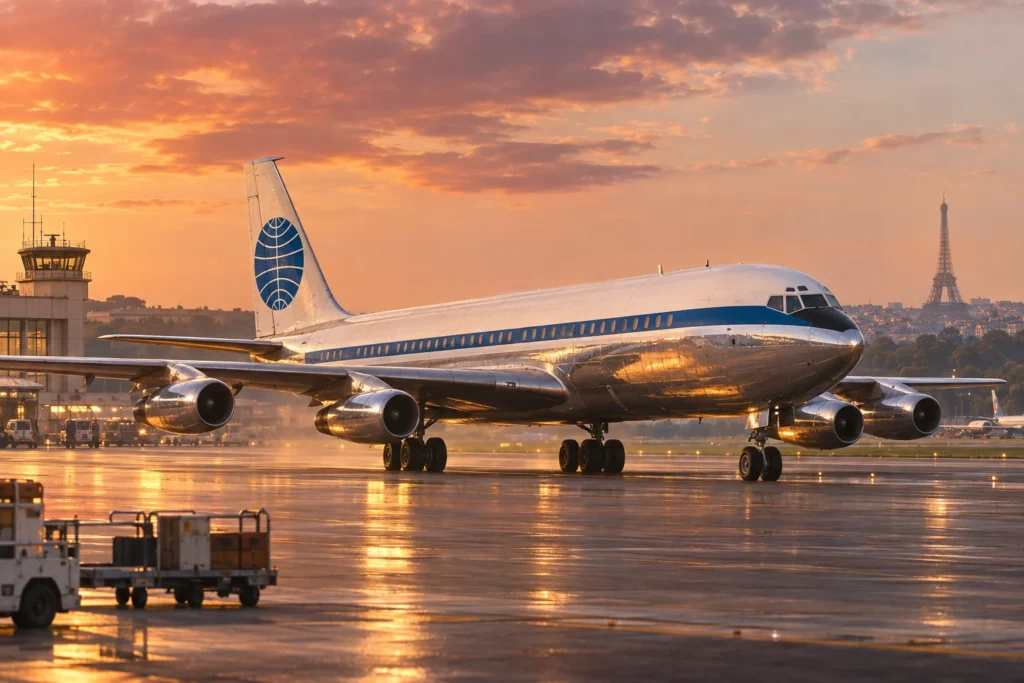
On October 26, 1958, a rain-slicked runway at New York’s Idlewild Airport—known today as John F. Kennedy International Airport—witnessed a watershed moment for global mobility. When Pan American World Airways dispatched its Boeing 707-121, christened Clipper America, toward Paris, it did far more than inaugurate an airline route. That evening launched the American commercial jet age, permanently altering the economics, speed, and accessibility of transatlantic jet travel and laying the groundwork for modern international tourism.
Carrying 111 passengers, the aircraft demonstrated how turbine-powered aviation could shrink oceans that once required grueling overnight crossings aboard piston-engine airliners. While Britain’s British Overseas Airways Corporation (BOAC) had introduced the de Havilland Comet 4 across the Atlantic three weeks earlier on October 4, 1958, Pan Am’s entry marked a decisive industrial shift. Under the leadership of chairman Juan Trippe, Pan Am’s commitment to the high-capacity Boeing 707 signaled to aviation authorities and travelers worldwide that propeller-driven long-haul flight was rapidly approaching obsolescence.
Engineering Speed and Capacity for Global Tourism
Before late 1958, intercontinental air journeys aboard aircraft such as the Douglas DC-7 or Lockheed Constellation demanded endurance from travelers and significant logistical planning from carriers. The Boeing 707-121 introduced four Pratt & Whitney turbojet engines slung beneath swept wings, a fully pressurized cabin, and a six-abreast economy seating layout. By cruising higher and faster than piston airliners, the jet drastically reduced travel fatigue and multiplied the number of crossings an airline could schedule each week.
Operational realities during the earliest days of the jet era still required careful route management. Because of runway limitations, payload weight, and fuel burn requirements on the early 707-121 variant, Clipper America could not complete the New York-to-Paris sector nonstop. Instead, the flight executed a scheduled refueling stop in Gander, Newfoundland—a strategic North Atlantic aviation hub since the Second World War. Even with the Newfoundland stopover, the aircraft touched down at Paris–Le Bourget Airport on October 27 in 8 hours and 41 minutes, with actual airborne time clocking in at roughly seven hours.
Landing at Le Bourget carried deep symbolic weight in aviation history. Just over three decades earlier, on May 21, 1927, Charles Lindbergh had arrived at the very same airfield after a solitary 33.5-hour crossing from New York. In thirty-one years, intercontinental flight had evolved from a daring solo feat into a scheduled commercial service transporting more than a hundred passengers in a single afternoon and evening.
Inside the Inaugural Crossing: Luxury Meets the Jet Age
Commanded by Pan Am Atlantic Division Chief Pilot Captain Samuel H. Miller, alongside First Officer W.W. Lynch, Flight Engineer James W. Etchison, and Navigator A.O. Powell, the inaugural flight—registered as N711PA—blended mid-century glamour with cutting-edge aerospace engineering. A dedicated cabin crew of seven attended to a manifest that included Academy Award-winning actress Greer Garson alongside aviation enthusiasts and business travelers.
Hospitality aboard early jetliners mirrored the prestige of ocean liners, with first-class travelers served gourmet cuisine prepared by Maxim’s of Paris. Yet despite the introduction of six-abreast economy seating designed to broaden the passenger base, flying remained an expensive privilege in 1958:
Economy Class Fares: A round-trip economy ticket between New York and Paris cost roughly $489 in 1958, translating to approximately $5,400 in 2026 purchasing power.
First Class Fares: Premium cabin tickets priced around $999, equivalent to roughly $11,000 today.
While those fares placed European vacations out of reach for average households in 1958, the operational efficiency of jet propulsion set in motion a steady decline in per-seat operating costs over the following decade.
Rapid Network Expansion and the Rise of Mass International Travel
Following the Paris debut, Pan Am rapidly scaled its Boeing 707 network between 1958 and 1960, linking New York with major European gateways including London, Frankfurt, and Rome, while extending jet corridors to San Juan, Caracas, Honolulu, and Tokyo. Subsequent longer-range variants, notably the Boeing 707-321 Intercontinental, soon eliminated the need for routine refueling stops in Gander, unlocking true nonstop city-pair connectivity across the Atlantic.
The transition was not without growing pains for civil aviation infrastructure. Early turbojets generated intense acoustic footprints and high fuel consumption during takeoff, prompting airport authorities in North America and Europe to establish new noise-abatement procedures, lengthen runways, and modernize terminal passenger-handling facilities to accommodate larger crowds arriving simultaneously.
The original aircraft from that historic October night, later renamed Clipper Mayflower, remained in active service until 1974. Twelve years after its 1958 breakthrough, Pan Am catalyzed a second revolution in global tourism by introducing the wide-body Boeing 747 in January 1970, further driving down ticket prices through unprecedented seating capacity. Together, the 1958 Boeing 707 launch and the subsequent wide-body era transformed international air travel from a rare luxury into an everyday bridge connecting cultures, economies, and millions of global visitors.
For more travel news like this, keep reading Global Travel Wire