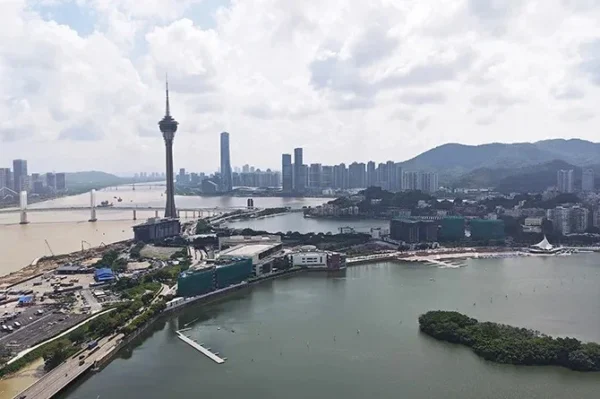
Macau plans to invest approximately MOP130 billion, equivalent to about US$16 billion, in four major projects designed to strengthen tourism, technology, education and logistics.
The five-year investment programme represents one of Macau’s strongest attempts to reduce its economic dependence on casino gaming. Authorities want non-gaming industries to contribute around 60% of gross value added by 2030.
Gaming will remain an important economic pillar. However, the new strategy aims to create additional sources of growth capable of attracting visitors, businesses, researchers, investors and skilled professionals.
Tourism sits at the centre of this transition. Macau plans to broaden the destination experience through culture, events, technology and entertainment while strengthening its position within the Greater Bay Area.
Four projects anchor Macau’s new economy
The programme centres on four large developments serving different parts of the diversification strategy.
The Macao-Hengqin International Education University Town will support higher education and talent development. It could help Macau build the specialist workforce needed by emerging industries.
The Macao Technology Research Industrial Park will provide space for innovation, applied research and technology businesses. Its success could also encourage closer cooperation between academic institutions and commercial enterprises.
Meanwhile, the Macao International Integrated Tourism and Cultural Zone will seek to diversify the visitor economy. It could introduce new attractions and experiences beyond the gaming floors traditionally associated with Macau.
Upgrades to the airport cargo terminal will strengthen logistics capacity and commercial connectivity. Better cargo infrastructure can support trade, retail, hospitality supplies and links with neighbouring markets.
Together, the four projects form part of Macau’s wider “1+4” strategy for appropriate economic diversification.
Cultural tourism could extend visitor stays
The proposed integrated tourism and cultural zone could become the programme’s most visible component for travellers.
Visitors increasingly expect destinations to offer culture, food, entertainment, events and interactive experiences alongside major attractions. Macau can respond by using its distinctive heritage to create broader itineraries.
Its historic architecture and Portuguese cultural influences already differentiate the territory from other Asian cities. Macau also holds international recognition for its historic centre and culinary traditions.
New cultural facilities, festivals and creative experiences could encourage visitors to explore more neighbourhoods and remain for longer periods. This would spread tourism spending beyond gaming establishments.
Hotels, restaurants, retailers, performance venues and local businesses could all benefit from a more diverse visitor economy. Longer stays may also support stronger demand for premium accommodation, guided experiences and destination dining.
The strategy could help Macau appeal to families, cultural travellers, event delegates and younger visitors seeking experiences beyond casinos.
Technology investment can transform tourism
The planned technology park gives Macau an opportunity to specialise in fields connected to its existing strengths.
Rather than competing broadly with larger technology centres, Macau could focus on tourism technology, digital payments, financial services, healthcare research and smart destination systems.
Tourism technology could improve crowd management, visitor information, reservations and personalised recommendations. It may also help hotels and attractions analyse demand more effectively.
However, infrastructure alone will not create a successful innovation centre. Macau must attract companies, researchers and entrepreneurs with clear regulations, incentives and access to suitable talent.
The university town could support this process by producing graduates with relevant skills. Stronger links between education, research and industry would make the technology park more than a collection of buildings.
If developed carefully, this ecosystem could create new jobs while helping Macau modernise its visitor economy.
Greater Bay Area opens regional opportunities
Macau’s connection with Hengqin and the wider Greater Bay Area provides access to a significant consumer market, business network and innovation environment.
Closer cooperation with Hengqin can give Macau additional space and economic capacity while allowing the territory to retain its international identity.
This relationship may attract companies seeking access to mainland markets alongside Macau’s tourism expertise and cultural links with Portuguese-speaking countries.
The territory’s European heritage could also support creative industries, design businesses, lifestyle brands and premium retail. Targeted support programmes may help Macau develop these opportunities without directly copying larger neighbouring economies.
Macau’s strongest position may lie in combining Asian connectivity, Portuguese influence and established visitor appeal.
Diversification depends on implementation
The MOP130 billion commitment establishes the physical foundation for economic change. Yet the results will depend on how effectively the projects become active centres for tourism, research, education and trade.
Businesses will need practical reasons to invest and remain in Macau. Skilled professionals will require attractive careers, while researchers need strong institutions and commercial partnerships.
Tourism projects must also create experiences that encourage longer stays and repeat visits. Cultural authenticity, service quality and convenient transport will remain essential.
Authorities will therefore need to align construction with workforce development, investment policies and international promotion.
The diversification programme marks a defining moment for Macau. If the territory combines major investment with focused execution, it could build a more resilient economy driven by culture, technology, education and tourism.
That transformation would not remove gaming from Macau’s identity. Instead, it would create a broader destination where heritage, innovation and entertainment contribute more evenly to future growth.
For more travel news like this, keep reading Global Travel Wire