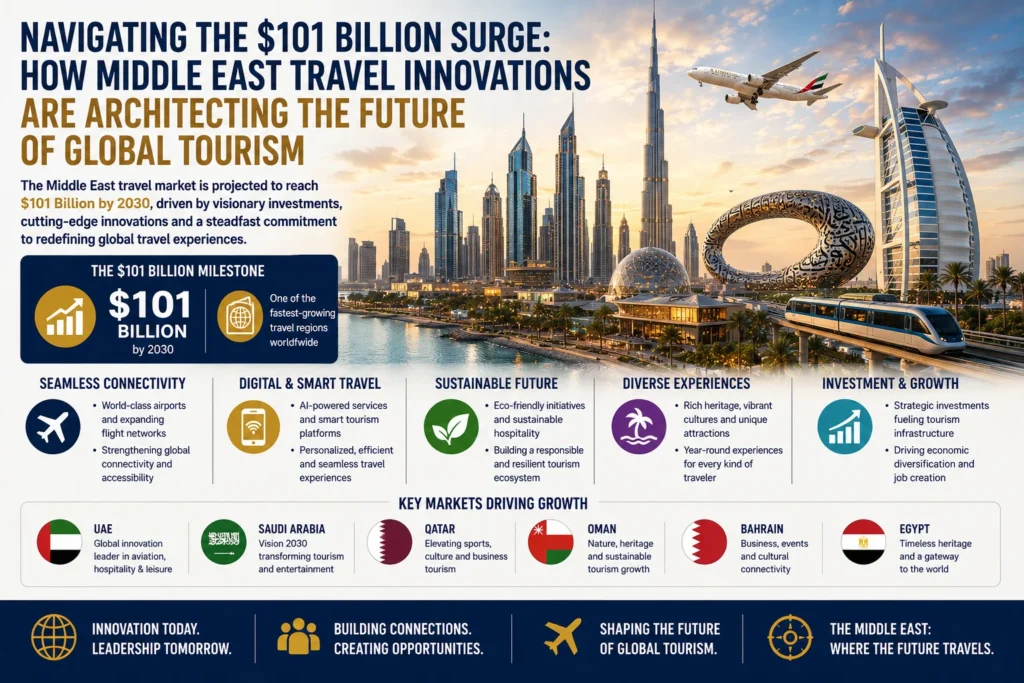
The landscape of regional hospitality and aviation is experiencing an extraordinary structural boom, characterized by historic capital investments and a dramatic pivot toward advanced technology integration. According to official sector indicators presented ahead of the upcoming Arabian Travel Market, total gross travel bookings across the Middle East have surpassed a staggering $101 billion. This monumental financial threshold highlights the region’s rapid evolution into a primary anchor of global tourism economics. It underscores a deliberate shift away from oil-reliant economic models toward a highly diversified, experience-driven infrastructure.
This rapid expansion will take center stage at the Dubai World Trade Centre from September 14–17, 2026, under the definitive strategic banner, “Travel 2040: Driving New Frontiers Through Innovation and Technology.” Official previews from the event’s organizing board emphasize that the multi-day international assembly will bring together premier public stakeholders, ministries of tourism, and private enterprise leaders. The core mandate is clear: transitioning from exploring theoretical concepts to demonstrating exactly how digital infrastructure can create tangible, sustainable, and long-term value for local communities and global travelers alike.
The Convergence of Physical and Digital Touchpoints
The foundational architecture of modern transit is undergoing a profound shift as artificial intelligence and automation transition from optional luxuries into essential operational components. Official administrative briefs highlight that future travel ecosystems will rely on the complete convergence of physical and digital touchpoints. This deep structural integration ensures that every step of the international transit process becomes more intuitive, predictable, and responsive to human behavioral patterns.
Rather than isolating technology as a standalone product, modern hospitality frameworks are embedding automated solutions throughout the entire visitor journey. This data-driven strategy enables hyper-personalized, predictive scheduling that anticipates passenger desires before arrival. By managing everything from biometric digital identity verification to responsive smart mobility connections across urban transit corridors, regional departments are working to eliminate systemic friction. This transformation allows destination networks to maintain an integrated presence that fundamentally redefines standard tourist expectations.
Artificial Intelligence as a Structural Safety Net
While consumer-facing personalization remains a highly visible aspect of digital transformation, the true industrial value of artificial intelligence lies in its ability to dramatically strengthen the resilience and daily efficiency of the broader commercial travel ecosystem. Official tourism analytics indicate that high-capacity regional operations benefit immensely from the deployment of deep learning models designed to streamline complex behind-the-scenes processes.
From an operational standpoint, automation handles the bulk of standard booking transactions and administrative tasks. This functional shift frees frontline human teams to focus entirely on direct guest relations and high-touch hospitality. On a broader scale, integrated analytical programs excel at complex demand forecasting and real-time disruption management. During unexpected weather delays or sudden airspace reconfigurations, automated data networks facilitate rapid, synchronized rebooking protocols across distinct airlines, hospitality networks, and ground transportation fleets. This proactive coordination minimizes bottlenecking at major international hubs and safeguards the consumer experience under volatile conditions.
Strategic Capital Diversification Across the Gulf
The continued growth of the Middle Eastern tourism market is the direct result of deliberate, multi-decade government master plans, aggressive airport expansions, and unprecedented cross-border collaboration. Official data sets published by regional development authorities demonstrate that targeted public investments have transformed the Gulf into a highly versatile powerhouse capable of weathering global economic fluctuations.
Initiatives such as the United Arab Emirates’ long-term tourism mandates and the comprehensive frameworks of Saudi Vision 2030 have successfully guided national economies toward sustainable commercial sectors. By investing heavily in next-generation airline fleets, sprawling airport cities, and large-scale cultural landmarks, regional administrations have expanded far beyond their traditional baseline of exclusive luxury leisure. Today, the economic landscape is heavily supported by dedicated investments in international business events, sports tourism corridors, global entertainment developments, and historic preservation projects. This comprehensive diversification broadens the geographic appeal of the region, ensuring a steady stream of year-round international arrivals.
Redefining Success Through Regenerative and Youth-Centric Models
As major municipal destinations continue to report record-breaking international arrival statistics, regional planning ministries are actively rewriting the metrics used to evaluate tourism success. Official policy positions stress that industry progress can no longer be calculated solely through total visitor volume or short-term hotel occupancy rates. Instead, future destination development must be measured by the long-term, regenerative value created for local communities, native ecosystems, and the conservation of cultural heritage.
This shift in evaluation matches a structural evolution in consumer demographics. Official statistics indicate that the rising wave of younger international travelers places an immense premium on authentic cultural exchange, transparent environmental purpose, and localized culinary and heritage experiences. For this highly connected generation, streamlined digital convenience, seamless mobile payment integration, and on-demand transit connectivity are viewed as baseline requirements rather than competitive advantages. To remain relevant, travel brands are adapting their structural frameworks to deliver highly flexible, culturally immersive, and socially responsible itineraries that align with these conscious consumption patterns.
A Shared Vision for Tomorrow’s Connected Ecosystem
The immense scale of the upcoming autumn gathering in Dubai underscores a growing consensus among international stakeholders: navigating a rapidly changing global market requires unprecedented levels of institutional knowledge-sharing and cross-sector alliance building. By serving as a neutral, high-capacity venue for global ministries, technology pioneers, and hospitality innovators, the event provides a critical launchpad for the next phase of international tourism development.
As data analytics, eco-conscious aviation fuels, and smart urban design become permanently woven into the fabrics of global cities, the future of travel will depend on how effectively the industry communicates with a highly informed public. Merging compelling cultural narratives with verified, data-backed operational insights allows destination managers to guide travelers toward more sustainable, meaningful decisions. The steady momentum of the regional sector proves that despite broader global market adjustments, a unified approach to technological innovation and infrastructure investment remains an incredibly powerful engine for international economic growth
For more travel news like this, keep reading Global Travel Wire