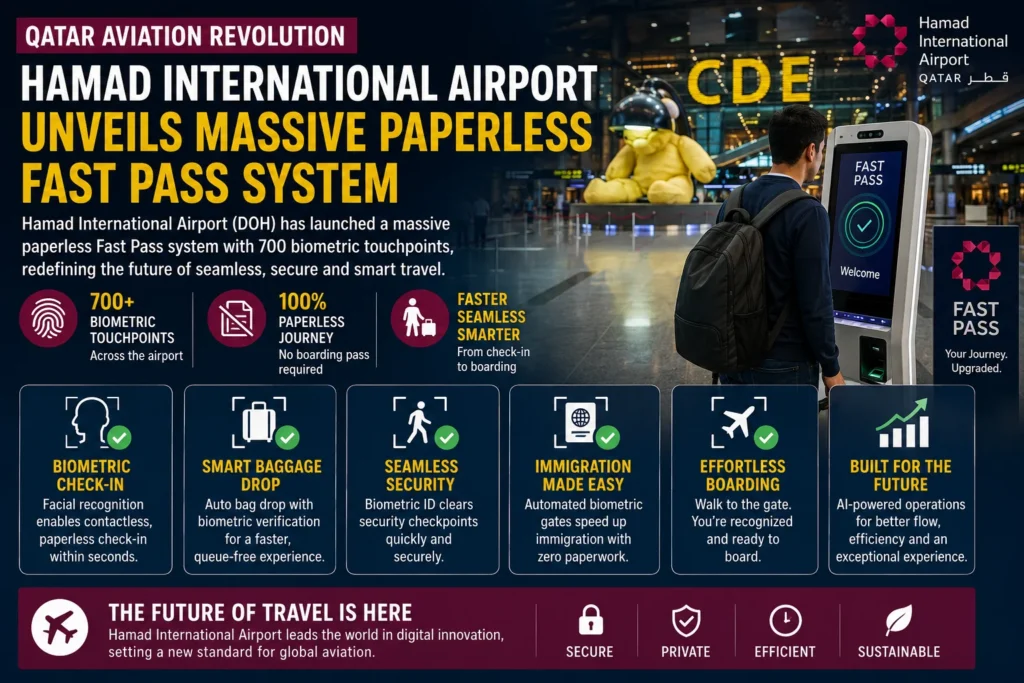
Hamad International Airport in Doha has initiated a significant operational upgrade by deploying one of the aviation industry’s largest biometric passenger-processing networks. Developed in close coordination with national carrier Qatar Airways and air transport technology provider SITA, the newly inaugurated Fast Pass service marks a major milestone in terminal automation. The advanced system integrates facial recognition capabilities across more than 700 distinct airport touchpoints, allowing departing passengers to complete nearly every phase of their pre-flight journey entirely passport-free and ticketless.
According to official declarations from Qatar’s civil aviation authorities and airport operators, the large-scale technology rollout is designed to accommodate accelerating global passenger volumes while systematically reducing terminal congestion. By linking major processing steps into a single digital pipeline, the hub aims to optimize operational throughput and establish a new benchmark for seamless international transit.
One Unified Digital Identity from the Check-In Desk to the Departure Gate
The newly expanded biometric network integrates facial verification technology directly into self-service baggage drop units, automated security checkpoints, pre-border clearance zones, and aircraft boarding gates. Under this automated framework, the system eliminates the traditional necessity for repetitive paper documentation checks by establishing a trusted identity profile at the very beginning of the traveler’s airport experience.
To participate in the program, eligible travelers can enroll in the service through two distinct pathways. Enrollment can be completed remotely via the official mobile application during standard digital check-in or physically within the terminal building at dedicated self-service kiosks. The identity capture process requires only a few seconds, involving a quick digital scan of a valid passport, acceptance of a transparent data privacy notice, and a high-resolution facial capture. Once verified, the passenger’s facial structure serves as their primary, secure boarding credential across all connected checkpoints.
Official security briefs from the airport administration emphasize that the core platform operates under strict international data protection standards. The technology is engineered to ensure that passengers maintain complete control over their personal identity metrics, with automated systems securely purging transit details according to data privacy regulations once a flight departs.
Meeting the Global Consumer Demand for Automated Airport Crossings
The strategic timing of the biometric deployment coincides with a distinct shift in consumer behavior and traveler expectations worldwide. Data released by the International Air Transport Association (IATA) from its latest Global Passenger Survey underscores a significant and rising international preference for streamlined, digital identity verification over traditional paper documentation.
The comprehensive industry survey compiled key passenger insights reflecting high levels of satisfaction with automated airport systems:
Eighty-five percent of surveyed international passengers who previously used biometric identification reported a highly positive experience with the automated process.
Seventy-four percent of global travelers expressed a clear willingness to share their biometric identity data with verified entities if it allowed them to bypass physical passport checks and traditional boarding card lines.
Forty-two percent of travelers who initially expressed hesitation regarding digital identification stated they would actively reconsider using the technology if robust data privacy guarantees were explicitly maintained.
By establishing a system where a traveler is securely verified a single time and recognized continuously throughout the departure concourse, airport management can facilitate a much higher volume of hourly passenger movements without experiencing physical queues or bottlenecking at critical safety checkpoints.
Expanding the Automation Footprint to Transit Networks and Partner Carriers
The initial launch phase of the paperless service is currently optimized for departing passengers utilizing the national flag carrier network. However, according to the airport’s long-term digital innovation roadmap, transport officials are already planning to scale the technology’s operational footprint significantly in upcoming operational cycles.
The next deployment phase will actively integrate the biometric service into the hub’s expansive transfer and transit areas. This addition is projected to streamline connections for millions of international long-haul passengers transferring between continents via Doha. Furthermore, plans are underway to open the digital infrastructure to other international commercial airlines operating out of the facility, ultimately transforming the entire airport into a unified, paperless transit gateway.
Industry experts notes that the successful integration of digital identity programs at this scale demonstrates a clear path forward for the global aviation network. By substituting physical documents with trusted biometric records, major international transit points are successfully modernizing their physical layout constraints, proving that future global travel can remain exceptionally secure while becoming faster, simpler, and completely built on digital efficiency.
For more travel news like this, keep reading Global Travel Wire