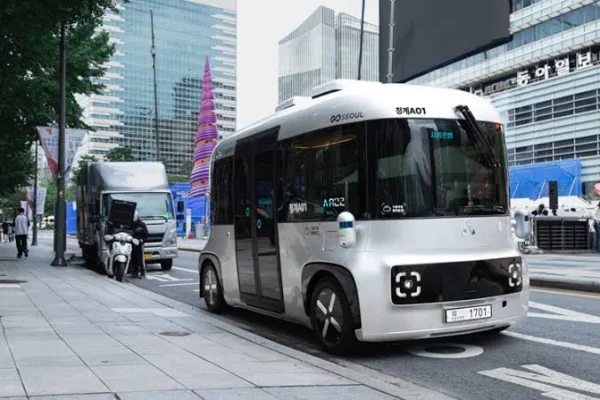
Seoul launched free evening operations of its Cheonggye A01 autonomous shuttle on 22 October 2026, connecting central attractions along Cheonggyecheon Stream. The service gives visitors another way to combine illuminated walks, traditional markets, restaurants and shopping districts after sunset.
Two vehicles serve a 4.8-kilometre round-trip route between Cheonggye Plaza and Cheonggye 5-ga, near Gwangjang Market. Weekday operations begin at 7 pm and finish at 11.50 pm.
The launch strengthens Seoul’s evening transport offer while bringing autonomous mobility into an established visitor district. However, each shuttle carries only eight passengers, making capacity an important consideration.
Weekday Departures Connect Central Attractions
Cheonggye A01 departs Cheonggye Plaza every 30 minutes, with nine scheduled departures each operating evening. The final departure leaves at 11 pm.
The service does not operate on Saturdays, Sundays or public holidays. Visitors should account for these restrictions when arranging their evening itinerary.
Eleven designated stops cover both directions, providing access to different sections of the commercial corridor.
Locations include Gwanggyo, Samilgyo, Gwansugyo and the Sewoon Shopping Arcade area. Outbound and return stops differ in places.
Passengers should therefore confirm their direction before boarding. The vehicles travel on roads beside Cheonggyecheon rather than along the stream’s pedestrian walkway.
Free Rides Require a Transport Card
Although introductory journeys cost nothing, passengers must tap a compatible public transport card when boarding. No fare is deducted during free operations.
Seoul proposes an adult fare of 1,400 won for a later paid service. Authorities have not announced a definite introduction date.
For now, the shuttle offers a low-cost addition to central Seoul sightseeing, particularly for travellers combining several nearby neighbourhoods.
Nevertheless, free admission does not guarantee immediate boarding. The small vehicles could fill quickly when visitor demand concentrates around particular departures.
Earlier municipal guidance described boarding as first-come, first-served, without advance reservations. Travellers should allow flexibility rather than depend on one specific shuttle.
Autonomous Design Retains Human Oversight
The route uses ROii vehicles developed by South Korean mobility company Autonomous A2Z. Their design removes the conventional driver’s seat and steering wheel.
Seoul describes the operation as South Korea’s first regularly scheduled night-time autonomous bus combining those design features.
An onboard display provides journey and autonomous-driving information. Each vehicle also carries a safety operator who can respond when intervention becomes necessary.
Passengers must wear seatbelts during the journey. Municipal guidance also identifies a wheelchair boarding lift, although travellers requiring assistance should confirm current arrangements.
Night-time trials took place in August 2026, with external specialists participating in safety assessments before regular evening operations began.
Markets and Dining Districts Gain Access
The route’s tourism appeal comes from connecting existing attractions across a compact section of central Seoul.
At its western end, Cheonggye Plaza provides a starting point for exploring the surrounding Gwanghwamun district.
Further east, stops offer access to Jongno’s restaurant streets and the commercial neighbourhoods around Euljiro and Sewoon Shopping Arcade.
Near the eastern turning point, Gwangjang Market adds traditional shopping and Korean dining experiences to an evening outing.
Visitors can combine a shuttle journey with walking beside the illuminated stream. However, reaching individual attractions may require additional walking.
The vehicle provides transport between districts rather than a guided sightseeing experience. Travellers should check attraction hours separately from bus operating times.
Night Tourism Strategy Supports Local Exploration
The timetable change replaces Cheonggye A01’s previous daytime operations. Visitors using older information should therefore disregard former morning and afternoon schedules.
Its evening focus supports Seoul’s broader ambition to develop activity after sunset through transport, culture, tourism and neighbourhood businesses.
The city’s 24-Hour Vibrant Economic City initiative covers activities between 6 pm and 6 am.
For restaurants, shops and accommodation providers, convenient evening connections could encourage visitors to explore beyond a single destination.
However, additional transport does not automatically produce higher spending. Commercial benefits will depend on where passengers stop and how long they stay.
Seoul’s strong visitor growth before the launch provides context for the investment, rather than evidence of the shuttle’s economic impact.
Check Conditions Before Travelling
Visitors can search for Cheonggye A01 or 청계 A01 in Naver Map or KakaoMap for stops and service information.
Heavy rain, snow and road restrictions can affect operations. Checking conditions before departure can help prevent unnecessary waits.
Passengers should carry a compatible transport card and retain another option for reaching their destination.
For travellers, the immediate attraction is straightforward: a distinctive evening journey linking familiar Seoul experiences with a new form of urban transport.
For more travel news like this, keep reading Global Travel Wire