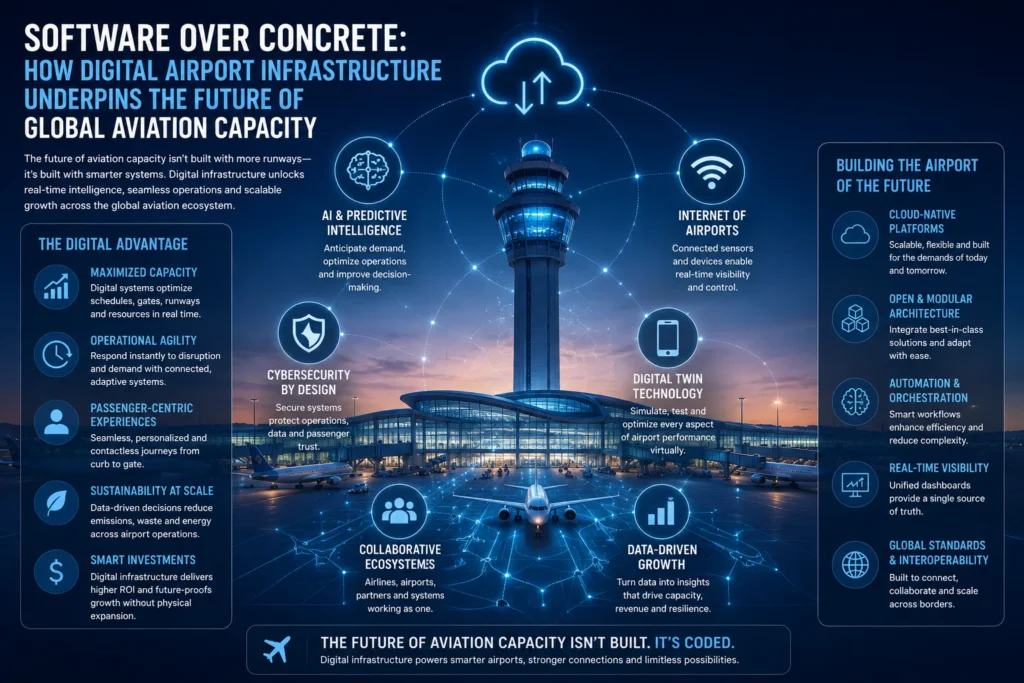
The architecture of international transit is confronting an unprecedented demographic challenge that is fundamentally shifting how aviation networks plan for long-term growth. Official airline industry forecasts managed by the International Air Transport Association state that global traveler volume is on a definitive trajectory to reach 8 billion within the next two decades, ultimately surging to nearly 10 billion annual passengers by mid-century. Faced with this massive influx of global commuters, the air transport sector is executing a major strategic pivot. Rather than relying on multi-billion-dollar capital investments to construct new runways and expand physical terminal footprints, the global travel industry is actively scaling software capacity to process double the traffic within existing facilities.
According to data sets published in the comprehensive SITA Impact Report 2025, the aviation sector’s primary solution to overcrowding lies in the widespread deployment of advanced digital airport infrastructure. This highly synchronized framework leverages artificial intelligence, real-time machine learning, and border pre-clearance mechanisms to process massive crowds efficiently. By prioritizing digital scalability over traditional brick-and-mortar construction, international airport authorities, sovereign border agencies, and commercial airlines are working together to increase throughput, minimize structural delays, and reduce the environmental footprint of heavy terminal hubs.
Biometrics and Contactless Pre-Clearance at the Border
The most immediate and visible benefits of this technology-first framework are materializing at international border checkpoints. Traditional document inspection queues, which routinely cause severe bottlenecks during peak holiday seasons, are systematically being replaced by advanced biometric authentication networks and decentralized identity management solutions.
Official operational data documents that these live production systems are already delivering dramatic improvements in passenger processing efficiency. On the Caribbean island of Aruba, the integration of verified digital travel credentials with biometric facial recognition has successfully cut arrival border clearance times down to as little as eight seconds per traveler. This milestone represents an exceptional 78% reduction in historical queue wait times. On a broader scale, integrated threat-assessment algorithms analyzed and screened more than 271 million incoming travelers worldwide before they ever reached a physical terminal queue, with the vast majority of these automated risk clearances completed in less than four seconds. This shift to pre-arrival verification allows border authorities to focus their enforcement resources on high-risk profiles while enabling the vast majority of tourists to move smoothly through the border without friction.
Artificial Intelligence in Live Airside Operations
Beyond passenger-facing terminals, machine learning and digital-twin simulations are moving out of isolated testing phases and directly into revenue-critical, live operations control rooms. These systems align massive data streams from flight logs, regional weather patterns, and airspace telemetry to strengthen real-time airport coordination and prevent sudden operational bottlenecks.
A primary example of this technology in active line service is the widespread implementation of advanced flight-efficiency software. By utilizing predictive digital-twin models to recommend highly optimized climb and cruise profiles to flight crews, this automated platform processed 2.9 million flights globally for dozens of international carrier fleets. The real-world impact of this single digital optimization is staggering, saving an estimated 127,732 tonnes of aviation fuel and directly cutting more than 403,000 tonnes of carbon dioxide emissions. Concurrently, public air navigation providers—including a highly successful collaborative test executed at France’s Reims Control Centre—are using shared, real-time meteorological maps across pilot cabins and ground control rooms to minimize weather-driven delays by up to 65%, preserving precious operational minutes during severe storms.
Revolutionizing Baggage Tracking and Turnaround Metrics
The integration of artificial intelligence is also driving a major decline in baggage mishandling rates, a sector problem that has historically cost global aviation billions of dollars annually in recovery expenses and logistical friction. By forming deep data-sharing alliances with major global consumer technology ecosystems, airlines have vastly improved luggage visibility.
Recent data demonstrates that when passengers utilize smart location-sharing tags paired with cloud-based baggage reconciliation software, the volume of truly lost luggage plummets by a remarkable 90%. In terms of local airport execution, specialized automated reflight programs have allowed regional carriers, including Thai Airways, to shrink their standard baggage-reconciliation timeframes from three full minutes down to a single second. When combined with advanced total airport management platforms currently operating at primary hubs like Toronto Pearson and Abu Dhabi International, these micro-second efficiencies create highly predictable aircraft turnaround times, allowing gates to handle significantly more daily flights without requiring new terminal construction.
Strategic IT Investment and Regulatory Challenges Ahead
To successfully sustain this software-defined operational model as global demand climbs, international aviation stakeholders are drastically increasing their technological capital expenditures. Financial records show that total IT investments have climbed to $36 billion for airlines and $14.8 billion for airport operators, representing a steady, multi-year increase in capital allocation designed specifically to build systemic resilience against global network disruptions.
However, scaling these interconnected digital platforms requires careful navigation of complex global compliance and regulatory challenges. Because decentralized digital identity frameworks rely heavily on the collection and processing of biometric metadata, sovereign governments must cooperate to establish unified, secure data-sharing standards that protect individual consumer privacy while maintaining strict border integrity. Additionally, as airport operations become increasingly software-reliant and interconnected, network planners are prioritizing robust cybersecurity architecture to protect distributed safety-critical systems from external vulnerabilities, ensuring that tomorrow’s aviation network remains both incredibly fast and completely secure.
For more travel news like this, keep reading Global Travel Wire