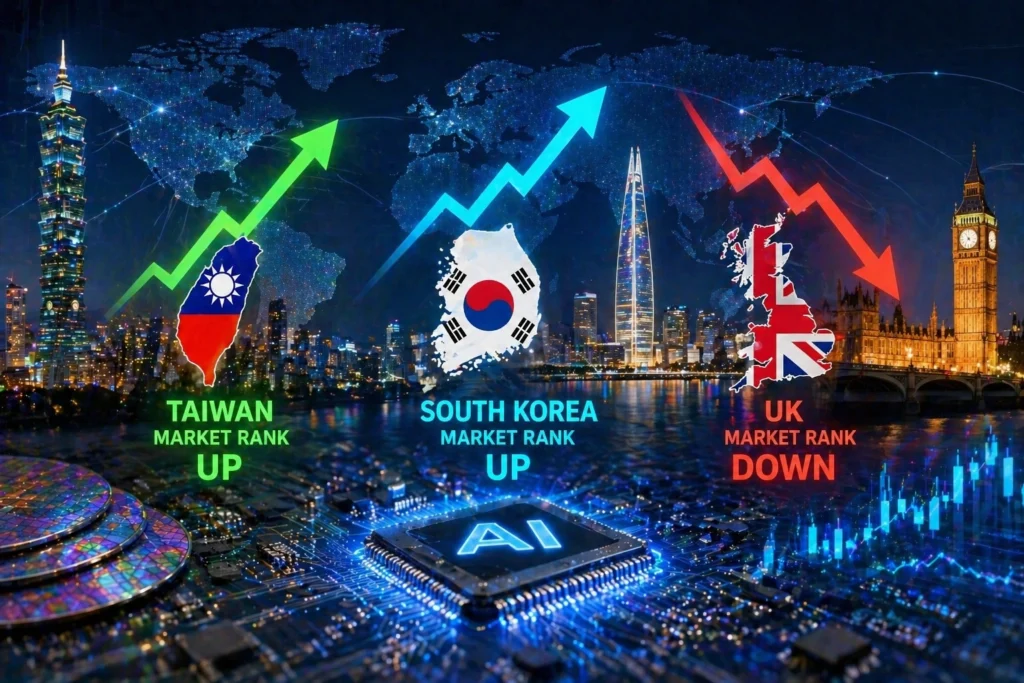
Taiwan and South Korea have surged ahead of the United Kingdom in global market rankings as soaring demand for artificial intelligence chips drives fresh gains for semiconductor-heavy stock markets. The shift underscores how technology manufacturing is increasingly shaping global financial power, with chip leaders in Asia benefiting from one of the strongest investment themes of the decade.
At the center of the rise are globally important semiconductor companies, particularly Taiwan Semiconductor Manufacturing Company and Samsung Electronics. Their strategic roles in producing advanced chips for AI systems, data centers, mobile devices, and next-generation computing have helped lift valuations and strengthen the wider market positions of both economies.
AI Demand Is Rewriting Market Leadership
Artificial intelligence has moved from a niche technology story to a core economic driver. As businesses invest in automation, cloud computing, robotics, and advanced analytics, the need for powerful semiconductors has expanded sharply.
That demand is flowing directly into equity markets. Investors increasingly favor countries and companies with strong exposure to chip manufacturing, advanced electronics, and digital infrastructure.
Taiwan and South Korea are among the clearest winners because they occupy critical positions in the global semiconductor supply chain.
Taiwan Strengthens Its Global Position
Taiwan’s market momentum is closely tied to the strength of its chip industry. Taiwan Semiconductor Manufacturing Company remains one of the world’s most important producers of advanced semiconductors, supplying major international technology brands.
As AI workloads become more complex, the need for smaller, faster, and more efficient chips continues to grow. That trend places Taiwan in a strategically valuable position, not only as a manufacturing hub but also as a market leader attracting global capital.
The country’s wider technology ecosystem also benefits. Companies linked to design, electronics, connectivity, and digital hardware can gain when semiconductor demand rises.
South Korea Gains Through Tech Scale
South Korea’s climb has been driven largely by Samsung Electronics and its broader industrial technology base. The country has long been a powerhouse in memory chips, consumer electronics, displays, and mobile innovation.
Now, AI-related demand is adding new momentum. High-performance computing, data storage, and advanced device ecosystems all rely on semiconductor strength, giving South Korea additional leverage in the current market cycle.
The result is stronger investor interest in Korean equities and a higher profile for the country in global capital markets.
Why the UK Has Slipped Behind
The United Kingdom remains one of the world’s major financial centers, but its listed market structure differs significantly from those of Taiwan and South Korea. While London has strengths in finance, energy, consumer sectors, and professional services, it has less direct exposure to the current AI chip boom.
That matters because markets often reward sectors experiencing rapid earnings growth and structural demand tailwinds. Semiconductor-led exchanges are benefiting from both.
The shift does not necessarily reflect broad economic weakness in the UK. Instead, it highlights how sector composition can influence market rankings during periods dominated by specific themes such as AI and advanced manufacturing.
A Wider Global Economic Realignment
The rise of Taiwan and South Korea points to a broader transition in the world economy. Financial influence is increasingly linked to innovation capacity, supply chain control, and leadership in strategic technologies.
Countries that dominate critical industries such as semiconductors, AI infrastructure, clean energy, and digital payments may command growing attention from investors over the coming years.
This also intensifies competition among nations seeking to build resilient technology ecosystems and attract advanced manufacturing investment.
Why It Matters Beyond Finance
The implications extend beyond stock markets. Stronger market performance can support investment, business expansion, job creation, research spending, and international influence.
For tourism and travel, economically stronger technology markets can also translate into rising outbound travel demand, premium spending power, and increased business mobility from key Asian source markets.
That means shifts in financial leadership may eventually influence airline demand, hotel growth, and global travel flows as well.
What Investors and Businesses Should Watch
Future momentum will likely depend on AI adoption rates, semiconductor capacity expansion, geopolitical developments, and continued demand for advanced computing infrastructure.
Investors will also monitor whether other markets can build stronger exposure to growth sectors or whether chip-focused economies maintain their lead.
A New Financial Era Emerging
Taiwan and South Korea overtaking the UK in market rankings is more than a headline milestone. It signals that the map of global finance is being redrawn by technology, manufacturing excellence, and strategic relevance in the AI age.
As artificial intelligence reshapes industries worldwide, the economies powering the chips behind that transformation may remain among the biggest winners.
For more travel news like this, keep reading Global Travel Wire